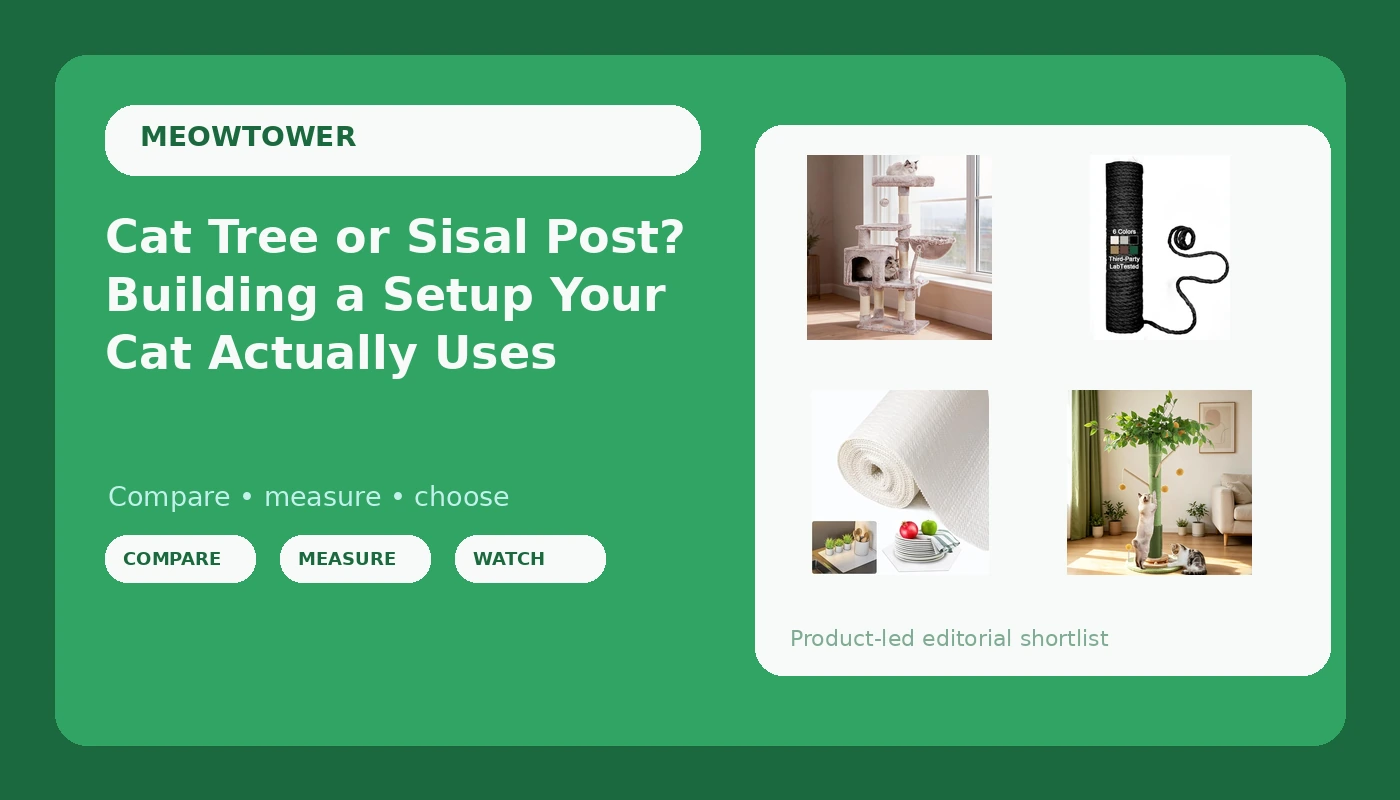
If you have ever watched a cat stroll past a brand-new cat tree to shred the arm of your couch, you already know the problem is rarely the cat. It is the surface and the height. A cat tree scratching post setup only works when three things line up: a post wrapped in a material claws actually want to dig into, a perch high enough that the cat feels secure while watching the room, and a base that stays put when an adult cat lands on top of it.
This explainer covers the four pieces that make up a working vertical territory setup: a tall single sisal post, a multi-level tower, a roll of replacement sisal rope, and a non-slip liner that helps keep a base plate where you put it. It is written for the person standing in a store aisle or scrolling a listing page, trying to decide which piece to buy first and which one can wait.
Related: Why Your Cat Scratches the Couch and How to Redirect It →
Quick answer
Start with one tall post wrapped in natural sisal and place it where your cat already scratches. Height matters more than decoration, because a post that lets an adult cat stretch to full length gets used and a short one usually does not. If you want scratching and perching in the same footprint, a multi-level tower covers both jobs. If you already own a tree whose posts are worn smooth, a roll of sisal rope lets you rewrap them instead of replacing the whole unit. If the base slides across hard flooring, a non-slip liner underneath is a low-cost fix. None of these is automatically the right first purchase for every household; the right pick depends on your flooring, your cat's size, and whether you are starting fresh or repairing something you already own.
Four useful options
| Model | Best fit | What stands out |
|---|---|---|
| 46" Tall Cat Scratching Post, Natural Sisal Cat Tree for Indoor Adult Cats | A single cat who needs one tall, dedicated scratching surface | 46-inch height with natural sisal wrapping, per the listing |
| Heybly Cat Tree with Toy, 43.3 inch Cat Tower for Indoor Cats HCT004SMU | Homes that want perching and scratching in one footprint | 43.3-inch tower that includes a toy |
| 1/4in 32FT Natural Sisal Rope for Cat Tree, Cat Scratch Rope Replacement | Rewrapping posts on a tree you already own | 32 feet of 1/4-inch natural sisal rope |
| Shelf and Drawer Liner for Kitchen Cabinet Non Adhesive Non Slip | Keeping a base plate from creeping on smooth floors | Non-adhesive and non-slip by design |
The tall single post: 46" Tall Cat Scratching Post, Natural Sisal Cat Tree for Indoor Adult Cats
A dedicated post is the simplest way to answer a scratching problem, because it removes every competing job from the equation. A cat does not have to climb it, sleep on it, or share it. The post exists to be scratched, and a 46-inch post gives an adult cat room to reach up, dig in, and pull downward the way cats naturally do. The trade-off is obvious: there is no perch, so this piece solves scratching and nothing else. If your cat already has a window sill, a bookshelf, or a cat bed at height, that is fine. If your home has no elevated resting spot at all, a post alone leaves the vertical territory half finished.
The multi-level tower: Heybly Cat Tree with Toy, 43.3 inch Cat Tower for Indoor Cats HCT004SMU
A tower is the piece most people picture when they hear "cat tree," and it earns that reputation by doing several jobs at once. Climbing, perching, and scratching all happen in one footprint, which matters in apartments and small rooms where you cannot spread four separate pieces around the house. The trade-off runs the other way from the single post: with more structure comes more to check before you buy. Look at how the levels are stacked, whether the perches look wide enough for a full-grown cat to lie down rather than perch on the edge, and how much floor the base takes up. A tower is only as useful as the perch at the top of it, and it is only as safe as the base underneath it.
The repair kit: 1/4in 32FT Natural Sisal Rope for Cat Tree, Cat Scratch Rope Replacement
This is the piece people forget until the day their cat starts ignoring a post that used to get daily use. Once sisal frays down to the bare core, the post stops rewarding the scratch, and the cat goes looking for a better surface, which is often your furniture. Rewrapping is the cheaper path: you keep the structure and the base plate you already vetted and replace only the worn material. The trade-off is labor. Wrapping a post takes patience, a steady hand, and enough rope to cover the full height with tight, overlapping coils. Measure your post before ordering, because a roll that runs short mid-post leaves you with a half-finished repair and a cat watching you work.
The stability helper: Shelf and Drawer Liner for Kitchen Cabinet Non Adhesive Non Slip
Be clear about what this is: a kitchen and cabinet liner, not a cat product. It shows up in cat furniture conversations for one narrow reason. A wide, heavy base plate does the real work of stability, but on tile, laminate, or finished wood, a base can still creep when a cat launches upward and lands hard. A non-slip, non-adhesive liner trimmed to the footprint of the base adds a grip layer without drilling, gluing, or damaging the floor. The trade-off is that it is a supplement, never a substitute. No liner will rescue a narrow, top-heavy tower, and no liner replaces anchoring a tall unit to a wall. It is the last five percent of a stability plan, not the first.
Prices and availability may change. Product images, names, and retailer links are matched to verified listings. No current price, rating, stock status, or measured result is stated here without current evidence.
Why sisal beats carpet for scratching posts
Scratching is not destruction. It is communication, scent marking, and claw maintenance rolled into one behavior, and cats repeat it on surfaces that give the right resistance. Carpet loops are the wrong resistance in two directions. They are loose enough that claws snag and pull, which can catch a toe, and they are the same material as the rug your cat is already allowed to scratch, which teaches the wrong lesson about what is fair game in the house. Natural sisal is a tight, plant-fiber rope that resists the claw, sheds a little as it is used, and looks visibly worn in a way that tells you the post is doing its job.
That is also why "carpet-covered scratching post" should read as a warning rather than a feature. A tree wrapped in the same beige loop pile as your living room rug is functionally a piece of your living room rug, placed in the open and endorsed by you. If you already own a carpet-wrapped tree, you do not have to throw it away. Wrap the main post in sisal rope and leave the carpet for the platforms, where cats nap rather than scratch. The post is what matters. The perch material is a comfort question, not a behavior question.
Height, base plate, and perch size
Three numbers decide whether a cat tree earns its floor space. The first is height. Vertical territory is the whole point of a tree, and a unit that tops out below your waist rarely gives a cat the lookout position it is looking for. Taller is generally better, provided the other two numbers hold up.
The second is the base. A wide, heavy base plate is what keeps a tall structure from tipping when a cat lands on the top perch, and it is the single most common place cheap trees cut corners. If a tower looks tall and narrow in the photos, treat that as a structural question, not a style question. Anchoring to a wall is the reliable answer for anything over waist height, especially in a home with multiple cats who chase each other upward.
The third is perch size. A perch needs to fit a sprawled adult cat, not a curled kitten. Look for platforms wide enough that a cat can lie flat rather than balance on the rim, and count how many of those wide platforms the unit actually has.
- Measure the height of your tallest cat standing on its hind legs with front paws extended, then look for a post that meets or exceeds it.
- Check the base plate dimensions against the tower height, and prefer wide and heavy over tall and slim.
- Confirm the scratching surface is sisal or another tight fiber rather than carpet.
- Count the perches that are wide enough for an adult cat to lie flat, not just sit.
- Decide whether you are buying new or repairing, because a worn post on a solid tree is a rope problem, not a furniture problem.
Practical guidance before you buy
- Place the post or tree where your cat already scratches, not in the corner where it looks tidy. Location decides whether it gets used.
- Plan for one scratching surface per cat, plus one, especially in a multi-cat home where resources get guarded.
- Anchor tall units to a wall. A base plate helps, but a wall strap is what prevents a tip-over.
- Keep the first post short enough that a kitten can use it, and expect to add height as the cat grows.
- Budget for maintenance. Sisal wears out, and a roll of replacement rope costs far less than a new tree.
Which option should you choose?
Choose the 46" Tall Cat Scratching Post when scratching is the problem you are solving and your cat already has somewhere high to rest. Choose the Heybly Cat Tree with Toy when you want climbing, perching, and scratching in one footprint and have the floor space for a wider base. Choose the 1/4in 32FT Natural Sisal Rope when you already own a tree with sound structure and shredded posts. Choose the Shelf and Drawer Liner when your base plate slides on hard flooring and you want a non-adhesive grip layer that will not mark the floor.
Two caveats are worth repeating. First, these listings describe materials and dimensions, not durability results, and no product here comes with a performance guarantee against a determined cat. Second, none of this replaces observation. Watch where your cat scratches, how high it climbs, and which perches it actually uses, then buy for that behavior rather than for the photo.
The bottom line
A cat tree scratching post setup works when the surface is right, the height is right, and the base stays planted. Sisal posts get used. Carpet posts teach cats that carpet is scratchable. Height gives cats the lookout position they are wired to want, and a wide base keeps that height from becoming a hazard. If you are starting from nothing, a tall sisal post is the highest-value first purchase, and a multi-level tower is the upgrade when you want vertical territory and scratching in one piece. If you already own a sturdy tree with worn posts, rewrap it with sisal rope instead of replacing it, and if the base creeps on smooth floors, put a non-slip liner underneath before you blame the tree.