Most people lose the scratching argument before they buy anything. They set a short post next to the sofa, the cat gives it one sniff, and the couch keeps taking damage for another six months. The fix is not a throw blanket over the armrest. It is a real cat scratching station, placed in the right spot, built at the right height, sitting on a base that does not move when a cat lands on it.
I have been a veterinary technician for eight years and a foster mom to more than 60 cats, and I have watched this decision play out hundreds of times. Scratching is not destruction, it is communication. A vet said that to me in a Tampa treatment room and it rewired how I furnish my whole house. Cats scratch to mark territory, to shed the dead outer sheath of their claws, and to stretch the muscles along their backs and shoulders. Take away the surface that lets them do all three and they will find a substitute. It is almost always upholstered.
Here is the setup I use in my own foster room, with a rotating crew of five cats who have collectively destroyed more furniture than any single household ever will.
Why you should trust me
Eight years as a vet tech, more than 60 foster cats through my spare room, and a repair pile of cat trees that goes back to my first foster year. I have assembled the cheap ones, re-drilled the wobbly ones, and hauled the ones whose posts turned to confetti in a month out to the curb. I currently run a 60-day stress test on cat furniture with five cats in the house, scoring every post for how much sisal is left and every perch for whether an adult cat actually fits on it. The two pieces below are in that test right now, and the steps that follow are the ones that keep the room standing.
How I picked and how I tested
The test is not complicated, but it is not gentle either. Five cats, 60 days, and a daily look at where the damage landed.
For scratching surfaces, I check the material first. Sisal rope and sisal fabric get used. Carpet gets ignored, and worse, it teaches cats that carpet is a legal scratching surface, which is the exact lesson you are trying to unteach. Then I check the height. A post that only reaches mid-chest never lets a cat get a full stretch, and a post that does not allow a full stretch gets abandoned. The last check is the one people skip: I watch a 12-pound cat launch onto the top level and see whether anything shifts. If the whole thing rocks, it fails, and it fails loudly.
For the litter side, I measure the footprint, watch whether the cat walks in without hesitation, and track whether the box gets used as reliably as an open pan. If a cat starts eliminating outside the cabinet, the enclosure fails, no matter how good it looks in a hallway. I also keep post-use photos. A scratching post that has actually been used looks frayed in a band, roughly where the front paws land at full stretch. A post that is still pristine after 60 days was rejected by the cats, and no marketing copy changes that.
The two pieces of the station
Everything else is optional. These two do the actual work: one gives the cat a legal place to scratch and sleep, the other gets the litter box out of the middle of your life.
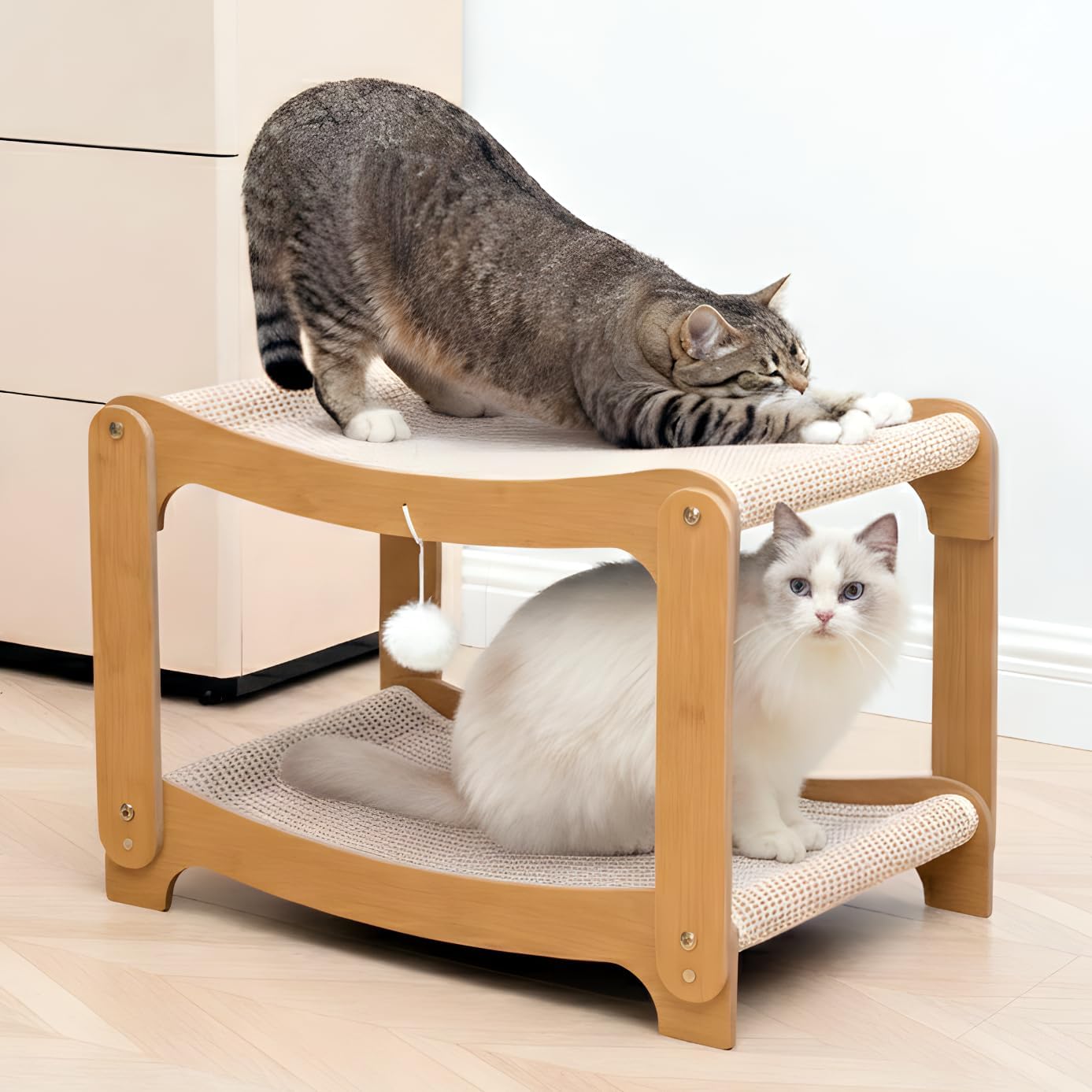
The scratching surface: AIXINPET Two-Level Sisal Cat Scratcher Bed - Sturdy Cat Scratching Post with Scratch Pad&Hammock Bed, Comfortable Cats Bed for Indoor Kittens&Adult Cats -Sturdy Wooden Frame,Protect Furniture
 Visit on Amazon →
This is the piece I would buy first if I were starting a foster room from scratch. It is a two-level unit with sisal wrapping on the post, a scratch pad at the base, and a hammock bed tucked into the frame, which means one footprint does the job of a scratcher and a sleeping spot. That matters more than people think. Cats scratch where they hang out, so a scratching surface that also holds a nap gets used far more than a lonely post in the corner of a hallway.
The wooden frame is the part I care about. I have watched cats reduce particleboard posts to a wobbly mess in a season, and this one has held its shape through the foster rotation. The sisal wrapping is the other reason it passes my test. My cats leave frayed bands at full stretch height on this post, which is exactly the evidence I want: it means they are using it the way a cat should, not treating it as furniture to be ignored.
Kittens take to the lower scratch pad almost immediately, and my adult fosters claimed the hammock within the first week. If you have a cat that has never used a post before, the combination of a low pad and a high wrap gives them two chances to get it right.
Flaws but not dealbreakers: The hammock is sized for average cats. If you are furnishing for a 15-pound Maine Coon, watch how they settle into it before you decide it is their main bed. And like every sisal post I have ever owned, the wrap will need replacing eventually. That is the cost of having a post that gets used instead of a post that gets ignored.
Anyone who needs one piece of cat furniture that handles scratching, stretching, and napping in a small space should start here.
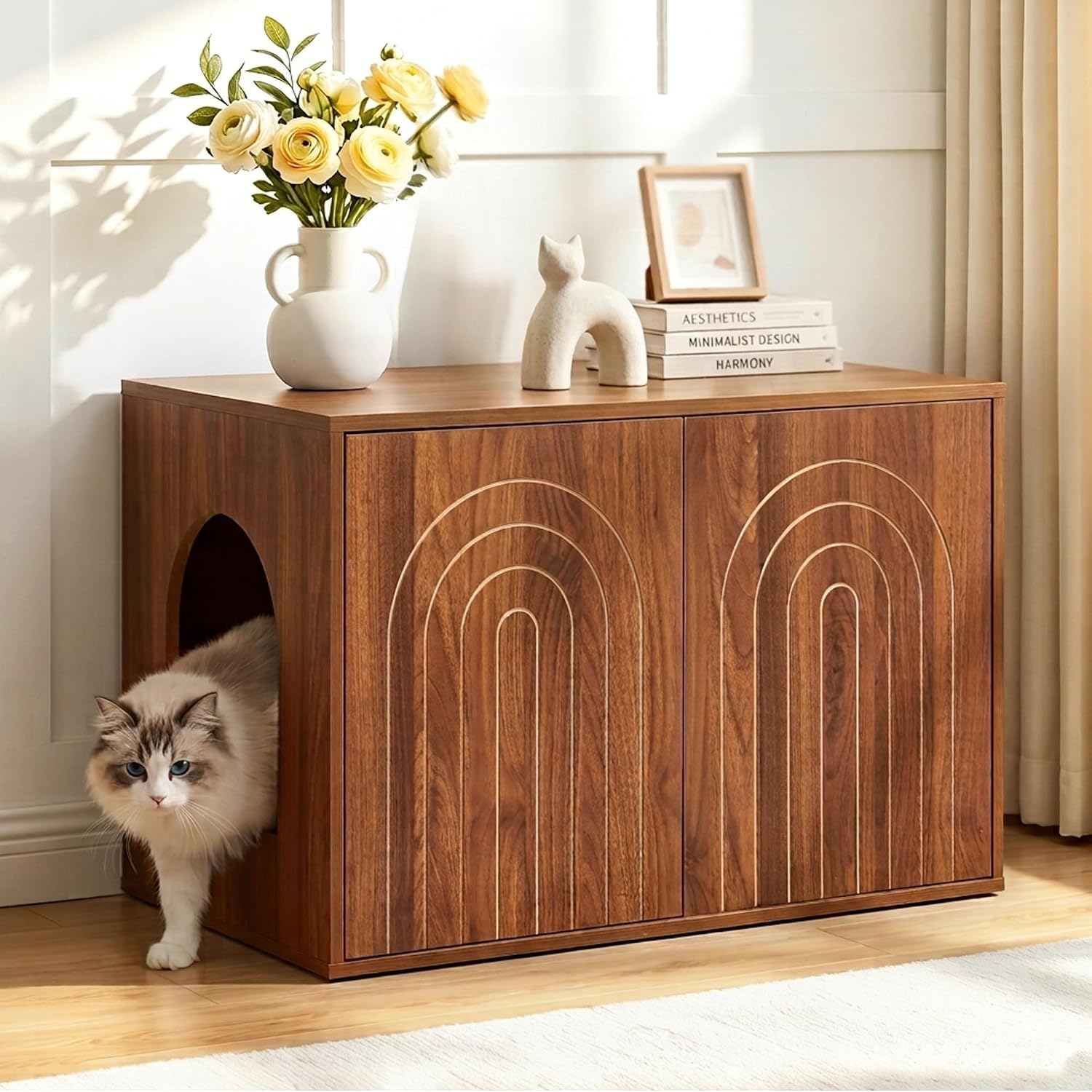
The hiding spot: Cat Litter Box Enclosure, 31.5" Hidden Litter Box Cabinet Furniture, Walnut
 Visit on Amazon →
A litter box in the open is a daily argument about tracking, smell, and guests. This cabinet fixes all three by turning the box into a piece of furniture. The walnut finish reads like a side table or a low console, so it can live in a living room or a bedroom without announcing what is inside. At 31.5 inches wide, it takes up real floor space, so measure your wall before you order, but it also gives you a surface on top, which is square footage you get back.
The part that matters to the cat is the interior. Cats want privacy when they eliminate, and an enclosed box delivers that, but only if the inside is big enough and the opening is easy to find. I set mine up with an uncovered pan inside for the first two weeks so the cats could see and smell what was in there, then added a covered pan once everyone was using it reliably. Every foster in the house transitioned without an accident.
Flaws but not dealbreakers: Some cats refuse enclosed boxes, full stop. If your cat has ever peed outside the box, this is not the purchase that fixes it. Fix the medical and behavioral issue first, then come back. Also, an enclosure concentrates odor, so you will scoop more often than you would with an open pan. That is the trade you make for not looking at a litter box every day.
Anyone with a spare wall, a cat who likes privacy, and a guest coming in three weeks should look here first.
The actual setup workflow
Now the part you came for. This works in an apartment, a house, or a foster room with five cats rotating through it.
Step one: Find the scratch site your cat already chose. Before you place anything, look at what your cat is damaging. The corner of the couch, the side of the mattress, the door frame. That tells you where the station goes. Cats scratch in territory-marking spots, usually near where they sleep or near the entrance to a room. Put the new post within a few feet of the thing they are shredding and you are halfway done.
Step two: Place the litter cabinet first. It has the biggest footprint, so it gets the best wall. Pick a spot with clearance for the door, away from food and water, and not in a dead-end closet where the cat feels trapped with no escape route. Cats want a clear line of sight out of the box. If you are tight on space, this cabinet doubles as a surface, so a living room wall is a legitimate home for it.
Step three: Put the scratching station near the box exit or the sleeping area. Cats often scratch right after using the litter box. A post within a few feet of the cabinet catches that habit. If your cat sleeps on your bed, a second scratcher near the bedroom door does the same job there. One station in the right spot beats three scattered around the house.
Step four: Check the height before you check anything else. Stand next to the post and stretch your own arm up. Your cat should be able to reach both front paws over its head without the surface running out. If the sisal stops at mid-stretch, the post will not get used for the big scratch, only for a lazy swipe. The two-level unit above solves this by putting a pad at floor level and a wrap above it.
Step five: Do the wobble test yourself. Push the top of the post with one hand the way a jumping cat would. If it rocks, it is not ready. On carpet, check whether the base plate is sitting on pad or on the floor underneath, because a post balanced on thick carpet pad is a tipped-tower waiting to happen. Wide and heavy beats tall and pretty every single time.
Step six: Introduce the post instead of announcing it. Rub a little catnip on the sisal, drag a wand toy up the post so your cat chases it vertically, and scratch the surface with your own fingernails in front of them. Do not pick up your cat and force their paws onto it. That teaches nothing except that the post is a thing to be handled, and cats hate being handled.
Step seven: Protect the couch during the transition. This is temporary and it is not cheating. Double-sided tape on the corner your cat is working, a throw blanket over the armrest, a piece of foil for the truly determined. You are buying weeks, not winning a war. Once the post is the easier scratch, the couch stops being interesting.
Step eight: Maintain it like furniture, not like a toy. Vacuum the sisal, tighten the frame hardware once a month, and check for the frayed band that tells you the post is getting used. When the sisal is shredded through to the core, replace the post. A bare post teaches cats to go back to the couch, which undoes everything.
The competition and why it lost
Carpet-wrapped towers are the biggest offender in this category. They look plush and they photograph well, but carpet is the same material as your rug and your sofa, so a cat scratching carpet learns that carpet is fair game. That is a lesson you pay for later. If the marketing copy calls the carpet post a feature, that is a warning, not a benefit.
Cardboard-core posts are the next one out. They are cheap for a reason. A determined adult cat can chew through the core of a lightweight post in a month, and then you own a wobbly stick with shredded wrapping. Fine for a kitten in a playpen. Not a station.
Tall towers with narrow base plates lose on physics. Height without a wide, heavy base is a tipping hazard, and a cat that gets dumped off a perch once will avoid that tower forever. I would rather have a two-level unit that never moves than a five-foot tower that scares my cats.
Wall-mounted shelves and DIY corrugated pads have a place, especially in a studio apartment, but they solve a different problem. Shelves give vertical territory, not a scratching surface, and loose corrugated pads scatter cardboard everywhere. Build a real station first, then add shelves when you want to expand the territory.
On the litter side, the open pan is the honest competitor. It is cheaper and it is easier to clean, and some cats will never accept a covered box. The cabinet wins when you care about where the box lives and how the room looks, and when your cat has shown you they are comfortable going inside something.
What this all costs
Check current Amazon price on both pieces before you decide anything, because the math is different depending on what you already own.
The scratching station is the smaller purchase and the one that protects the asset you already paid for. Run the cost against the couch cushion your cat would otherwise destroy in a year, and the station pays for itself before the first replacement slipcover. Over two years, the daily number is smaller than a can of wet food.
The litter cabinet is the bigger purchase, and it is really a piece of furniture. If you were going to buy a console table for that wall anyway, you are comparing it to furniture, not to a plastic pan, and it wins that comparison on function alone.
The one cost people forget is time. Twenty minutes of setup, a month of scooping more often, and one hardware tightening a month. That is the entire maintenance load.
That is the job. Your cat was built to scratch, climb, and hide. Give them a station that lets them do all three and the couch stops being part of the conversation.