Scratching is not destruction. It is communication. A cat scratches to shed the dead outer sheath of the claw, to stretch the spine and shoulders, and to leave a scent mark on the thing that matters most in the room. When someone tells me their cat "ruined" the couch, what usually happened is that the couch was the only surface in the house tall enough and stable enough to do the job.
That is why I care so much about one piece of furniture. A sisal cat scratching post solves three problems at once: it gives the claws a legal target, it adds vertical territory, and it takes pressure off your sofa. The wrong post does none of those things. It wobbles, it is wrapped in carpet that teaches the cat to scratch carpet, and it ends up in the garage by March.
This guide is how I choose one, in order, from the floor up.
Why you should trust me
I have been a veterinary technician for eight years, and I have fostered more than 60 cats out of a house in Tampa with tile floors and one very opinionated resident. Right now I am running five foster cats through a 60-day stress test on cat furniture: eight units, one room, and a notebook that tracks which posts get shredded and which ones nobody touches. A foster cat named Biscuit has personally rejected around 30 trees in her life and approved exactly two, so I take her votes seriously.
I do not recommend a post I have not lived with. I do not call something stable until a cat has jumped onto it from the arm of a chair. And I do not call a scratching surface used without looking at the fibers afterward. Those are my rules, and they come from replacing too many cheap trees.
How I picked and how I tested
The two posts below are the ones that survived my filter, and they survived it for different reasons. Before I get to them, here is the filter itself, because the criteria matter more than the brand.
Height. A post has to let a cat stretch all the way up. If a cat has to crouch to scratch, it will find a taller surface, and the tallest surface in most homes is the side of a sofa. I want the post taller than the cat standing on its hind legs with the front paws extended.
Base plate. This is the whole game. A tall post on a small base is a lever, and your cat is the force on the end of it. I check the footprint of the base before I check anything else. Wide and heavy beats tall and pretty every single time.
Material. Sisal rope or nothing. Carpet-wrapped posts are marketed as a feature, and they are the reason so many cats scratch carpeted stairs. Sisal gives the claw something to catch and shed against.
Perch. If the unit has a top platform, it needs to fit a sprawled adult cat, not a kitten. A perch that is too small gets ignored, and ignored vertical territory is just clutter.
Wobble. I do the 12-pound jump test: a cat launches onto the top, and I watch the base. If the whole thing tips, it is a liability, not a cat tree.
I applied that filter to both units below over the same 60-day window, in the same room, with the same five cats.
The two posts worth your floor space
One is a dedicated single post for people who want the simplest possible fix. The other is a taller multi-post tree for households that need vertical territory and a scratching surface in the same footprint.
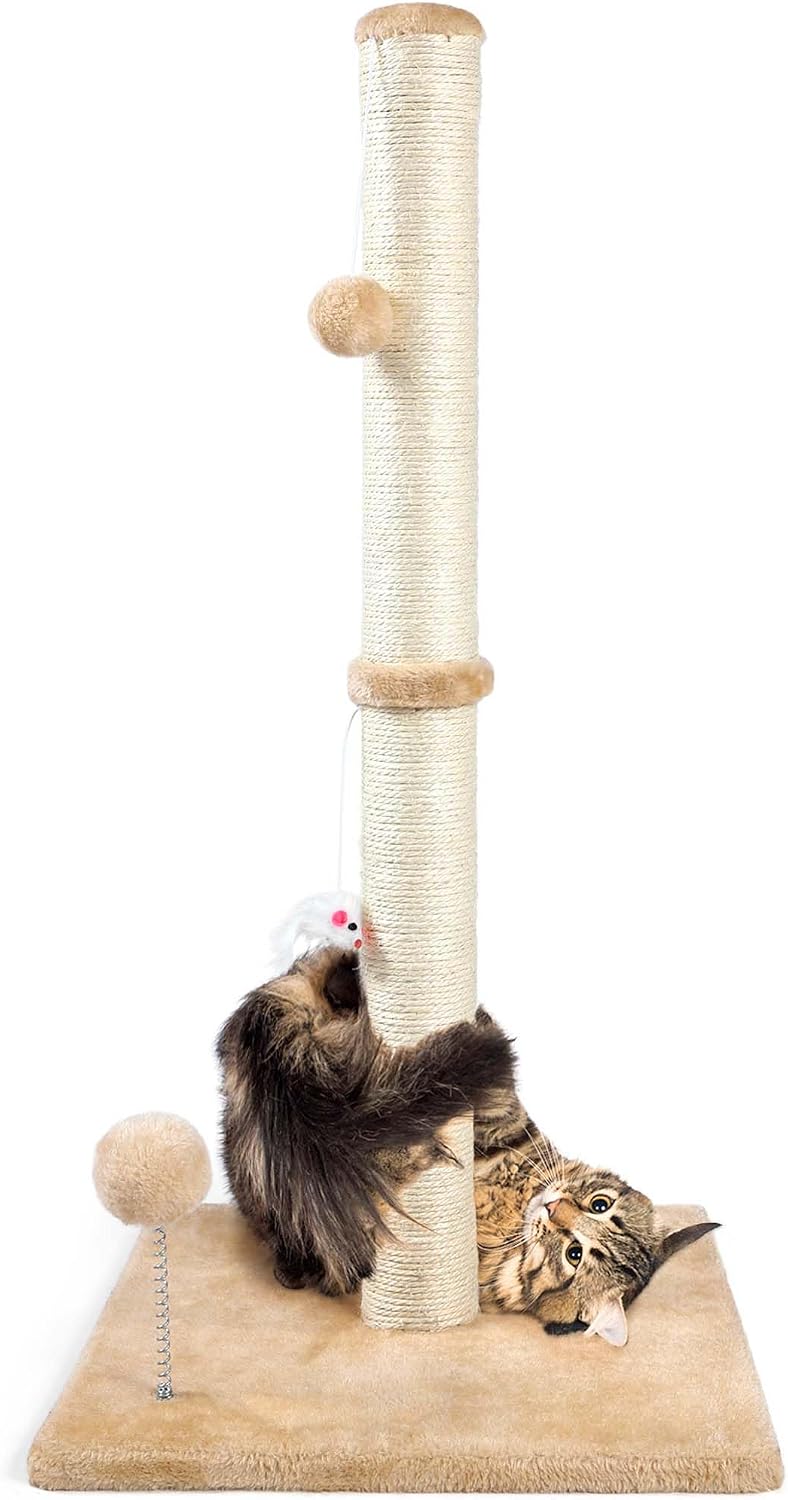
Budget pick: ANWA 32" Tall Sisal Cat Scratching Posts Tree for Indoor Cats Adults, Beige
 Visit on Amazon →
This is the one I point people toward when they want height without spending a lot, and the 32 inches in the name is the reason. That is enough post for an average adult cat to get a full stretch, which is more than I can say for the 16-inch posts sold at big-box stores.
The sisal wrapping is the other reason it made the list. The posts are wrapped rather than carpeted, so the surface rewards the behavior you want instead of teaching the cat that carpet is a scratching target. In a room with five cats that distinction shows up fast: the sisal posts get worn shiny at the top of the scratch stroke, and the carpet-wrapped pieces sit untouched until someone decides they make a good napping shelf.
Flaws but not dealbreakers: A taller unit with a modest footprint will always carry more tipping risk than a squat single post, so placement matters here. Put it in a corner, or against a wall, or on carpet with a rug pad, and check it after the first week. If your cat is on the large side, watch the top perch. Platforms on value-priced trees tend to be sized for average cats, and a big cat may use the post and skip the platform entirely. That is not a failure. It just means you bought a scratching post with a bonus shelf.
Anyone furnishing a first apartment, a foster room, or a bedroom where a single tall post is not quite enough will get the most out of this one.
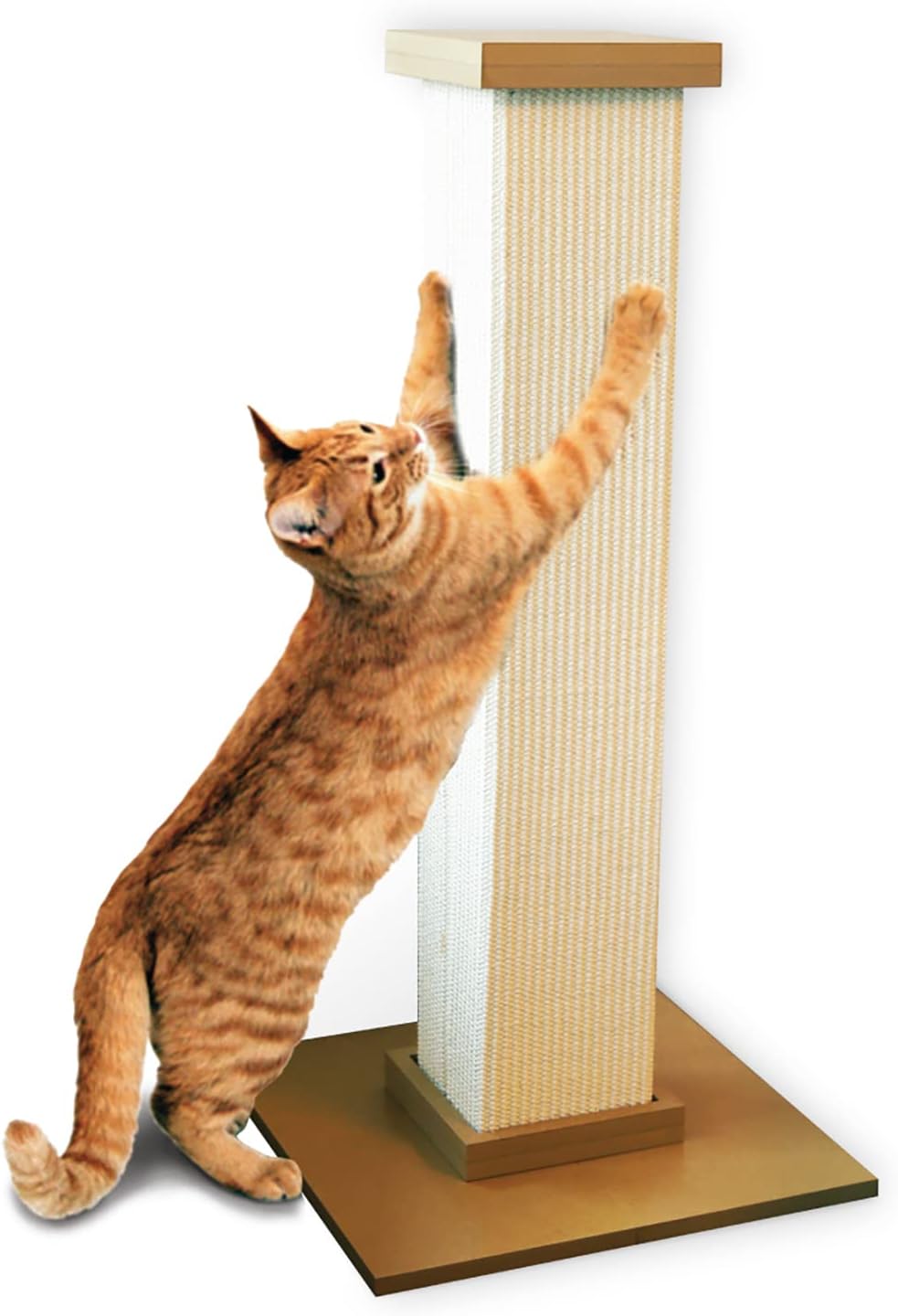
Our pick: SmartCat Pioneer Pet Ultimate Scratching Post (Beige)
 Visit on Amazon →
This is the post I would buy with my own money, and the one I recommend to people who are tired of replacing things. It is a single tall post on a wide, heavy base, wrapped in sisal, and the design is honest about what it is: a scratching station, not a jungle gym.
The base is the part that sells me. A wide, weighty footprint is the difference between a post that stays put when a cat launches onto it and a post that skids across the tile every time someone gets the zoomies. The full-height wrap also means the cat can start the scratch low and finish it stretched out, which is exactly how cats use a post when it is tall enough.
The trade-off is that it is one post and one job. There is no perch, no hammock, no second level. If your cat wants to be up high and survey the room, this does not solve that, and you would pair it with a separate tree or a window perch. What it does solve is the couch, and it solves it without wobbling.
Flaws but not dealbreakers: Sisal frays. That is the nature of the material, and a well-used post will look shaggy at the top of the stroke within a few months. Trim the loose strands with scissors instead of pulling them and the post keeps working. The other caveat is that a single-purpose post takes up floor space without giving you a perch in return, so in a small apartment you have to decide whether the scratching surface or the vertical territory is the bigger need.
Anyone with a dedicated scratcher, a cat who has already picked a favorite spot in the living room, or a household that just wants one thing that works should start here.
The setup workflow, step by step
Buying the right post is half the job. The other half is where it goes and what you do in the first week.
Step one: Measure your cat, not your room. Stand your cat next to a wall and mark where the top of the shoulders lands when the front paws are stretched up. That mark is your minimum height. If the cat will not cooperate, use the honest rule: a post under knee height is a rug with legs.
Step two: Check the base before you check the height. A tall post with a narrow base is worse than a short post with a wide one. Look at the footprint, not at the product photo with the cat added in afterward.
Step three: Confirm the wrap is sisal rope. Run your eye down the post. If it looks like the carpet in your hallway, it will teach your cat to scratch the carpet in your hallway.
Step four: Assemble it and tighten everything twice. Most wobble complaints trace back to hardware that was snugged by hand and never checked again. Tighten the bolts, let the post sit for an hour, then tighten them again. Sisal and wood both settle.
Step five: Do the wobble test yourself. Push the top of the post with one finger, then with your palm. If the whole unit leans more than an inch, fix it before your cat ever touches it. Corner placement, a wall strap, or a grippy pad under the base all help.
Step six: Put it where the cat already scratches. Do not hide the post in the laundry room because it is not pretty. Cats scratch where they hang out, usually near a sleeping spot or a doorway they patrol. Move the post to the scene of the crime and the crime slows down.
Step seven: Make the introduction. Rub the post with a little catnip, or dangle a wand toy up the length of it so the cat reaches and grabs. You are teaching the cat that this object is worth interacting with, and you are doing it in the first 48 hours, before the couch gets another vote.
Step eight: Reward every use. The first time your cat stretches on the post, that is the moment to walk over and deliver a treat or a scratch behind the ear. Cats repeat what pays.
Step nine: Protect the post from your own habits. Do not drape a blanket over it, do not stack laundry on the base, and do not shove it behind a chair when guests come over. A post that disappears for a weekend gets forgotten for a month.
Step ten: Maintain it. Check the bolts monthly, trim frayed sisal instead of pulling it, and vacuum the base. A post that is dirty and loose stops being attractive long before it stops being functional.
The competition and why it lost
Most of what I test does not make it into a guide, and the reasons are consistent.
Carpet-wrapped trees lose on material. They are everywhere, they are often cheap, and they teach exactly the wrong lesson. The classic budget tree brands are fine for kittens, who will climb anything, but with adult cats the carpet posts go unused and the whole unit wobbles. If a listing leads with "carpet covered" as a selling point, I close the tab.
Short posts lose on height. Anything in the 16 to 20 inch range only works for a cat who is still growing, and you will be shopping again in a year.
Narrow-base towers lose on stability. I have watched a cat launch onto a tall tower with a small footprint and ride it to the floor. That is a furniture problem, but it can also be a safety problem, especially with kittens underfoot.
And the very cheap stuff loses on durability. If the core of the post is cardboard or the sisal is stapled on in a thin strip, the post will be confetti in a month and you will be back to the couch.
The two units above are the ones that cleared all four filters in my foster room. That is the whole bar.
What this all costs
Both of these are one-time purchases, and both cost a fraction of what reupholstering a sofa arm runs. Check current Amazon price on each listing and do the math against the thing you are protecting. A post is a one-time line item. A couch is not.
If you want the simplest version of the math, take the price you see, divide it by 365, and compare that daily number to the cost of a slipcover, a repair, or a new sofa. I have never had a client regret the post. I have had plenty regret the couch.
The two-purchase strategy is also worth considering if you have more than one cat. A tall tree for vertical territory plus a dedicated single post for the serious scratcher covers both needs, and in a multi-cat house that combination prevents the traffic jam that happens when everyone wants the same surface at the same time.
That is the job. Your cat is not trying to ruin your furniture. It is trying to tell you something. Give it a sisal post that reaches above its shoulders and does not move, put it in the right spot, and the conversation gets a lot quieter.