Most cat trees get assembled once, shoved into a corner, and ignored for two years. I have watched that happen in my own foster room more times than I want to admit, and the reason is almost never the cat. It is the setup.
Cat tree setup is three decisions, not one: where the tree goes, whether it moves when a cat lands on it, and whether the scratching surface is one a cat actually wants to use. Get those three right and a cat will claim the top perch within a day. Get them wrong and you have bought an expensive grey object that your cat walks past on the way to your couch.
I am a veterinary technician in Tampa, eight years in, and I foster. Sixty-plus cats have come through my house. Five are here right now, which means every piece of cat furniture in my living room is under constant, unpaid stress testing. I have assembled more trees than I can count, from forty-dollar carpet-wrapped disasters to solid-wood condos, and the assembly instructions are the least important part of the job.
Here is the order that works.
Why you should trust me
I have been a vet tech for eight years, which means I spend my days explaining feline behavior to people who are convinced their cat is doing something out of spite. Scratching is not spite. Scratching is communication, marking, and nail maintenance, and a cat that has nowhere legal to do it will pick your couch every single time.
I foster, so I do not get to be precious about furniture. Sixty-plus cats have lived in my house. Right now I am running a foster crew of five through a 60-day durability check on eight trees, scoring every post and perch for wear, wobble, and actual use. A tree that survives five cats survives one.
What I am not going to do is quote you a number I did not measure. If I tell you a perch is big enough, it is because I have watched an adult cat try to fold itself onto it.
How I picked the tree in this guide
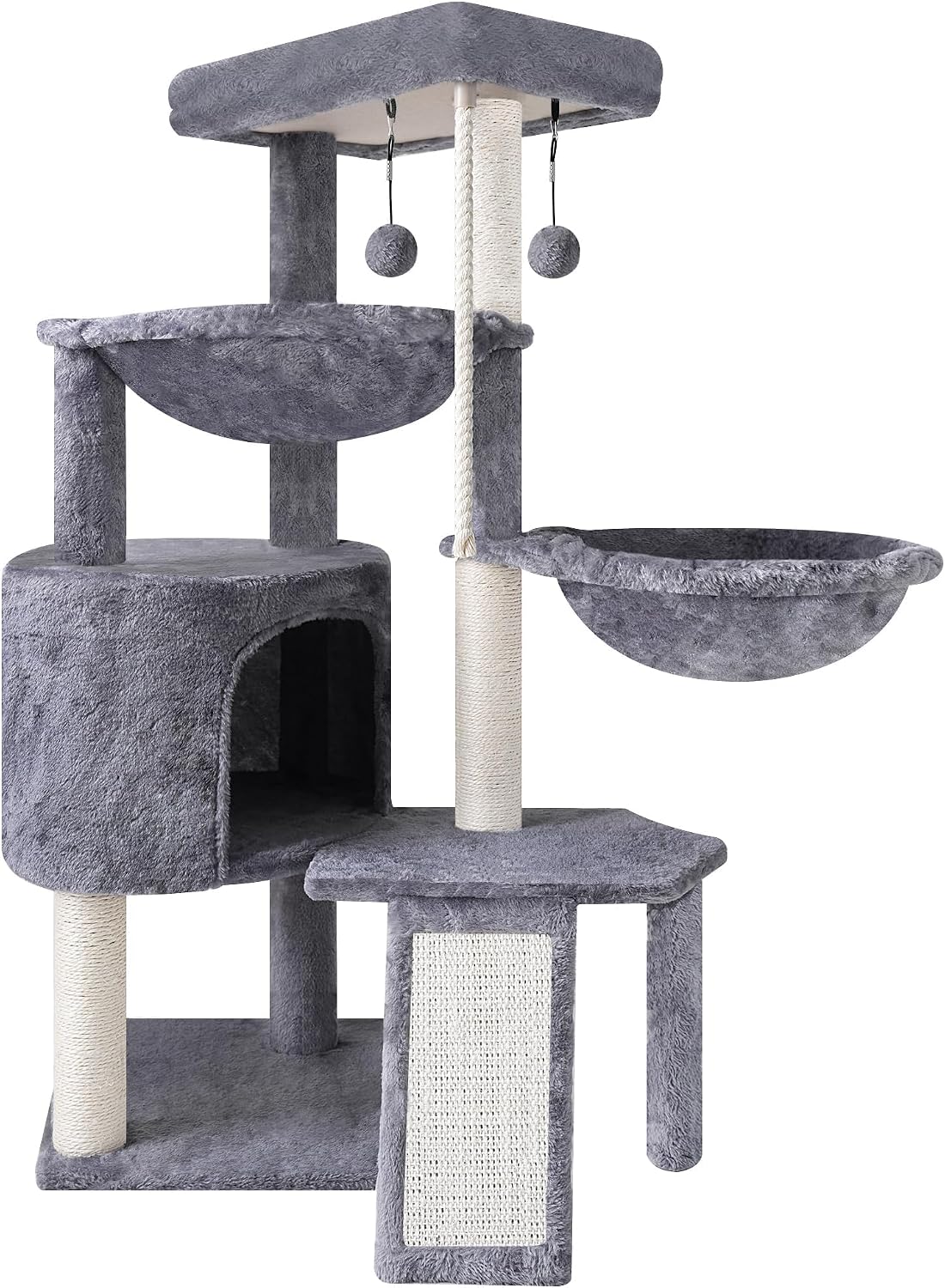
The tree in this article is the one I would hand a first-time fosterer or a first-time cat owner, and the reason is boring: it covers three things a cat needs at once. It has height, it has a condo for hiding, and it has two hammocks, which is the piece most budget trees skip. Hammocks get used. More than perches, honestly, because a hammock lets a cat hang its head over the edge and watch the room, and watching the room is the entire point of vertical territory.
A tree with a condo and hammocks also solves the multi-cat problem. Five cats cannot share one perch without a fight. Five cats can share a three-layer tree with a condo and two hammocks, because there is somewhere to be that is not the same place as everyone else.
The other thing I looked at is size relative to a real cat. Kittens fit anywhere. A twelve-pound adult cat sprawled out needs a perch that does not make it look like it is balanced on a fence post. If the top platform cannot hold a sprawled adult, the tree is a kitten tree, and you will be buying another one in eight months.
Our pick: Three Layer Cat Tree with Cat Condo and Two Hammocks,Grey
 Visit on Amazon →
This is the shape I recommend to almost everyone starting out: three levels, a condo, two hammocks, grey fabric that does not scream for attention in a living room. The layering matters more than the label. A cat that wants to hide goes in the condo. A cat that wants to supervise goes up top. A cat that wants to be near you but not on you takes a hammock. One tree, three jobs.
Flaws but not dealbreakers: A tree at this level is not going to be solid wood, and the posts will not last forever. That is fine. Replaceable wear is not the same as a bad purchase, and the fix for a worn post is a sisal wrap, not a new tree. Budget trees also tend to arrive with exactly enough hardware and no spares, so tape the Allen key to the underside of the base.
Anyone with one or two cats and a normal-sized apartment will get years out of this. If you have a fifteen-pound Maine Coon, size up.
The cleanup tool that keeps the tree usable
Here is the part nobody warns you about. A cat tree is a fabric tower, and fabric towers collect hair. Hammocks are the worst offenders because they are hammocks: the cat lies in it, sheds into it, and the hair works its way into the weave.
Hair on a tree is not just cosmetic. A matted perch gets avoided. Cats are particular, and a hammock full of loose fur is a hammock they will stop using, which puts you right back at square one with an ignored tower.
Also worth having: ChomChom Roller Pet Hair Remover, Original Size Reusable Lint Roller for Cat & Dog Hair on Furniture, Couch, Carpet, Car, Rugs & Bedding, Portable, Eco-Friendly (White)
 Visit on Amazon →
Reusable beats sticky sheets here, and not just for the waste. A lint roller with adhesive sheets is close to useless on a hammock, because the fabric is curved and the sheets gum up after one pass. A reusable roller with a back-and-forth motion pulls hair out of upholstery and carpet without needing a fresh sheet every ten seconds.
I keep one on the shelf next to the trees. It gets used on the hammocks, the condo roof, the couch the cats are not supposed to be on, and the cat bed that is somehow always full of grey fur.
Flaws but not dealbreakers: It is a manual tool. You are the motor. On a big sectional couch you will feel it in your shoulder, and it will not pull embedded hair out of a deep-pile rug in one pass. Two passes, fine.
Anyone with a fabric cat tree, a fabric couch, or both will use this weekly.
The actual setup workflow
Now the part that decides whether the tree gets used. Work through these in order.
Step one: assemble on a hard floor. Not carpet. Carpet hides the fact that your bolts are not seated, and a tree assembled on carpet can be a quarter inch out of square without you noticing. Hard floor, good light, all hardware laid out.
Step two: tighten in stages, then come back. Run every bolt in finger tight, then go around and torque them down, then wait an hour and do it again. Bolts in particle board compress the material and loosen. The second pass is the one that matters.
Step three: check the base plate footprint. The base plate is the whole game. A wide, heavy base is what keeps a tree from tipping when a cat launches onto the top perch. If the base is narrower than the top platform, you have a physics problem. Push the assembled tree at the height of the top perch and see how much it moves. If it rocks, it is not done.
Step four: choose a spot where the cat already spends time. The most common setup mistake is putting the tree where you want it instead of where the cat wants to be. Cats want vertical territory with a view and a wall behind them. A tree in the middle of a hallway with nothing to look at will be ignored. A tree in the corner by the window will be claimed.
Step five: give it a wall or a corner. Push the tree against a wall or into a corner. It stops the tree from rocking front to back, and it gives the cat a sense of cover. Cats do not want to perch in the open. They want a wall at their back and the room in front of them.
Step six: anchor it if you have a jumper. If your cat takes the top perch at a run, strap the tree to the wall with a furniture strap or a small L bracket. This is not overkill. A tipped tower is a vet visit, and I have seen it.
Step seven: stabilize on carpet. Carpet is the enemy of stability. A tree on carpet sits on compressed pile, and compressed pile moves. Put a thin plywood board or a piece of anti-slip rug pad under the base. It sounds like a hack. It works.
Step eight: make it smell like a cat, not like a box. New fabric smells like a warehouse. Rub the posts and the hammock with a cloth that has been in your cat's bed, or sprinkle a little catnip in the condo. Do not spray citrus anywhere near it, which should be obvious, but people do it.
Step nine: put the scratching surface where the cat scratches. Cats scratch after waking up and after eating. If the tree is next to the spot where your cat naps, it becomes the scratching post. If it is across the room, it does not.
Step ten: leave it alone for a week. Do not pick the cat up and place it on the tree. That teaches the cat that the tree is a place where humans grab you. Let the cat find it. Most cats take the top perch within three days once the placement is right.
Maintenance, so the tree keeps getting used
Once a month, check every bolt. Particle board loosens, and a loose bolt is a wobble waiting to happen.
Vacuum or roll the fabric weekly. Hair buildup is the number one reason a cat abandons a perch it used to love.
Watch the posts. If the wrapping is shredded to the core, wrap it with sisal rope. Sisal is the material cats actually prefer, and a fresh sisal wrap costs a fraction of a new tree. Carpet-wrapped posts that get shredded teach your cat to scratch carpet, which is a lesson you do not want taught.
And if you have a chewer, check the fabric for loose threads. A swallowed thread is an obstruction, and obstructions are expensive.
The competition and why it lost
Taller trees exist. Wider trees exist. Trees with solid wood frames and replaceable posts exist, and if you have the budget and the floor space, they are genuinely better.
They are also not what this guide is about. A six-foot solid wood tower with a heavy base is a great purchase for someone who already knows their cats use trees. If your cats have never had one, or you are not sure they will use it, start with the three-layer tree and find out.
The same goes for the hair situation. A robot vacuum will get hair off the floor. It will not get hair out of a hammock. That job is a hand tool, and it is a five-minute job, not a chore.
What this all costs
Check current Amazon price for the tree and the roller; both move around.
The math that matters is not the sticker. It is whether the thing you buy gets used. A tree that gets used every day for five years is cheap per day. A tree that gets ignored is expensive at any price.
So the setup is the investment. An hour of assembly, ten minutes of placement, and a weekly pass with a roller is what turns a box of parts into the piece of furniture your cat actually lives on.
Get the base wide, get it against a wall, get it in the room where your cat already spends its time, and let the cat do the rest.