A cat tree setup that gets ignored is the most expensive piece of furniture in your house that nobody uses. I have watched a lot of people spend real money on a tower, wrestle it out of the box, park it in the dead corner behind the recliner, and then wonder why their cat still sleeps on the back of the couch.
The tree was never the problem. The placement, the anchoring, and the first week are the problem.
I am a veterinary technician in Tampa, and I foster cats, which means my living room is a rotating cast of animals with strong opinions about furniture. Over eight years I have assembled, repaired, and watched cats destroy more towers than I can count, and I run a five-cat foster stress test on new units as they come through. The pattern never changes. Cats use trees that are tall, stable, and sitting where the cat already wanted to be. A proper cat tree setup is 20 minutes of thinking and a wrench, not a shopping problem.
This is the setup guide I wish came in the box.
Why you should trust me
I have been a vet tech for eight years and I have fostered more than 60 cats. Some of them were kittens who climbed everything. Some were 15-pound adults who landed on things like they were being paid to do it.
I have assembled towers that cost less than a bag of groceries and towers that cost more than my first car. I have replaced sisal, re-drilled stripped bolt holes, and thrown away trees that turned into cardboard confetti in a month. I keep a running destruction score for every post and perch that comes through my foster room, and I do not recommend a tower I would not put in a room with five cats in it.
I also have a $50 tower in my bedroom that I keep patching. Nobody is perfect.
How I picked and how I tested
This is a setup guide, not a roundup, so I am only working with two towers here, both from Globlazer, both built for the large adult cat weight class. That size class is the hardest one to buy for, because a 15-pound cat exposes every shortcut in a design: a narrow base plate, a thin post, a perch that fits a kitten and nothing else.
Four things decide whether a tower survives my foster room.
The base plate. Wide and heavy beats tall and pretty, every time. If the base is narrower than the top perch, physics is already against you.
The posts. Sisal or nothing. Carpet-wrapped posts are marketed as a feature and they teach your cat that carpet is a scratching surface, which is a lesson your couch pays for.
The perch. It needs to fit a sprawled adult cat, not a curled-up kitten. If the cat cannot stretch out flat on the top platform, they will find somewhere else.
The height. Above your waist is the floor. At or above your eye level is where cats actually want to be.
Every tree I keep gets the same jump test: does the top perch hold steady when a 12-pound cat launches onto it from the arm of a couch? If it wobbles, it goes back. If it tips, it never should have been in the house.
Two towers that fit this setup
Both of these are built for the same job, which is holding a big cat at height without a wobble. The difference is where you put them.
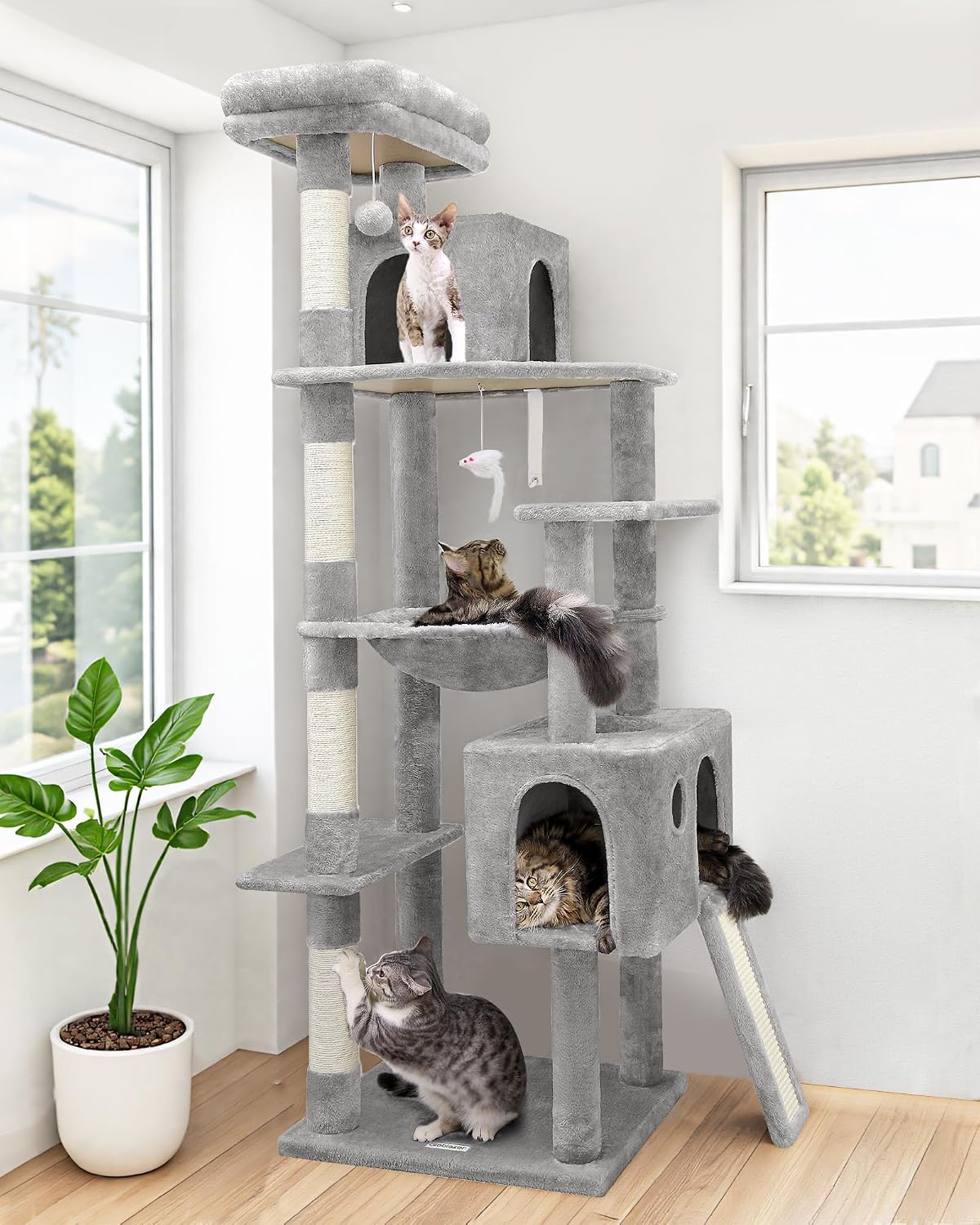
Our pick for big cats: Globlazer F70 Pro Heavy Duty Cat Tree Tower for Indoor Cats Large Adult
 Visit on Amazon →
The F70 Pro is the one I point at first when someone tells me their cat is big. Heavy duty is not a marketing word in this class, it is a structural requirement, and this tower is designed around the weight of a full-grown adult rather than a kitten who will grow out of it in eight months.
Here is what to verify when yours arrives. Set the base plate on the floor and stand on it. Not gently. Put your full weight on the plate and see if it flexes. A base that flexes under a human foot will flex under a cat landing from height. Then check the post material before you assemble anything. Run your thumbnail across the wrapping. If it bites into carpet fiber, you have the wrong tree for a house with a couch in it.
For a large adult cat, the value of this tower is the perch depth. A 15-pound cat needs to be able to lie flat, chin down, tail out, without any part of them hanging off an edge. Cats do not relax on a surface they are worried about falling off.
Flaws but not dealbreakers: Any tower in this weight class is going to be heavy and awkward to move once it is built. Assemble it where it is going to live, not in the middle of the living room where you have elbow room, unless you enjoy dragging furniture.
Households with one or two big cats and a spot against a solid wall will get the most out of this one.
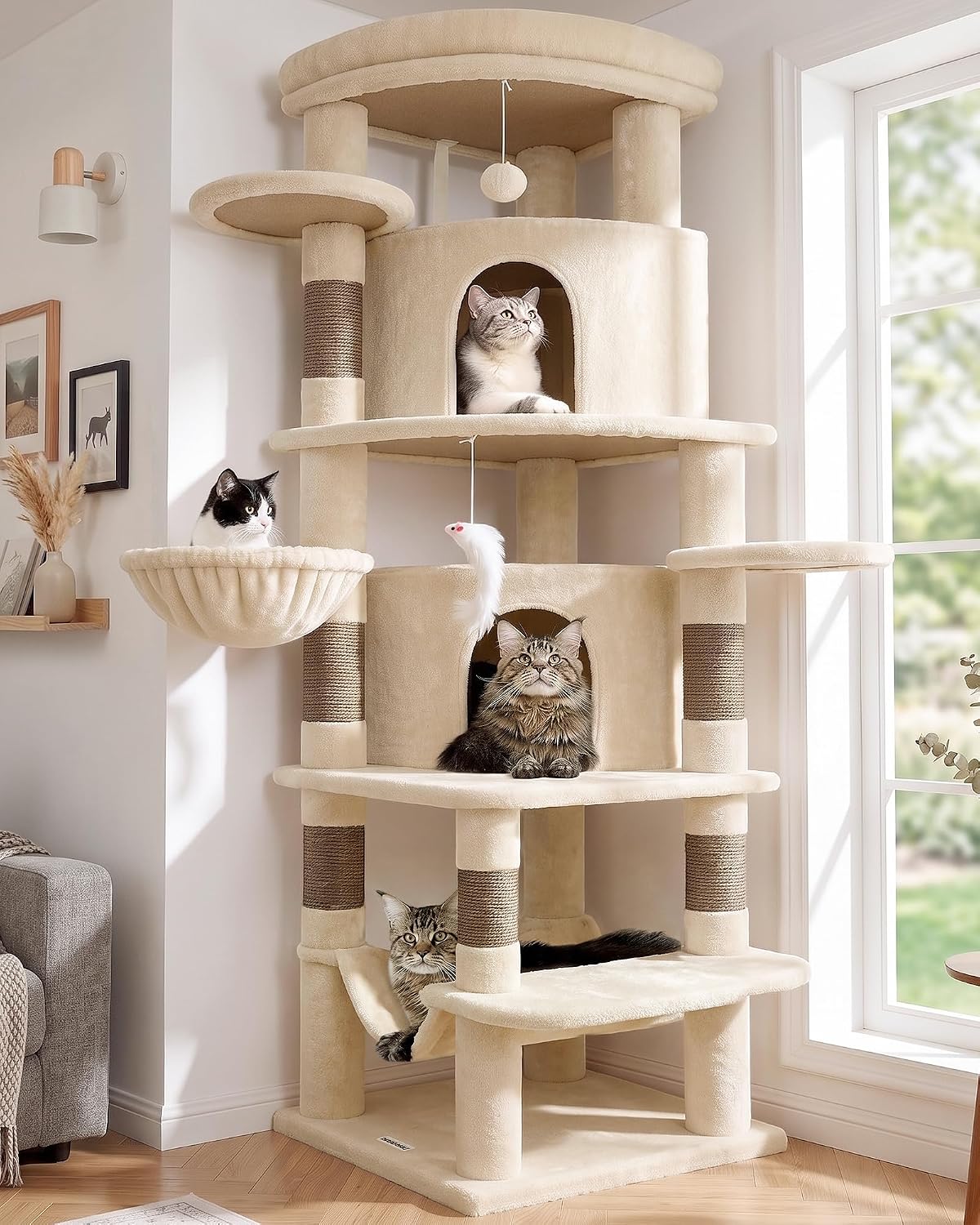
The corner option: Globlazer 66inch Corner Cat Tree Tower for Indoor Large Cats, C66, Beige
 Visit on Amazon →
A corner tower solves the problem that keeps most people from buying a tree at all, which is floor space. The C66 wedges into a 90-degree corner, so the footprint it steals from your room is a triangle you were not using anyway. It also gets a stability assist for free, because two walls behind a tower do work that a base plate has to do alone in the middle of a room.
Sixty-six inches puts the top perch above the waist of most adults, which is the minimum for real vertical territory. The beige finish is a deliberate choice, and it is the right one if you do not want a cat tower to be the loudest thing in your living room.
Two things to measure before you order. First, check that your corner is actually square. Old houses in Tampa are full of corners that are a few degrees off, and a tower built for a true 90 will leave a gap or fight the baseboard. Second, confirm the ceiling clearance if the top perch has any kind of platform or house above it. Cats want to sit on top of the highest surface in the room, and they need headroom to do it.
Flaws but not dealbreakers: Corner placement means one side of the tower faces the wall permanently, so plan the scratching posts so the usable sides face into the room. You are paying for floor space savings, and the trade is that you do not get to walk all the way around it.
Apartments and small bedrooms where a free-standing tower would eat the walking path are exactly what this is built for.
The actual setup workflow
Now the part you came for. Do these in order and you will skip the four weeks of "my cat won't use the tree" that most people spend before they give up.
Step one: Choose the spot before you open the box. Watch your cat for a day. Where do they already perch? The back of the couch, the windowsill, the top of the bookshelf? That is where the tree goes, or as close to it as you can manage. Do not put a tower in a dead corner your cat never visits and expect the tree to change their habits. Cats do not go looking for new territory. They claim territory they can already see.
Step two: Give them a view of a doorway. Vertical territory is about security, and security means being able to see who is coming. A tower facing a doorway, a hallway, or a window outperforms a tower against a blank wall every single time.
Step three: Check the floor under the base. A wide base plate on thick carpet will settle and rock. On hardwood it will slide. Before you load the tree with a cat, put the base down, push it side to side with your hand, and decide whether you need a non-slip pad underneath or a wall strap at the top. A strap is a few dollars and it is the difference between a tower and a tipped-tower problem.
Step four: Assemble it with your own tools. The hex key in the box is fine for starting bolts. It is not fine for finishing them. Use a real wrench or a screwdriver with a proper handle and get every bolt snug. Snug, not gorilla tight. You will strip a bolt hole in a particleboard platform if you crank on it.
Step five: Re-tighten everything after a week. This is the step nobody does and it is the one that matters most. Wood and composite settle, bolts loosen, and a tower that was rock solid on day one develops a shimmy by day ten. Walk the whole thing with a wrench once a week for the first month, then monthly after that.
Step six: Set the height so the top perch is above your waist. If you bought a tall tower and it still feels short, check whether the top perch is actually the highest usable surface. Some platforms are decorative. Your cat will pick the highest spot on the structure and ignore the rest, so make sure the highest spot is a real perch and not a roof panel.
Step seven: Break it in with scent and play. New furniture smells like a warehouse. Rub the posts and perches with a little catnip, or better, drop a t-shirt you have worn for a day on the top perch. Then get a wand toy out and run it up the levels, over the perches, and around the posts. You are teaching your cat that this object is a hunting ground, not an obstacle. Ten minutes of wand play a day for the first week does more than any product feature.
Step eight: Introduce the scratching surface deliberately. Take your cat's paws and scratch the sisal yourself, in front of them, while they watch. Then move the tree, or move yourself, so scratching the post is easier than scratching the couch. Every time you catch them on the couch, pick them up, put them at the post, and scratch it once. Boring, repetitive, and it works. Scratching is communication, not destruction. Your job is to give them the right surface to say it on.
Where not to put it
Do not put a tower next to a bookshelf, a dresser, or a kitchen counter unless you want a bridge. Cats build highways, and a tower that sits one jump away from your breakables is a tower that will eventually deliver a cat onto your breakables.
Keep it away from heaters, radiators, and direct sun through a window in a Tampa summer. Cats love a warm perch right up until it is a hot perch.
Skip high-traffic hallways. A tower in the middle of the walking path is a tower that gets bumped, and a bumped tower is a wobbly tower.
What this all costs
The towers here sit in the mid range, and the accessories that make the setup work are almost free by comparison. A wall anchor strap, a non-slip pad, a wand toy, and a bag of catnip together cost less than dinner for two.
The real cost is the mistake you are avoiding. A cheap tower that wobbles gets returned, or worse, it gets used once and then ignored while your cat scratches the couch instead. You pay for that either way, and the couch is the more expensive item.
Compare that to a professional reupholstery quote on a sofa your cat has been using as a scratching post, and the math stops being close.
The bottom line
Height, stability, and sisal. Get those three right, put the tree where your cat already wants to be, and then spend a week teaching them it belongs to them. That is the entire job.
The tower is the easy part. The setup is what decides whether it gets used, and it takes one afternoon and one wrench. Do it once, tighten the bolts every month, and you will have a cat who spends their evenings at the top of the room instead of on your keyboard.