I have assembled, patched, and eventually hauled to the curb more cat trees than I can count. Eight years as a veterinary technician in Tampa and a foster room that has cycled through more than 60 cats will do that to a person. So when someone asks me whether they should buy a floor tower or bolt shelves into the wall, I don't answer with brand loyalty. I ask the question I ask every adopter: where does your cat want to be at 3 p.m., and what is currently stopping them from getting there?
That is the whole cat tree vs cat wall shelves argument in one sentence. Both formats sell the same thing, and that thing is vertical territory. Cats climb because height is safety. A cat who feels secure at shoulder height stops treating your countertop, your bookshelf, and the top of your refrigerator as contested real estate. The difference between the two formats is how much floor you're willing to give up, how much drywall you're willing to drill, and how much wobble you're willing to tolerate before you start looking up structural repair costs.
For most homes, the Globlazer F70 Pro Heavy Duty Cat Tree Tower is the pick, because a freestanding tower with a broad base delivers vertical territory without a single hole in your wall. Wall systems win in small apartments, in rooms where floor space is already spoken for, and in homes with a cat who climbs like the shelves were always there. The rest of this comparison is about figuring out which side of that line you're standing on, plus one item in this set that is not cat furniture at all.
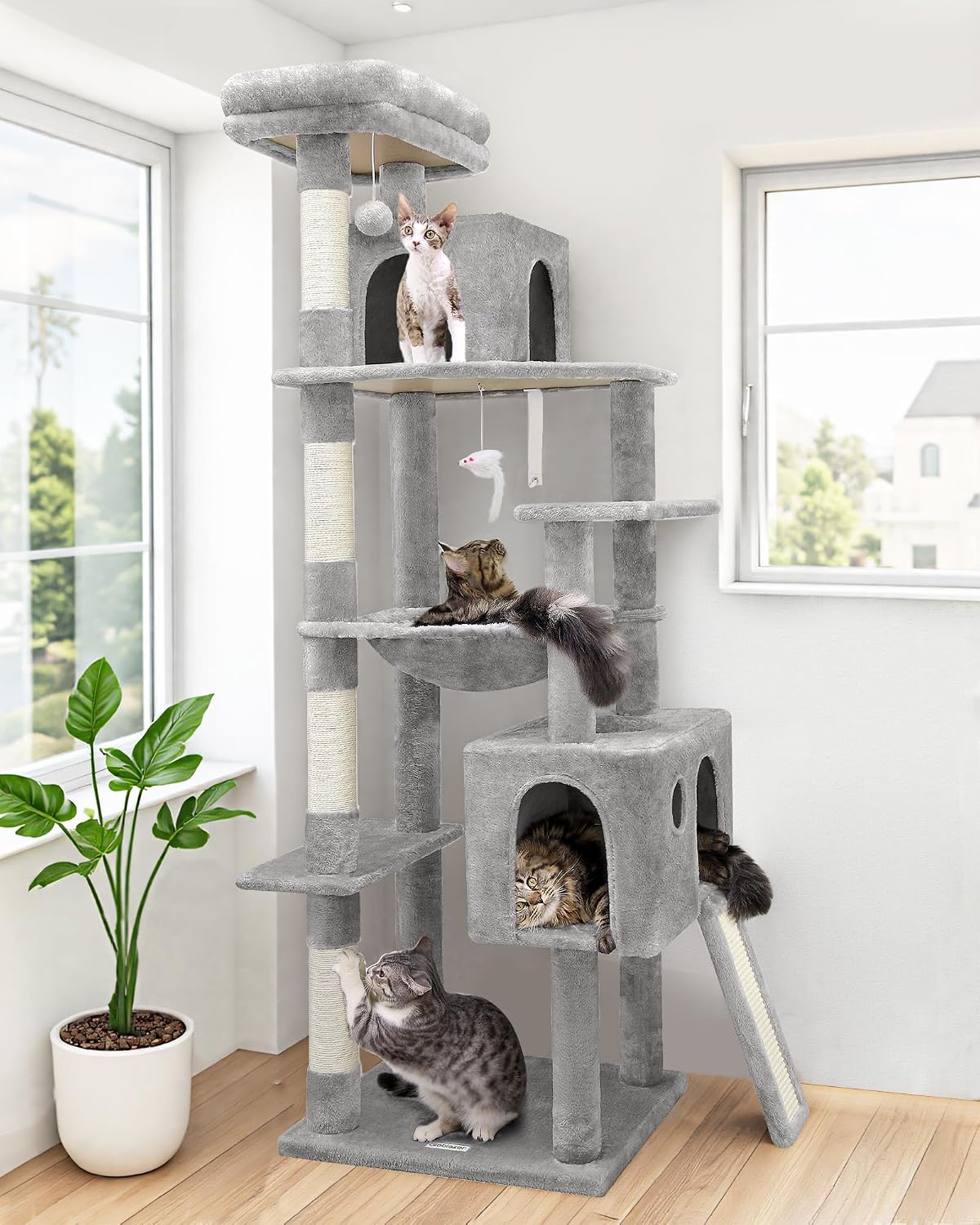
Globlazer F70 Pro Heavy Duty Cat Tree Tower for Indoor Cats Large Adult
Freestanding, built and marketed for large adult cats, no drilling, no landlord conversation
Eats floor space, hardware needs snugging back down over time
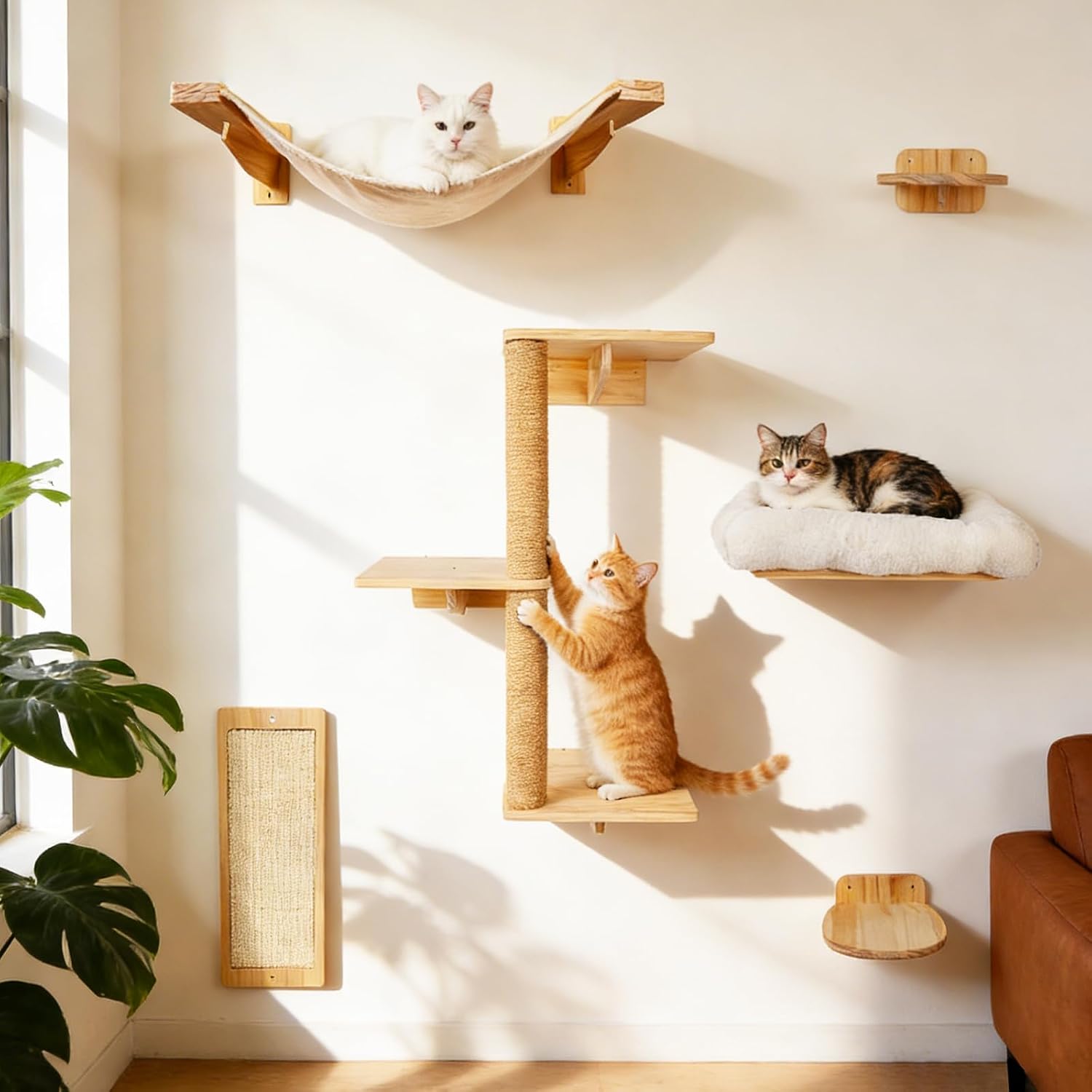
6 in 1 Cat Wall Shelves Climbing System with Sisal Scratching Perch
Puts the whole route above the floor, sisal scratching perch included on the climb
Every piece is a hole in your wall, installation quality decides whether it holds
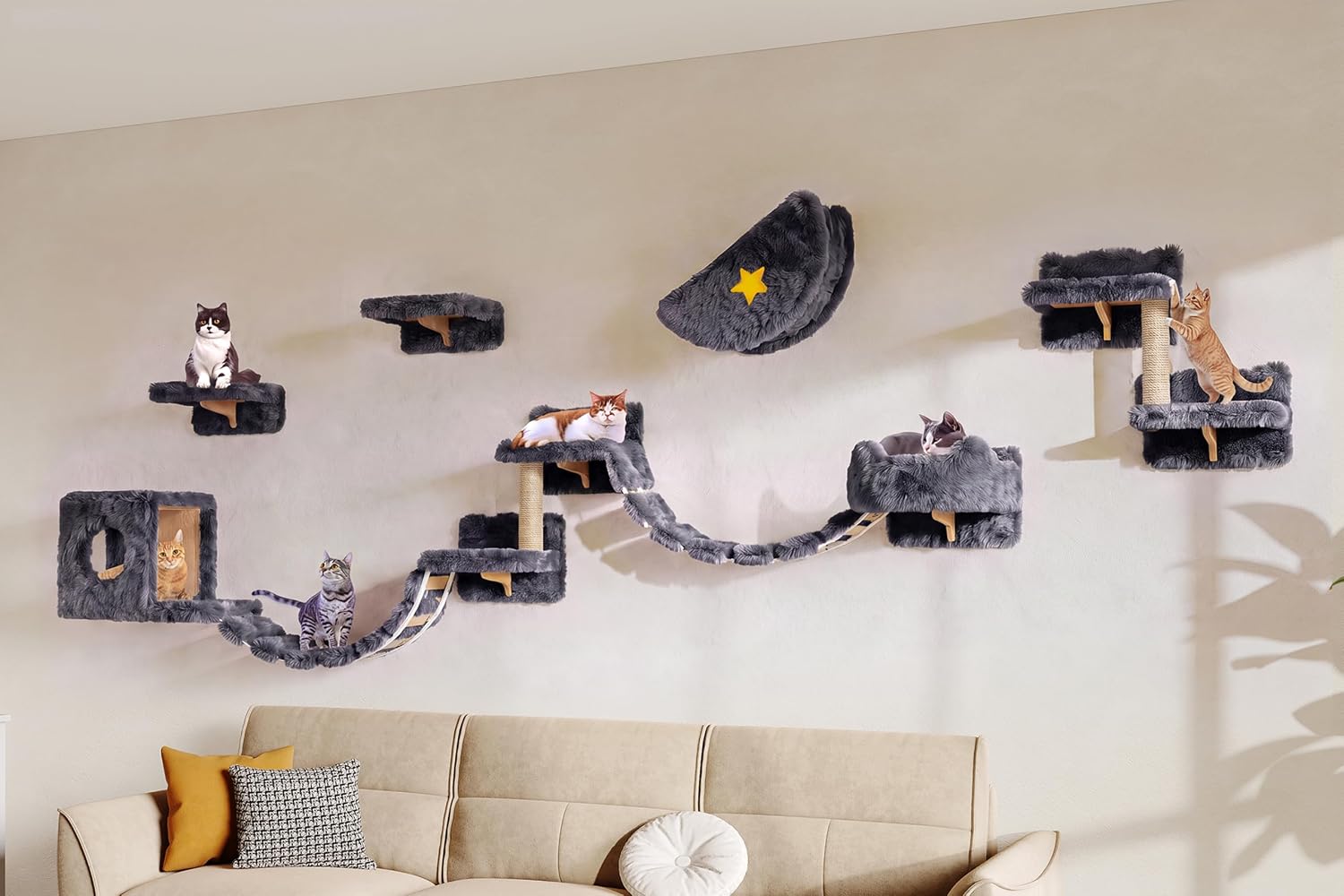
13-in-1 Cat Wall Shelves, Moon & Bridge Cat Wall Furniture, Grey
Most layout flexibility of the set, moon and bridge shapes read as furniture, not cat gear
Thirteen pieces means thirteen chances to get leveling wrong

Chasing Enough: How to Find Satisfaction in a World That Always Wants More
Cheapest item here, and the only one that might stop you from over-buying cat gear
It is a book. It holds no cats and scratches nothing
Prices and availability were captured from Amazon Creators API and may change.
How I judge cat furniture, in order
Height above your waist. A tree that tops out below your belt is a rug with legs. Cats want the high ground, and they will find it on your kitchen counters if you don't give them a legal version of it. This is the single reason to buy any of this furniture at all.
Scratching surface. Sisal or nothing. Carpet-wrapped posts are the enemy, and I will keep saying that until the industry stops printing "carpet-covered scratching post" as if it were a feature. Carpet teaches a cat that carpet is a scratching surface. Your living room rug is carpet. Do the math.
Stability. The base plate or the wall anchor is the whole game. A tower that sways when a full-grown cat lands hard on the top perch is a tipped-tower vet bill waiting on a date. Wide and heavy beats tall and pretty, every single time.
Perch size. A perch needs to fit a sprawled adult cat, not a curled kitten. If a cat can't stretch out, they'll use it once and go back to your couch.
Replaceable parts. Posts wear out. That is what they're for. A tree with no replacement posts is a disposable tree.
Globlazer F70 Pro Heavy Duty Cat Tree Tower for Indoor Cats Large Adult
The Globlazer F70 Pro is the only freestanding option in this comparison, and it's aimed squarely at the household that describes its cat as "big." The name says heavy duty and large adult, and that framing matters, because a tower built for large adult cats is generally designed with a wider footprint and sturdier posts than the kitten-sized towers that fill the budget aisle.
Where it wins: it stands on its own. No stud finder, no landlord conversation, no patching when you move. You can shift it to another corner when you rearrange the room, and you can put it in the middle of a room if that's where the sunlight lands, which is exactly where your cat wants to nap. For a large cat, a floor tower also gives you a genuinely wide base plate instead of a wall bracket holding all the weight.
Where it loses: floor space, and the maintenance that comes with any bolted-together tower. Every freestanding tree I've lived with has needed its hardware snugged back down after a few months of hard landings. If you don't want to own a hex key, you don't want a floor tower.
6 in 1 Cat Wall Shelves Climbing System with Sisal Scratching Perch
Wall systems solve the problem floor towers create. They turn a blank wall into a route, and they leave the floor to your furniture and your vacuum.
The detail I care about most here is in the name: a sisal scratching perch is part of the climb. Cats scratch where they land and where they stretch after a nap, so putting sisal directly on the route is the difference between a system your cat uses and a system your cat walks past. A climbing route with no scratching surface is just a staircase.
Where it wins: footprint. Six pieces of climbing hardware occupy roughly zero square feet of your apartment, which matters more than any other feature if you live somewhere small. It also puts the cat above the dog, above the toddler, and above the doorway traffic, which is where a nervous cat wants to be.
Where it loses: installation, and installation is not a small thing. Every shelf is a hole in your wall and a decision about whether you found a stud. Anchors can work, but I have watched a determined cat work a poorly anchored shelf loose, and a shelf that drops once gets avoided forever. If you rent with a strict lease, price out the patch job before you commit.
13-in-1 Cat Wall Shelves, Moon & Bridge Cat Wall Furniture, Grey
The 13-in-1 set is the same idea with more pieces and a different look. Moon and bridge shapes in grey read more like wall decor than like cat equipment, which is the point for anyone whose cat room is also the living room.
More pieces means more layout options. You can build a staircase up one corner, an L across two walls, or a scattered route that runs the length of a long room. With a multi-cat household, that spread matters, because five cats on one tower is a territorial argument and five cats on a long route can each claim a step.
Where it wins: flexibility and looks. It's the pick when you want the climbing system to be something you're happy to look at every day.
Where it loses: complexity. Thirteen pieces is thirteen chances to get leveling wrong, and cats notice a wobbly step immediately. Install it in stages, test each piece with your hand before you trust it with a cat, and don't try to finish the whole wall in one afternoon.
The odd one out: Chasing Enough
I'll be direct with you: this one is a book, not cat furniture. It holds no cats, it scratches nothing, and it will not survive a landing. It's in this comparison because it ends up in the same cart as cat gear for a lot of people, and honestly, I understand why.
Chasing Enough is about finding satisfaction in a world that always wants more, which is a strange thing to find next to a cat tower and also the most useful thing in this table. Cat furniture is an easy place to overspend. I have watched people buy a second tower for a room that already had one, then a third because the first two were the wrong color, and end up with three ignored trees and a cat sleeping on the printer.
The honest case for it: it is the cheapest item here by a wide margin, and it's the only one that might talk you out of a purchase you don't need. The honest case against it: if you're reading this because your cat has nowhere to climb, a book will not fix that. Buy the furniture first, the philosophy second.
Floor tower vs wall system: the real trade-offs
Here's how I actually break the decision down for adopters.
Renters. A freestanding tower is the safe answer. You can take it with you and you never have to explain a wall of holes to a property manager. Wall shelves are doable, but treat the patch job as part of the purchase price.
Small apartments. Wall shelves win, and the 6 in 1 system in particular. When every square foot is contested, going vertical on the wall instead of on the floor is the smarter trade.
Big cats. A floor tower built for large adults, like the Globlazer F70 Pro, is the more forgiving format. Wall brackets concentrate load at the mounting points, and a large cat landing hard on a shelf is asking a lot of two screws and a bracket.
Multi-cat homes. More surface area beats more height. A long wall route spreads cats out. One tower becomes a hierarchy argument with a single throne at the top.
Design-conscious rooms. The moon and bridge set is the one you won't want to hide behind a couch.
Kittens and seniors. Kittens climb everything, so anchor whatever you install. Older cats with arthritis want gentle steps and low landings, not a ladder to the ceiling.
Questions I get from adopters
Do wall shelves actually hold an adult cat? They hold if the mounting does. The shelf is rarely the weak point. The anchor is. Find studs when you can, use hardware rated well above your cat's weight, and re-check the screws a month in.
My cat ignores the tree. Why? Usually height or placement. A tree below your waist, tucked in a corner nobody uses, is easy to ignore. Put it where the family already sits, and make sure the top perch is above your eye level.
How many scratching surfaces do I need? More than one, in more than one room, if you have more than one cat. Scratching is communication, not destruction. Give them the right surface and the couch argument mostly ends.
Do I need both a tower and wall shelves? In a five-cat foster room, yes. In a one-cat apartment, no. Pick the format that matches your floor plan and put the money into quality instead of quantity.
What I'd do with my own foster room
If I were setting up a single room tomorrow with one large cat and a normal ceiling, I'd put the Globlazer F70 Pro in the sunniest corner and call it done. If I were setting up a small apartment with a cat who already treats the top of the fridge as home, I'd go with the 6 in 1 climbing system and put sisal on the route. If the room doubles as a living space and I wanted it to look intentional, the moon and bridge set is the one I'd hang. And if I already had enough furniture for every cat in the house, I'd skip all three and read the book.
That's the test I keep coming back to, and it has nothing to do with price tags: would I put this in a room with five cats and expect it to still be standing, still be used, and still be scratchable in a year? Buy the thing that passes that, and buy it once.