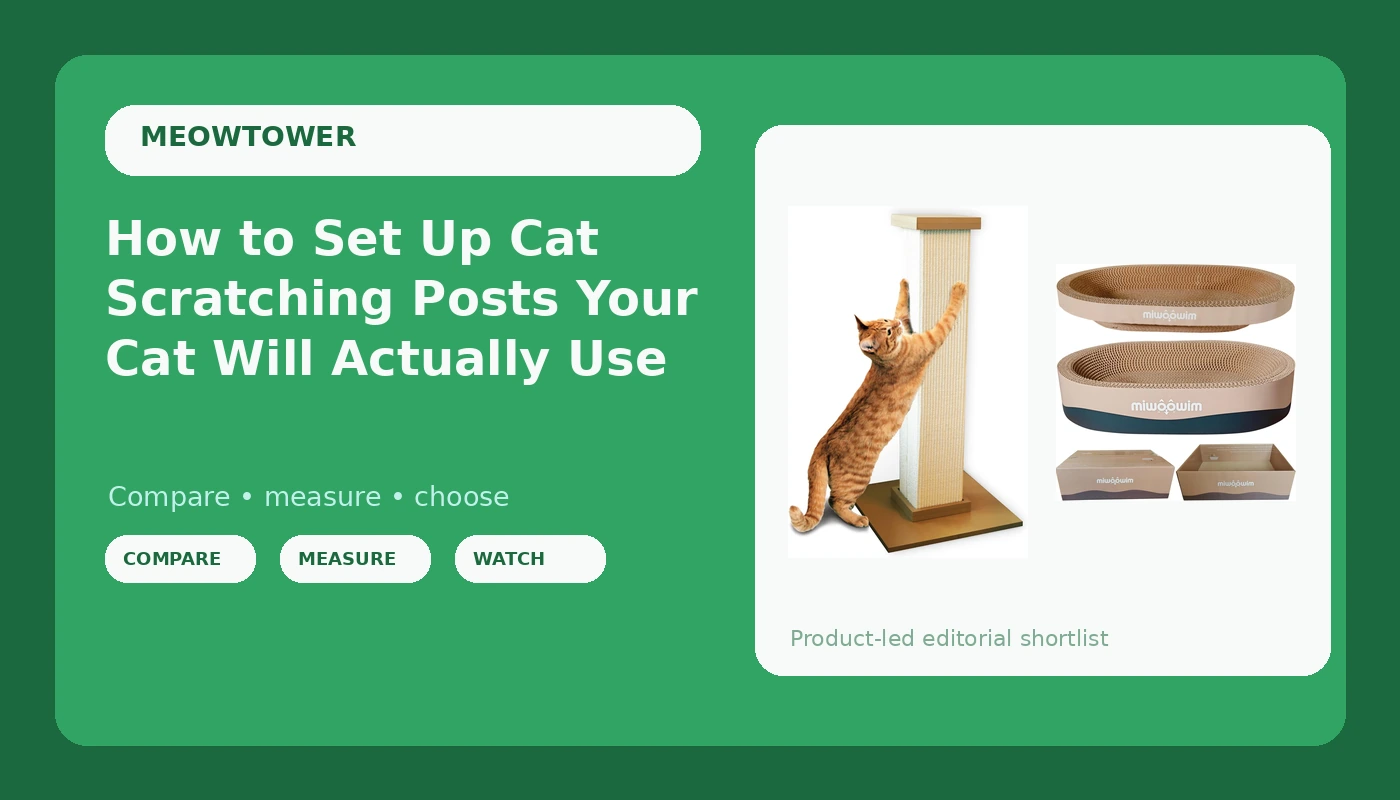
Scratching is communication, not destruction. A vet told me that during my first year as a technician, and it rewired how I talk to people about their shredded sofa arms. Your cat is not being spiteful. She is stretching her spine, marking territory, and shedding the dead outer shell of her claws. Every cat scratching post setup problem I get asked about in the clinic hallway traces back to the same three variables: the surface, the height, and where the thing is standing.
I have been a veterinary technician for eight years in Tampa, and I have fostered more than 60 cats. Right now there are five fosters in my spare room, which means any piece of cat furniture in this house gets jumped on, clawed, slept in, and knocked sideways by a rotating crew of testers who do not care about my opinion.
Here is the part most guides skip. You can buy the best post on the market and still watch your cat walk past it to shred the corner of your couch, because the post is in a hallway nobody uses and it wobbles when she puts weight on it. Fix the setup and the post gets used. That is the whole job.
Why you should trust me
I have assembled, repaired, patched, and thrown out more cat trees and posts than I can count, from budget carpet-wrapped towers to solid wood condos. I do not recommend anything I have not watched a real cat use. My rules are simple: nothing gets a recommendation without surviving a 60-day foster stress test, no stability claim without a 12-pound cat launching onto it, and no scratching claim without a photo of the post after it has actually been used. I have patched the same post in my bedroom three times, so I also know what "durable" looks like after a year.
How I picked and how I tested
For this guide I am looking at two scratching surfaces, a tall vertical post and a three-piece set that includes a lounging bowl. Those are two different jobs, and the cats in my house use them differently, which is exactly why I kept both in rotation instead of picking one.
Every surface got the same test. First, does a cat touch it within 72 hours of it going down, without me dragging a paw across it? Second, does it stay put when a 12-pound cat pushes off it at full stretch? Third, what does the surface look like after 60 days of five cats? Fourth, does any cat sleep on or in it, because a scratching surface that doubles as a resting spot gets used twice as often.
The things I judge hardest are the ones you cannot see in a product photo: whether the base stays flat on carpet, whether the scratching material shreds into confetti or frays the way sisal should, and whether an adult cat can stretch all the way up without her front paws running off the top.
The two scratching surfaces I keep recommending
These are not competing products. One is a vertical scratching station for cats who want to stand up and pull, and one is a low, curved set for cats who scratch on the floor or want somewhere to curl up. Most homes with more than one cat need both jobs covered.
Our pick: SmartCat Pioneer Pet Ultimate Scratching Post (Beige)
 Visit on Amazon →
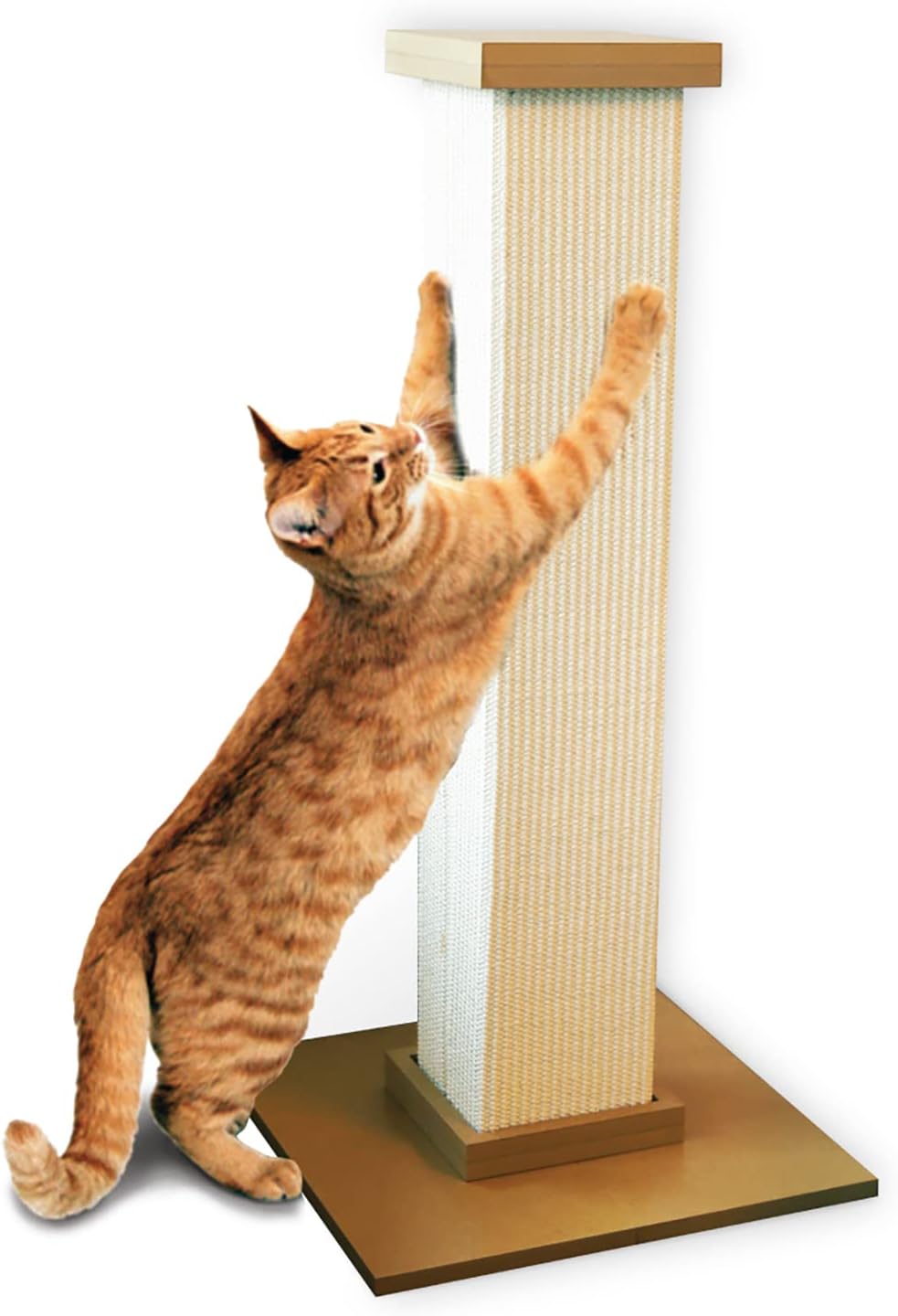
This is the post I point people to when they tell me their cat only scratches the back of the sofa. It is a single tall vertical column built for a full stand-up stretch, which is the exact motion that ruins upholstery. A cat cannot do that stretch on a short post, so she finds the tallest vertical thing in the room, and that is your couch.
The scratching surface is the other reason it stays in my rotation. It holds up to repeated use instead of turning into a pile of fuzz, and my fosters keep coming back to it weeks in, which is the only review that matters to me. The base is heavy enough that I have not had to bolt it to anything, even with a cat who launches.
Flaws but not dealbreakers: It is one job and one job only. There is no perch, no hide, and no second level, so it does not replace a tree. It also needs floor space in a spot with a wall behind it, and if you tuck it behind a door where nobody walks, your cat will ignore it. Some cats need a week and a pinch of catnip before they commit.
Anyone with a dedicated couch shredder, or a cat who scratches standing straight up, should start here.
Budget pick: miwoowim 3-Piece Cat Scratcher Set, Oval Bowl Nest for Indoor Cats
 Visit on Amazon →
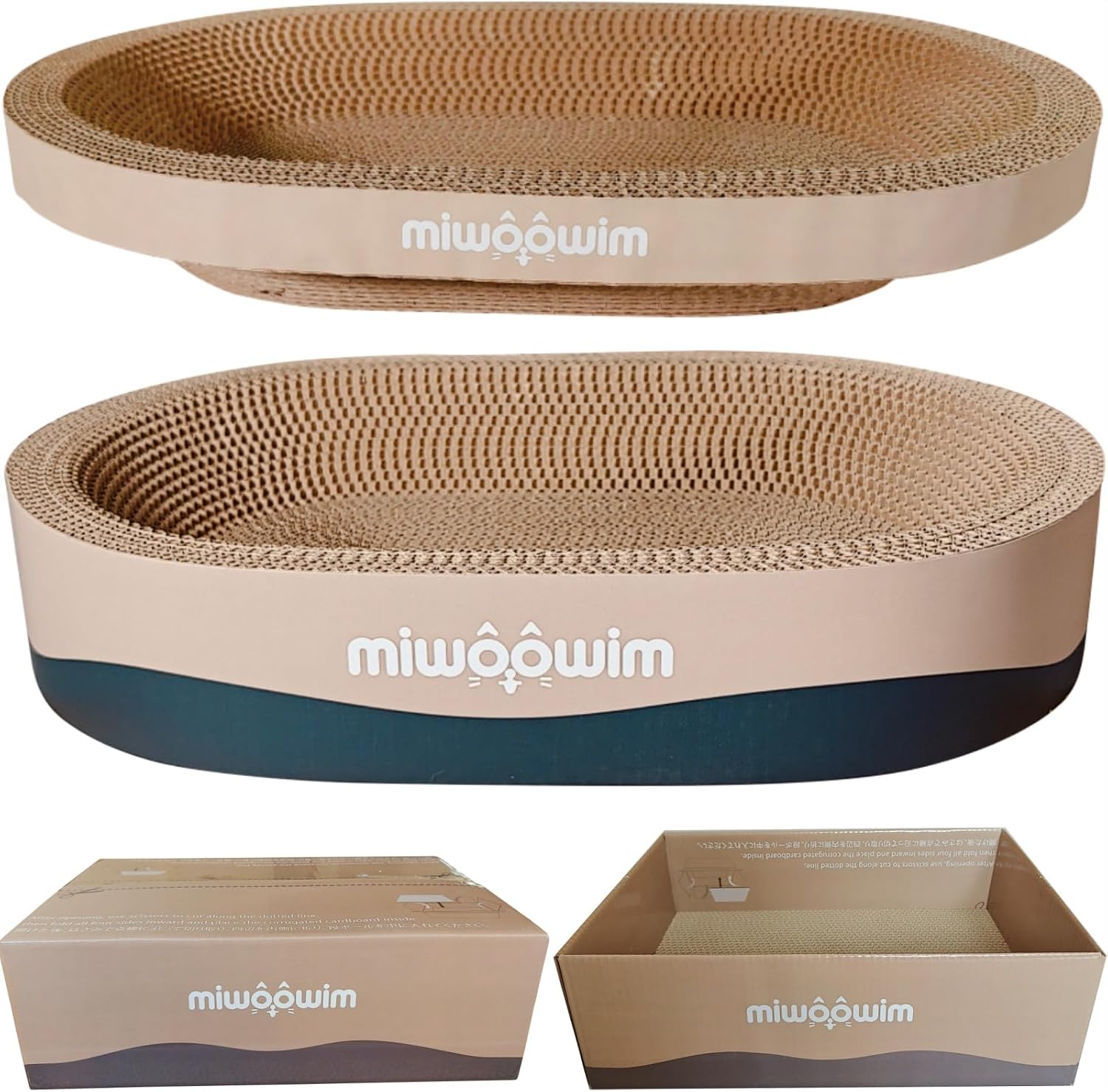
This set covers the other half of cat scratching that people forget about: the cats who scratch low and flat, and the cats who want to scratch and then immediately fall asleep in the same spot. The oval bowl nest is the piece my fosters fight over. It gives a cat a curved surface to rake her claws down and a place to curl, and that combination gets used far more than a bare flat pad on the floor.
The three pieces let you spread scratching stations around the house instead of crowding one corner. In a small apartment, that matters. Cats like to scratch near where they sleep, near where they eat, and near the front of their territory, so having multiple low surfaces to place is a real advantage over one big post.
Flaws but not dealbreakers: It is a low-profile setup. A cat who wants a full vertical stretch will still need something tall, so this does not replace the post above. The bowl shape also means you should check it for hair and loose fiber every week or so, because a curved surface collects both.
Anyone in a smaller space, or anyone with a cat who scratches the carpet and the rug edges, should have this in the mix.
The actual cat scratching post setup workflow
Now the part that decides whether any of this works. None of it is expensive and none of it takes long.
Step one: Watch where your cat already scratches. Before you move anything, note the spots. Couch arm, rug corner, door frame, the side of the speaker. That is your cat telling you where she wants a scratching station. Put the new surface within a few feet of one of those spots, not in the room you think looks better.
Step two: Put it where the people are. Cats scratch in socially important areas, not in the back bedroom nobody enters. The living room, the hallway by the kitchen, the spot next to the window where she watches birds. A post in a dead corner is a post that stays pristine.
Step three: Check the wall behind it. A tall post wants a wall behind it or a corner beside it. A cat who scratches at full stretch pushes backward, and if the post is free-standing in open floor, it will slide. Back it against something solid and you solve half your stability problem before you touch the base.
Step four: Test the base on your actual floor. Press down on the top of the post like you are a cat pushing off. If the base lifts, you have a wobble problem. On thick carpet, a wide flat base is fine. On hardwood or tile, put a non-slip pad under it or move it to a rug. A post that moves once teaches your cat to avoid it.
Step five: Get the height right. The test is simple. When your cat stands on her hind legs and reaches all the way up, her front paws should still be on the scratching surface, not waving in the air above it. If she cannot stretch fully, she will go find something taller.
Step six: Cover the low scratching too. Some cats prefer horizontal scratching on the floor. That is what the low, curved pieces are for. If your cat rakes the rug instead of the post, place a low surface directly over the spot she is already using.
Step seven: Reward the first scratch. The first time she touches it, treat her, praise her, or rub a little catnip into the surface. Do not grab her paw and drag it down the post. That teaches her the post is something that happens to her, not something she chose.
Step eight: Leave the old damage alone for a while. Do not repair the couch the same week you add the post. Let her transfer the behavior first, then patch the upholstery once the post is the established habit.
Common mistakes that make cats quit a post
The biggest one is a post that moves. If it slides an inch when your cat pushes off, she learns it is unreliable and stops using it. Anchor first, decorate later.
The second is carpet as a scratching surface. Carpet feels similar to your couch and your rug, so a cat who learns to scratch carpet-covered posts keeps scratching carpet everywhere. Sisal and similar rope materials give her a distinct surface that does not blur the line.
The third is placement for your convenience instead of hers. A post tucked behind the sofa because it looks tidy is a post that collects dust.
The fourth is punishment. Spraying, yelling, or tapping a cat for scratching the couch teaches her to scratch when you are not in the room. You cannot punish a cat out of a normal behavior. You redirect it.
The fifth is one surface for a multi-cat house. The rule I use with fosters is one scratching station per cat, plus one, spread across the rooms they actually use.
The competition and why it lost
Carpet-wrapped posts lose because of the material problem above. They are cheaper to make and they teach exactly the wrong lesson.
Cardboard-core towers and flimsy multi-level trees lose on the 12-pound jump test. I have watched a foster land on the top perch of a lightweight tree and bring the whole thing down. That is not a scratching problem, that is a safety problem, and it is why I judge the base before I judge anything else.
Short nub posts lose on height. A cat cannot complete a stretch on something she has to crouch for, so she finishes the job on your furniture.
And small perches lose on fit. If an adult cat cannot sprawl on it, she will not use it, which means the piece is taking up floor space for nothing.
The two surfaces in this guide win because they each do one job correctly. The tall post gives a cat a full stand-up stretch on a surface that is not your couch, and the low three-piece set covers floor-level scratching and a place to curl up.
What this all costs
Check current Amazon price on both surfaces before you commit, because the numbers move.
The math I actually run with people is cost per day over the life of the post. A scratching surface that lasts three years and gets used every day costs you a rounding error per day, and it is the cheapest insurance you can buy for a sofa, a rug, and a door frame. A cheap post that your cat rejects costs you the full price of the post plus the damage she does instead.
If you are setting up a house with more than one cat, budget for two surfaces minimum. One tall vertical post for the cat who stretches, one low set for the cat who scratches flat and naps in place. Then place them near where the scratching already happens, anchor them so they do not move, and give it two weeks before you decide it failed.
That is the whole method. Your cat is not destroying anything on purpose. She is asking for the right surface in the right spot, and once you give her one, the couch stops being part of the conversation.