Cats do not ask for much furniture. They ask for height, a surface that rewards scratching, and a platform that does not shift when they land on it. That is the whole brief, and it is why a cat tree and scratching post decision goes wrong so often. Most shoppers grab the tallest listing on the results page or the cheapest box on the shelf, then spend a year watching a twelve-pound cat ignore it in favor of the arm of the sofa.
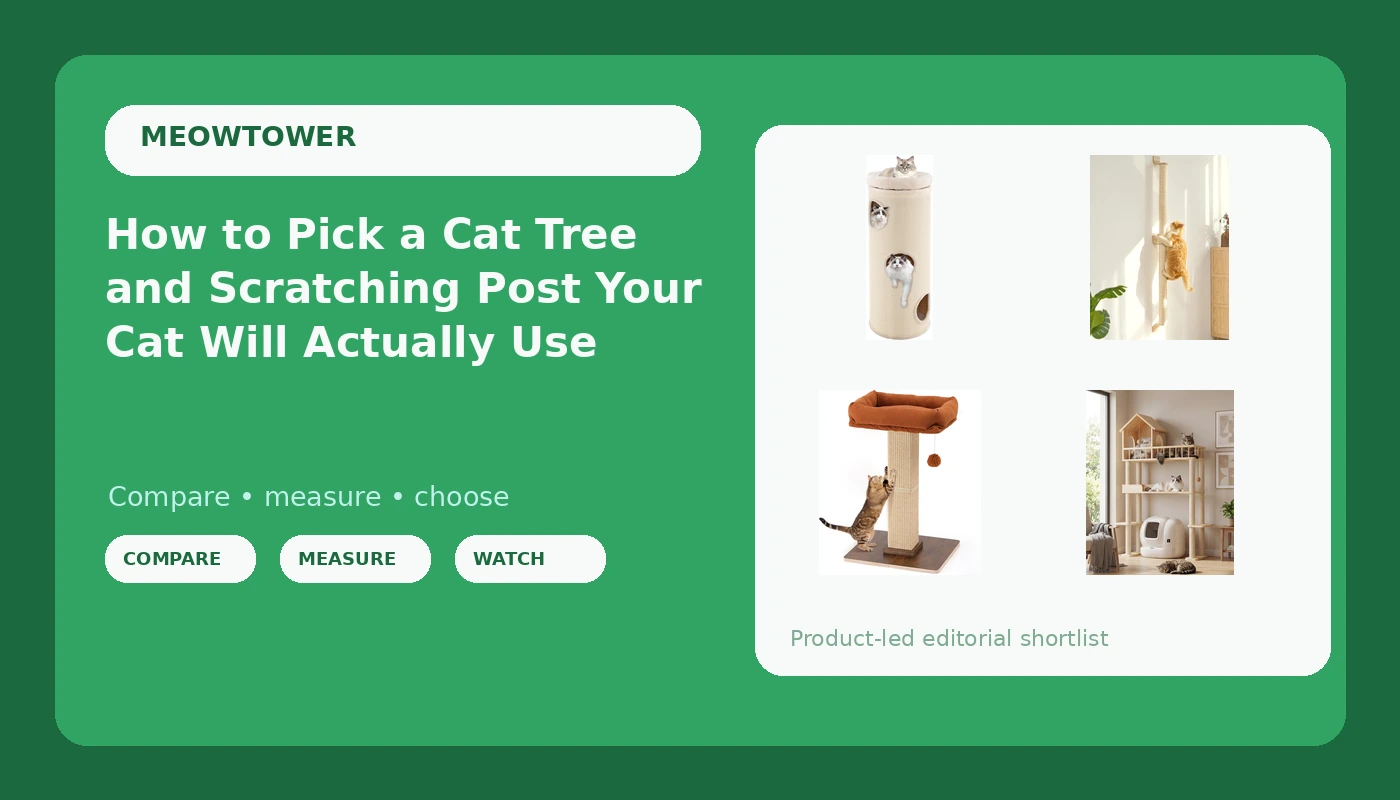
The four designs in this guide split that brief into different shapes: a barrel-shaped condo with enclosed hideaways, a wall-mounted scratcher that uses no floor space, a compact post with a single perch, and a four-tier wood tower meant to sit beside an automatic litter box. Each one solves a different problem in a different room, and none of them is a universal answer.
Related: Sisal or Carpet? How the Scratching Surface Decides Whether Your Cat Uses the Post →
Quick answer
Match the furniture to the need that is currently unmet. If your cats have nowhere to hide, a multi-level condo with enclosed hideaways gives them somewhere to retreat. If floor space is the constraint, mount the scratcher on a wall. If one adult cat has claimed a single corner, a full-height post with one perch covers it. If the tower has to live next to an automatic litter box, choose a design intended for that pairing. Whatever you pick, check three things first: the height against your tallest cat's stretch, the width and weight of the base plate, and whether the scratching surface is sisal rather than carpet.
4 useful options
| Model | Best fit | What stands out |
|---|---|---|
| Tangkula 4 Story Cat Tree Condo | Multi-cat homes that need hiding spots | Four levels, three hideaways, and a detachable sisal scratching board |
| FUKUMARU Cat Wall Scratcher | Rooms with no free floor space | A 60-inch scratching run that mounts to the wall |
| FUKUMARU Retro-Style Cat Scratching Post with Perch | One adult cat with one scratching problem | A full-height post topped with a single perch |
| Wood Cat Tower for Automatic Litter Box | Litter corners that need a tower beside them | Four wood tiers reaching 60 inches |
The hideaway-heavy option: Tangkula 4 Story Cat Tree Condo
Hideaways are the feature multi-cat homes underrate. When several cats share a room, the ones getting chased need to break line of sight, and an enclosed cubby does that far better than an open platform. The trade-offs are footprint and cleaning: a barrel-shaped body with three hideaways collects fur in places a flat perch never does, and the interior bamboo mat is the part you will be vacuuming most often. A detachable scratching board is the other practical detail worth noting, because a board that lifts off can be replaced or repositioned without moving the entire tower.
The no-floor-space option: FUKUMARU Cat Wall Scratcher
A wall-mounted scratcher answers a very specific complaint: the cat scratches the corner of the hallway and there is no room for a post. Mounting solves the footprint problem, and a 60-inch run lets a cat commit its full stretch in a way a short post cannot. The trade-off is installation. Anything on a wall needs to go into studs or proper anchors, and it has to go where the cat already scratches, not where the wall looks emptiest. This one is described as a kitten scratching post, so if you have a large adult cat, pay attention to the mounting height rather than the label.
The single-cat option: FUKUMARU Retro-Style Cat Scratching Post with Perch
This is the simplest shape in the group: one post, one perch, no hideaways. That works well for a single adult cat that wants a high seat and a dedicated place to scratch, and it fits apartments where a full condo would dominate the room. The trade-off is capacity. One perch means one cat at a time, and there is no cubby to retreat into when a second cat or a dog walks in. The perch itself is the part to think about hardest, because an adult cat wants enough surface to sprawl on rather than balance on the edge of.
The litter-corner option: Wood Cat Tower for Automatic Litter Box
Litter box furniture is its own category of problem. An automatic litter box needs clearance, a power source, and a location that is not the middle of the living room, and stacking a tower above or beside it turns dead space into vertical territory. This four-tier wood tower is 60 inches tall and described for use with an automatic litter box, which makes it a fit for a utility corner rather than a living room centerpiece. The trade-off is that you are buying around an appliance, so measure the litter box and its clearance before you commit to the spot.
Prices and availability may change. Product images, names, and retailer links are matched to verified listings. No current price, rating, stock status, or measured result is stated here without current evidence.
Height, base plate, and sisal: the three things cats judge
Scratching is communication, not vandalism. Cats scratch to mark territory, to shed the outer layer of their claws, and to stretch the muscles through their shoulders and back. A post that lets them do all three gets used. A post that lets them do only one gets abandoned, and the couch takes over the job.
Height is the first filter. A cat scratching at full stretch reaches higher than most people expect, and a post that stops at knee height forces the cat into a hunched, half-hearted scratch. That is the core argument for tall posts and wall-mounted scratchers: they let a cat put its whole body weight behind the motion.
Stability is the second filter, and it decides whether a nice-looking tree becomes an expensive mistake. Towers wobble for two reasons. The base plate is too small for the height above it, or the base sits on thick carpet and rocks on the padding underneath. Wide and heavy at the bottom beats tall and slender every time. If you can push the top of a tower with one finger and feel the whole thing lean, a twelve-pound cat landing on that perch will feel it much more.
Sisal is the third filter. Carpet-wrapped posts are cheap to make and easy to market, but carpet fibers do not give a cat the resistance sisal rope does, and plenty of cats simply stop using them. A sisal surface that can be replaced or repositioned, like a detachable board, extends the working life of the entire piece.
How to choose without a showroom visit
Product photos tell you more than the bullet points do. Zoom in on the base plate and compare it to the width of the top perch. If the base looks narrower than the perch, the tower is top-heavy by design. Look at how the levels connect, because a single central post with no cross-bracing is the classic wobble layout. Then read the dimensions in inches and hold a tape measure against your own wall before ordering, since a 60-inch tower in a room with a standard ceiling is fine, and the same tower under a low window is not.
Five steps make the decision faster:
- Measure your tallest cat at full stretch, then treat that number as the minimum height you will accept.
- Measure the floor space and the wall space separately, because those two answers lead to different products.
- Check the scratching surface on every post, and treat replaceable sisal as a feature worth paying for.
- Count the cats, then count the perches and hideaways, since one perch serves one cat at a time.
- Plan the room placement before you buy, so the tower lands where the cat already spends its day.
Setup and maintenance that keeps the furniture in use
- Put the tower near a window or against a wall the cat already scratches, rather than in the corner you find least useful.
- Anchor tall pieces to the wall if the base plate is narrower than the top perch, especially on carpet.
- Place the scratcher next to the spot the cat currently destroys, then move it an inch at a time toward where you want it.
- Vacuum hideaways and mats weekly, because a cubby packed with fur stops being a retreat.
- Inspect the sisal for fraying and rotate or replace detachable boards before the cat loses interest in them.
Which option should you choose?
Choose the Tangkula 4 Story Cat Tree Condo when you have several cats and the missing piece is privacy, since three enclosed hideaways and four levels give every cat a place to be alone. Choose the FUKUMARU Cat Wall Scratcher when floor space is the real constraint and the cat is already scratching a wall or a doorway. Choose the FUKUMARU Retro-Style Cat Scratching Post with Perch when one adult cat needs a high seat and a dedicated scratching surface without a full condo taking over the room. Choose the Wood Cat Tower for Automatic Litter Box when the tower has to share a corner with a litter setup and you want that dead space working as vertical territory.
One caveat applies to all four. The descriptions here cover dimensions, materials, and intended use, not the results of a long-term durability test, and stability depends heavily on your floor surface and how you assemble and anchor the piece. Treat the listing details as the starting point and your own room as the deciding vote.
The bottom line
The furniture that works is the furniture that matches a behavior your cat already shows. Height satisfies the need to survey a room. A wide, heavy base plate satisfies the need to land without fear. Sisal satisfies the need to scratch something that pushes back. A hideaway satisfies the need to be left alone, and a perch satisfies the need to sit high and watch.
Work out which of those needs is currently going unmet in your home, then pick the shape that solves it: a condo with hideaways for multi-cat households, a wall mount for tight rooms, a single post with a perch for one adult cat, or a utility tower for the litter corner. Check current Amazon price on the one that fits, measure the space twice, and anchor it properly.