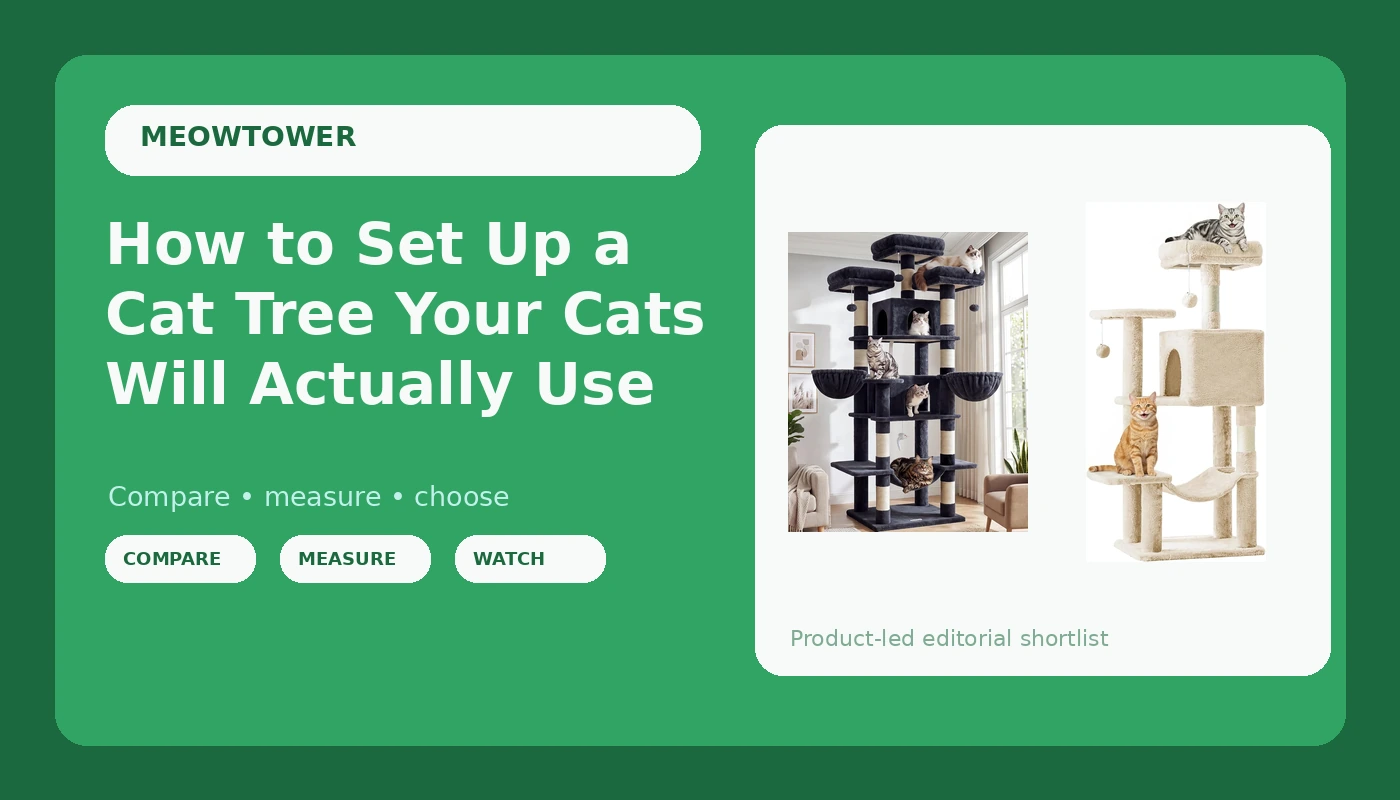
Most cat trees fail in the first month. Not because cats are picky, but because the tree was the wrong height, the wrong base, or wrapped in a material no cat wants to sink claws into. Buying a cat tree for indoor cats is the easy part. Setting it up so the cats actually use it is where most people quit, and then they blame the cat.
I have spent eight years as a veterinary technician and a lot longer than that fostering. More than sixty cats have come through my house, and five of them are here right now, which means every piece of cat furniture in my living room is under constant audit. I have watched kittens turn a cheap post into confetti and watched a fifteen-pound foster claim a perch nobody expected him to fit on.
Here is how I choose a tree, and more importantly, how I set it up so it gets used instead of ignored.
Why you should trust me
Eight years in a clinic taught me the behavior side: scratching is communication, not destruction, and a cat that shreds a couch is a cat that was never given a better surface at the right height. Fostering taught me the durability side. I have patched posts, re-wrapped platforms, and thrown out more carpet-wrapped trees than I can count.
My rules are boring and they have not changed. The tree has to reach above my waist. The base has to be wide and heavy enough that a 12-pound cat landing on the top perch does not move it. The scratching surface has to be something a cat will actually dig into. If a tree fails any of those three, nothing else about it matters, no matter how many levels the listing photo shows.
How I picked and how I tested
The two trees below went through the same routine every tree in my house goes through. They spent 60 days in a foster room with five cats. Every post got checked for real claw damage, which is the only honest proof that a scratching surface works. Every perch got the sprawl test, because a platform an adult cat cannot lie flat on is a shelf, not a perch. And every top platform got the jump test: a 12-pound cat launching onto it from the floor, on carpet, with nobody holding the base.
I also checked the boring things that decide whether a tree survives year two. Base plate footprint. Whether the posts can be flipped or replaced once the top section wears out. Whether the whole thing can be moved by one person without folding in half. Whether the platform edges are rounded enough that a cat landing hard does not catch a claw.
What I did not do is pick based on photos. A tree that looks tall in a listing can still be a rug with legs once it is standing in your living room. Height above your waist, and a base you cannot tip with one hand, are the two things that separate real furniture from decoration.
The two trees I would put in a foster room
Not every tree needs to be a solid-wood condo. It needs to match the cats you actually have. One kitten and a household of four adults need completely different footprints, and buying for the wrong one is how people end up with a tower nobody touches.
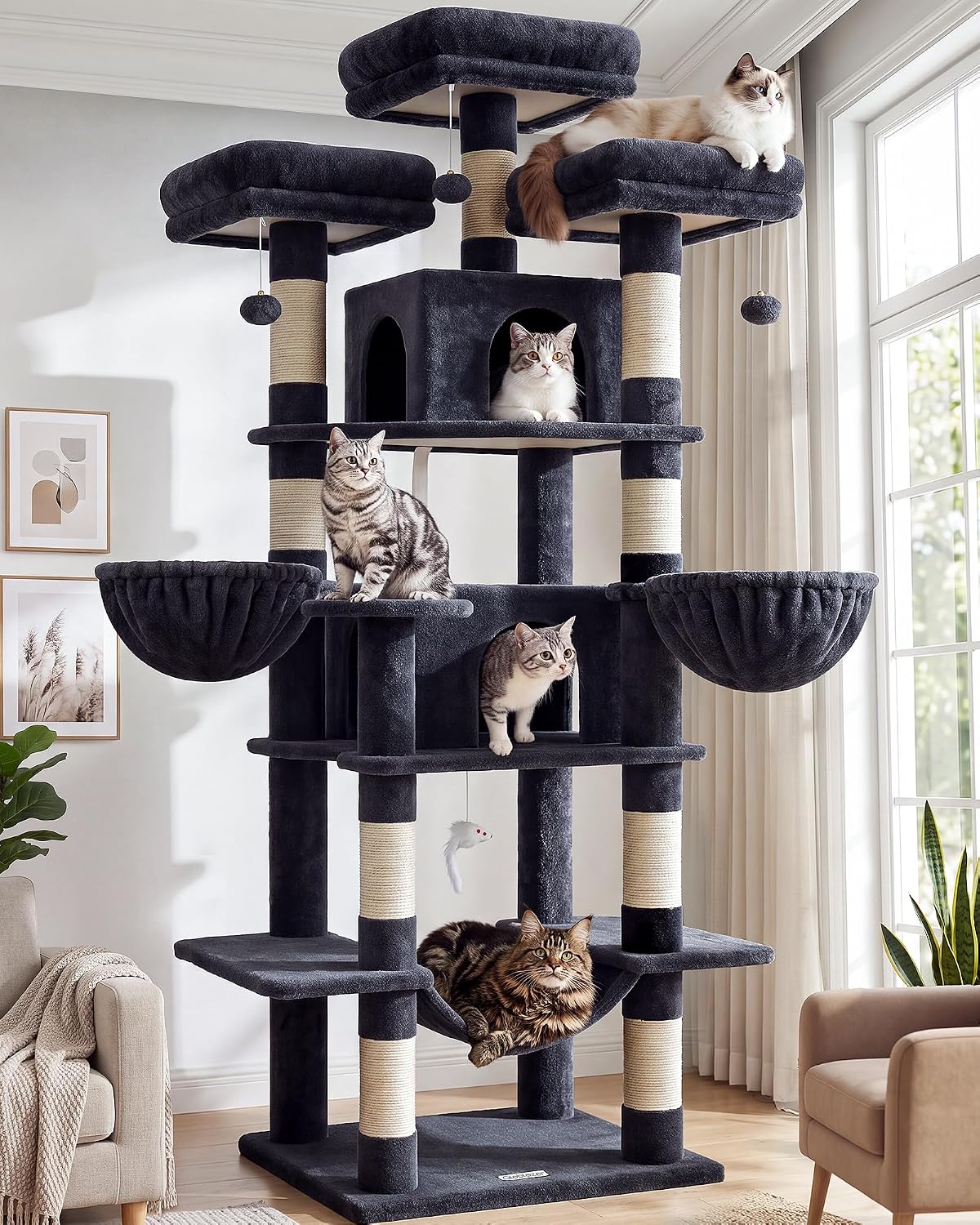
Best for multi-cat homes: Globlazer Big XXL Cat Tower for Indoor Multiple Cats, F80, Dark Grey
 Visit on Amazon →
This is the size class I point people toward when there is more than one cat in the house and the cats are already adults. The XXL footprint and the multiple-cat design are the whole point. Vertical territory only works when there is enough of it to go around, and two cats sharing one perch is how you get a standoff at three in the morning.
Before you commit, do the base check. Put one hand on the top platform and push sideways. If the base plate lifts, it is too narrow for the height, no matter how good the tower looks. Then check the post wrap with your thumbnail. If it gives like carpet padding, plan on the cats ignoring it. If it is a tight wrap, that is the surface they will use.
The dark grey finish is the practical choice for a foster room, and honestly for any room. Light beige cat furniture shows every paw print, every hairball, and every bit of tracked litter within a week.
Flaws but not dealbreakers: Big towers eat floor space. Measure the corner before you order, and leave at least a foot of clearance on the side your cat will use to launch. A tall tree jammed against two walls with no runway is harder to use than a shorter tree with room around it.
Anyone with two or more adult cats, or a single large cat, should start here.
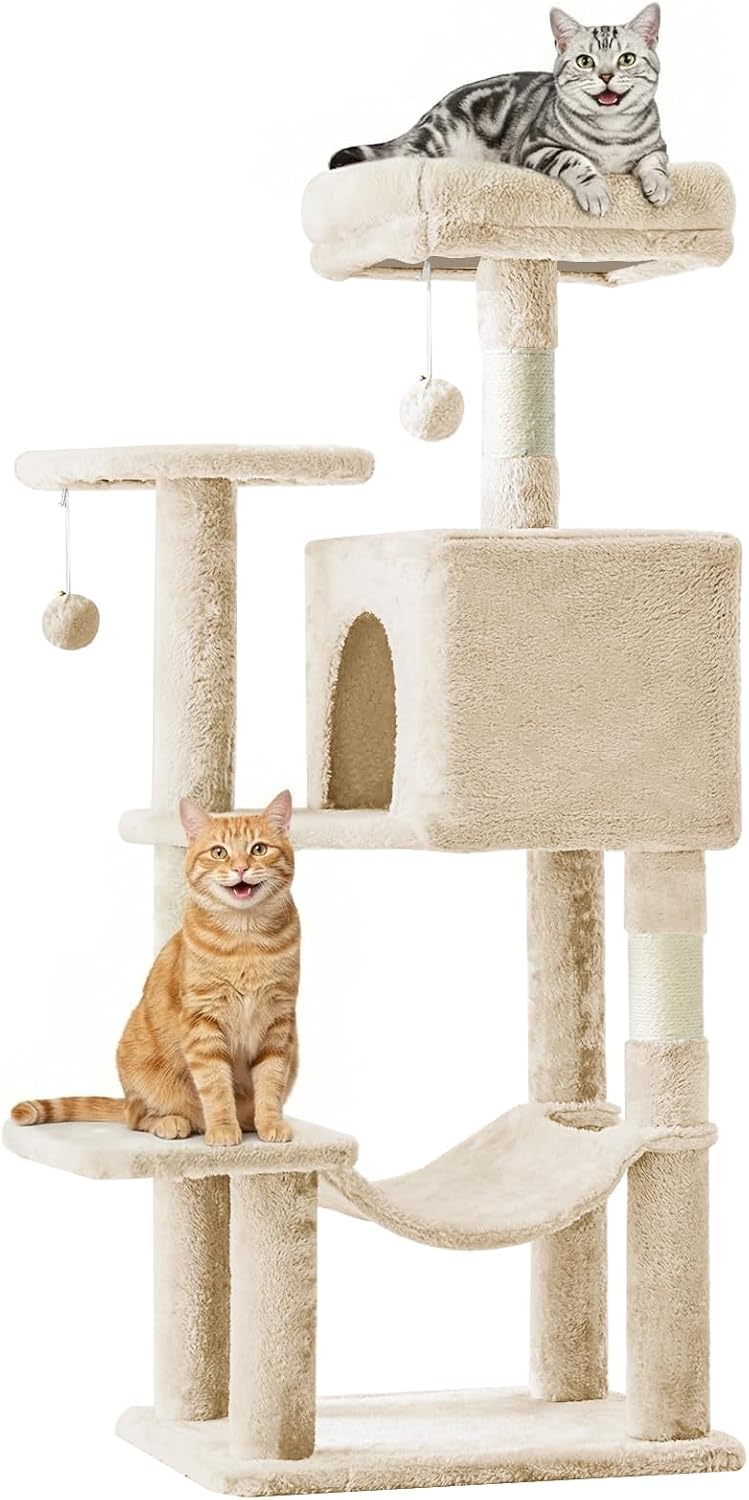
Best for kittens and small apartments: Sweetcrispy 44 Inch Cat Tree Tower for Indoor Cats and Kittens
 Visit on Amazon →
A 44 inch tower is a starter tree, and I mean that as a compliment. Kittens do not need altitude. They need something they can climb without a long fall at the end of it. A shorter tower with more levels gives a young cat a ladder to learn on, and it gives you a piece of furniture that fits in a small apartment.
This is also the right shape for a senior cat or a cat with mobility issues. Low platforms mean no jump has to be a leap of faith. If your cat has stopped using the top of an old tall tree, that is not stubbornness. That is a cat telling you the trip up is no longer worth it.
The catch with any 44 inch tower is placement. Put it next to a window or beside the couch so the top platform is level with something the cat already likes to sit on. A short tree in the middle of an empty wall gets ignored. The same tree beside a window becomes the best seat in the house.
Flaws but not dealbreakers: This is not the tree for a household of four adult cats. There is not enough vertical territory to go around, and you will end up with one cat guarding the top and three cats on the floor. Buy it for kittens, for one or two cats, or for a small space.
Anyone in a studio apartment, or anyone bringing home a first kitten, will get the most out of it.
How to set up a cat tree so cats actually use it
The setup matters as much as the purchase. Work through these in order.
Step one: Pick the wall before you pick the spot. Cats want to watch a room, not sit in the middle of one. Put the tree against a wall with a sightline to a doorway, a window, or wherever you spend your evenings. A tree facing a blank wall is a tree that gets used once.
Step two: Check the base before you build anything. Assemble the base and the bottom platform first, then push the whole thing sideways with one hand. If it slides or lifts easily on carpet, it will tip when a cat lands on it. Move it onto a rug if you can, and if the base is still narrow, this is the moment to reconsider, not after you have built the tower.
Step three: Anchor it if the tower is taller than you are. For tall towers, a strap or bracket from the top platform to a wall stud takes ten minutes and removes the whole tipping question. This matters most in homes with hardwood or tile, where a jumping cat has nothing to grip.
Step four: Assemble bottom to top. Build the base, then the lowest platform, then work upward. Do not tighten every bolt as you go. Get the whole frame together, stand it up, and then tighten from the bottom up so the tower settles square instead of leaning.
Step five: Tighten again after 48 hours. Posts compress. A tower that feels rock solid on day one will have a little play in it after two days of cats. Go back through every bolt once and snug them. Then put the wrench somewhere you will remember, because you will do this again in six months.
Step six: Put the scratching surface at the right height. A cat scratches to stretch, so the post they use most should let them reach up with their front paws at full extension. If every post is short and low, they will find a vertical surface that is not, and it will be your couch. If the tree has one tall post, that is the one to leave clear.
Step seven: Leave the top perch empty. Do not put a bed, a blanket, or a toy on the highest platform. The height is the reward. Cats want that perch because it is the highest point in the room, and covering it with a cushion changes nothing for them but everything about whether they use it.
Step eight: Move the tree, not the cat, if it is ignored. If two weeks pass and nobody has touched the tower, the problem is almost always placement. Move it to a busier room, turn it so the perch faces the action, and give it another two weeks. Cats do not need to be taught to climb. They need the tree to be worth climbing.
Step nine: Show them the posts. Drag a wand toy up the side of a scratching post a few times during play. That is how a cat learns which surface is theirs. It takes about thirty seconds and it works better than any spray or catnip you can buy.
What I left off this list
I did not include the very cheap carpet-wrapped towers, and it is not snobbery. The wrap on those is soft and forgiving, which is the opposite of what a scratching surface should be. Cats want resistance. A post that gives under a claw teaches them that fabric is for shredding, and then they apply that lesson to your sofa.
I also left off the tiny trees, the ones that top out around knee height. If a tree does not reach above your waist, it is not vertical territory. It is a rug with legs, and it will be ignored by every adult cat in the house.
Leaving something off this list is not the same as telling you not to buy it. If your budget only reaches the entry level, buy a small tree with a wide base rather than a tall tree with a narrow one. Stability beats altitude every single time.
What this all costs
Both trees sit in the affordable range, and the setup is free.
- A kitten-sized tower for a small apartment or a first cat: Check current Amazon price.
- An XXL tower for a multi-cat household: Check current Amazon price.
- A wall anchor and strap for a tall tower: a few dollars at any hardware store.
- A wrench you keep in a drawer for the 48-hour re-tighten: whatever you already own.
Spread over the five or six years a good tree lasts, the daily cost of either one is pennies. The expensive outcome is buying a cheap tree twice a year, then replacing the couch on top of it.
The bottom line
Buy for the cats you have, not the cats in the listing photos. Match the height to your household, check the base before you trust the tower, anchor anything taller than you are, and re-tighten the bolts after the first two days. Then leave the top perch alone and let the cats decide.
A tree that reaches above your waist, sits on a base you cannot tip with one hand, and offers a surface worth scratching will get used every single day. Get those three things right, and the couch stops being the alternative.