Most people treat a heavy duty cat tree setup like flat-pack furniture. Open the box, follow the cartoon, park it in the corner. Then a 16-pound cat launches onto the top perch, the whole thing leans, and the tree gets demoted to a laundry rack. I have watched that sequence play out in foster rooms for eight years, and it almost never has anything to do with the tree being cheap. It has to do with the order of operations.
A heavy duty cat tree setup done right answers three questions before the first bolt goes in: where does the base plate sit, what is behind the tree, and how high can the perch go without turning into a lever. Get those right and a big cat gets the vertical territory she needs. Get them wrong and you have built a tipping hazard with a cactus on top.
Two pieces of gear do most of the work here, a tree rated for an adult cat's weight and a cool spot for the cat who runs hot. Both are below, followed by the actual steps.
Why you should trust me
I am a veterinary technician in Tampa, eight years in, and a foster mom to more than 60 cats. My living room has been a cat tree graveyard: carpet-wrapped towers, wobbly condos, a solid wood unit that finally survived. I have assembled them, re-drilled them, re-wrapped posts in sisal, and watched a 12-pound foster named Biscuit reject more furniture than she has accepted.
What I know about trees comes from behavior, not marketing. Scratching is communication, so the post material decides which surface your cat argues with. Height is security, which is why a short tree gets ignored. And a wobble is the one flaw a cat never forgives, because a predator does not nap on a surface that moves.
How to judge a tree before it comes home
Four checks, in this order. If a tree fails the first two, no amount of catnip rescues it.
- Does it hold a jumping adult cat? The test is the landing, not the sitting. A wide, heavy base plate with the weight kept low is what keeps a tree still when a cat drops onto the top perch from the couch.
- Are the posts sisal? Carpet-wrapped posts teach a cat that carpet is a scratching surface, which is the same lesson your couch is about to receive.
- Is the top perch big enough for a sprawled adult? A perch sized for a kitten becomes a shelf the adult cat avoids, and a tree with an unused top perch is a tree with no vertical territory.
- Would it survive a room with five cats? Multi-cat homes need at least two high spots, or the top perch becomes a nightly negotiation.
Height without stability is just a taller fall. That is the whole reason this is a setup guide and not a shopping guide.
What you want on hand before you start
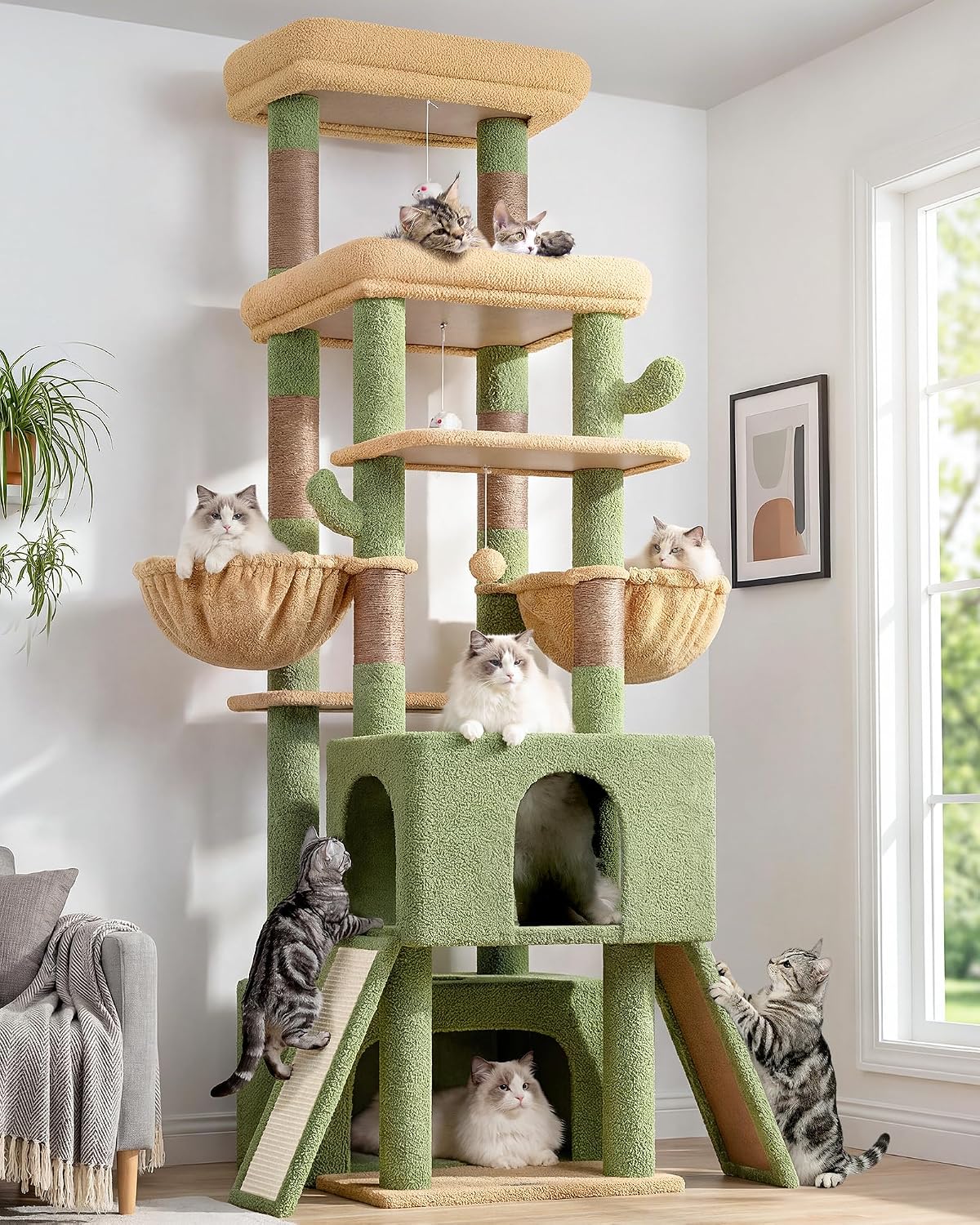
The centerpiece: Globlazer Z78 Heavy Duty Cactus Cat Tree for 20lbs Large Adult Cats, Green
 Visit on Amazon →
This is the tree in this guide: a cactus-shaped unit built around cats up to 20 pounds, which puts it in a different class from the kitten towers at the pet store. If you have a Maine Coon, a big domestic shorthair, or a foster who arrived at 15 pounds and stayed there, the weight rating is the first thing to look at, and this one is aimed at that cat. Check current Amazon price.
What I like about the shape is that a cactus silhouette reads as a vertical column, which is what cats actually want. It gives a tall climb without the sprawl of a condo with six platforms and no clear top. The green finish also reads as a plant rather than a piece of carpeted scaffolding, which matters if the tree is going in a living room instead of a basement.
Flaws but not dealbreakers: Fewer resting platforms than a condo-style tree, so in a three-cat house the second and third cats get the middle levels or nothing. And any tree this tall needs to sit against a wall, so measure your space before you commit, not after assembly.
The comfort layer: The Green Pet Shop Cool Pet Pad - Large, Blue - Self-Cooling, Pressure Activated Mat for Dogs & Cats from 46-80 lbs - Non-Toxic Gel, No Water Needed
 Visit on Amazon →
The second piece is not part of the tree, and that is the point. This is a pressure activated cooling mat with non-toxic gel inside, no water to add and nothing to plug in. The large size is rated for pets in the 46 to 80 pound range, which means it will not slide out from under a big cat the way a small mat does. Check current Amazon price.
Where it fits in a cat tree setup: big cats run hot, and a cat who just spent ten minutes on the top perch on a Tampa afternoon wants a cool surface to stretch out on. Lay it on the base platform if the platform is wide enough, or on the floor at the foot of the tree where the cat lands. Some cats take to it in a day, some ignore it for a week and then claim it in July. Because it needs no water and no freezer time, it can live under the tree permanently without you thinking about it.
Flaws but not dealbreakers: It is a mat, not a bed, so a cat who wants to burrow under a blanket will not use it. And a cooling mat only helps the cat who chooses to lie on it. You cannot schedule it.
The actual setup, step by step
Now the part you came for. This works on any tall tree, but the steps assume a heavy duty unit rated for a full grown cat.
Step one: Pick the wall before you open the box. Cats want height with a view and a wall at their back. A corner, a spot beside a window, or the end of a couch where the cat already perches is right. Keep the tree away from the litter box, away from the food bowl, and away from a heating vent that will blow hot air across the top perch. If the tree is going in a high-traffic hallway, expect it to be ignored.
Step two: Assemble it flat, then stand it up. Lay the base plate on the floor and build upward while the tree lies on its side. A tall tree assembled upright is a tree that wobbles later, because you cannot see a cross-threaded bolt when you are fighting gravity. Two people make this faster. One person with a cordless driver and a bad attitude makes it slower.
Step three: Snug, do not crank. Over-tightening strips threads in particleboard, and a stripped bolt hole is how a perch ends up sagging a month in. Snug every bolt by hand feel, then come back after 48 hours of cat traffic and snug them again. That second pass is the one that matters.
Step four: Anchor it. A wall strap or an L-bracket into a stud. If the tree stands taller than your waist and your cat is full grown, anchor it, no exceptions. This is the step people skip because it means putting a hole in the drywall. A hole in the drywall costs less than a vet visit, and much less than a tipped tower landing on a cat who was sleeping underneath.
Step five: Get the base plate right. Carpet is the enemy of stability. Thick pile compresses unevenly under a heavy base, which is why a tree can feel solid in the store and rock in your living room. Put a hand on the top perch and push gently. If it rocks, slide a thin plywood board or an anti-slip pad under the base plate and check again. On hard floors, check that the base is not bridging a low spot in the floor.
Step six: Set the perch height. Above your waist at minimum, ideally at or above your eye level. A cat who cannot get above the humans in the room is a cat looking for a counter to jump on instead. If you have a low ceiling or a ceiling fan in the way, drop the top perch one level and add a second high spot elsewhere rather than crowding the fan.
Step seven: Deal with the scratching surfaces. Sisal posts get used. Carpet posts get used as a launch pad while the cat scratches the couch instead. If your tree arrives with carpet-wrapped posts, plan to wrap them in sisal rope, starting at the bottom and wrapping upward so the loose end is under the wrap, not sticking out for a cat to pull.
Step eight: Introduce the cat, do not install the cat. Do not place a cat on a new tree. Rub a worn t-shirt over the perches so the tree smells like the house, put a few treats on the base platform, and rub catnip or silvervine on the top perch. Then walk away. Letting the cat discover the tree on her own terms is the difference between a claimed perch and a piece of furniture with a cat-shaped hole in the dust.
Step nine: Place the cooling pad. Put it where the cat already naps, which after a few days will be obvious. On the base platform, at the foot of the tree, or on the floor beside the window the cat watches. Move it once if the cat ignores it, then leave it alone.
Step ten: Maintain it. Check the bolts monthly. Vacuum the platforms, because a tree full of cat hair is a tree a cat stops using. Trim loose sisal strands instead of letting them dangle. Re-snug everything after the first week, then again after the first month, and after that twice a year is enough.
When the tree still wobbles
Diagnose in order, because the fix is almost never a new tree.
Loose bolts are the most common cause, and they loosen with use. Re-snug everything, then re-test with a push on the top perch. If the tree sits on thick carpet, the base plate is likely rocking on compressed pile, so put a board under it. If the floor itself is uneven, shim the low corner. If the tree is not anchored, anchor it. If all of that is done and the tree still moves when a cat lands, the top perch is too high for the base width, and dropping it one level is the honest fix.
A tree that moves an inch when a cat lands is a tree that will move three inches a year from now. Fix it while the hardware is still tight.
What I would not buy instead
Skip the bargain-bin towers with cardboard-core posts. Those posts are confetti waiting for a rainy month, and the carpet wrap teaches the wrong scratching surface at the same time. A kitten-sized tower is a fine starter for a six-pound cat and a waste of floor space for an adult, because the perch is too small and the whole thing is too short to count as vertical territory.
Wall shelves and window perches are great additions and poor substitutes. They give a cat a landing spot, not a base to climb from, and a cat needs the climb. A tree rated for an adult cat plus one cool surface covers the whole job, which is why this guide keeps it to two purchases.
What this costs
Two purchases, and they are not the same kind of purchase. The tree is a one-time buy, the piece of furniture you plan to keep for years, so the weight rating and the base plate are worth paying for up front. The cooling pad is the cheap half of the pair and the one you can add later if your cat turns out to run hot.
Check current Amazon price on each before you decide, because both move around. Then do the math the honest way: a cheap tree that wobbles gets replaced, and a replaced tree costs more than the one you should have anchored the first time. Add the cost of a wall strap and a board for under the base plate, which is a few dollars at any hardware store.
The setup itself is free, and it takes about an hour with two people. That hour is what separates a tree your cat uses every day from a tree you are quietly embarrassed to have in the living room. Do it once, snug the bolts twice, and let the cat decide the rest.