Most cat furniture fails for the same three reasons, and none of them is the color. The posts get wrapped in carpet instead of sisal, so the cat keeps working on your couch. The base plate is too small or too light for a twelve pound cat to launch onto the top perch without tipping the whole thing. Or the tower tops out below your waist, which means the cat climbs it once, decides it leads nowhere, and goes back to the bookshelf.
I have fostered more than sixty cats and worked as a veterinary technician for eight years, and the pattern never changes. Cats want vertical territory, a surface that rewards scratching, and a platform wide enough to sprawl on without hanging off the edge. Choosing among cat trees and scratching posts is mostly about matching those three needs to your space and your cat's size. The four products below cover the range: a full tower, a jumbo cardboard lounge, a compact post, and the grooming kit that handles claws and coat between furniture purchases.
Related: Why Your Cat Ignores the Scratching Post You Bought →
Quick answer
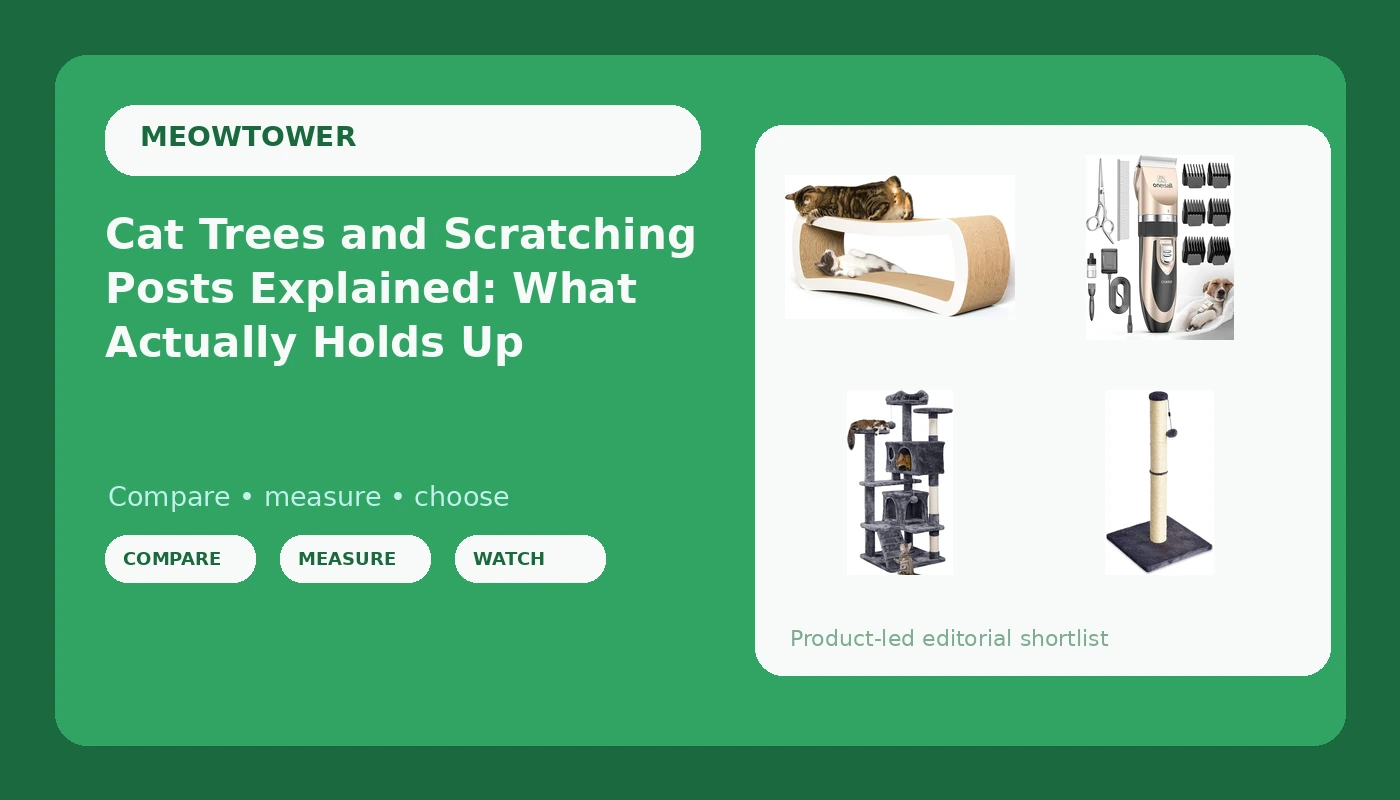
Match the furniture to the cat, not to the room. A cat that lands heavy needs a wide, weighty base plate and a perch that fits a sprawled adult. A cat that shreds the side of your couch needs a sisal or heavy corrugated cardboard surface tall enough for a full stretch. For a complete multi-level tower, the Yaheetech 54in Cat Tree Tower is the tallest option here, with two caves and a kitten-ear top perch. For big cats and serious scratchers, the PetFusion Jumbo Cat Scratcher Lounge offers the largest single surface. The Amazon Basics Cat Scratching Post is the compact, low-commitment choice for a small apartment or a single kitten. The oneisall grooming kit covers claw trims and coat care, which is the other half of keeping a cat off your furniture.
Four useful options
| Model | Best fit | What stands out |
|---|---|---|
| Yaheetech 54in Cat Tree Tower, 2 Caves, Kitten-Ear Perch & Scratching Posts | Kittens and households that want a full tower | 54 inch height with two caves, a kitten-ear top perch, and built-in scratching posts |
| PetFusion Jumbo Cat Scratcher Lounge (99 x 28 x 36 cm, Cloud White) | Big cats and heavy scratchers | Jumbo corrugated cardboard lounge that doubles as a resting platform |
| Amazon Basics Cat Scratching Post for Indoor Cats & Kittens, Medium (31.5"H) | Small apartments and single cats | 31.5 inch post with a dangling ball toy in a compact footprint |
| oneisall Low Noise Dog Clippers Grooming Kit for Dogs Cats Pets | Claw and coat upkeep | Grooming clipper kit listed for dogs, cats, and other pets, marketed as low noise |
Starter tower: Yaheetech 54in Cat Tree Tower, 2 Caves, Kitten-Ear Perch & Scratching Posts
Height is the number that matters most on this one, and 54 inches puts the top perch above the waistline of most adults, which is where cats start feeling secure. The two caves do double duty as hideouts for a nervous foster and nap spots for a confident one, and the kitten-ear perch is sized for a cat that likes to sit upright and supervise the room. The trade-off is the usual one with tall, affordable towers: the higher the perch, the more the base plate has to do. Plan on a corner placement against a wall, and check the listed base dimensions against your floor before you commit. One thing to verify in the listing is what the scratching posts are wrapped in, because a tower is only as good as the surface your cat is supposed to scratch.
Big-cat lounge: PetFusion Jumbo Cat Scratcher Lounge (99 x 28 x 36 cm, Cloud White)
Corrugated cardboard is a legitimate scratching substrate, not a compromise. Cats shred it, the shredded edges refresh the surface, and a lot of cats prefer it to rope. The jumbo footprint is the reason this one lands on the list for larger cats: a Maine Coon or a chunky fifteen pound domestic can stretch out along the curve instead of draping over the sides of something smaller. The honest limitation is that this is a floor item. It adds scratching surface and a lounging spot, but it adds no vertical territory, so it complements a tree rather than replacing one. The brand's durability claim about outlasting cheaper alternatives comes from the listing, and how long any cardboard scratcher survives depends on how many cats are working on it and how often you flip it.
Budget post: Amazon Basics Cat Scratching Post for Indoor Cats & Kittens, Medium (31.5"H)
This is the one I point people toward when they are not sure their cat will use a post at all, or when the apartment is too small for a tower. At 31.5 inches it sits around waist height for many adults, which is enough for a kitten or a smaller adult to get a decent stretch, and the dangling ball gives a kitten something to bat at while it is learning where scratching belongs. The limitation is size. A tall, heavy cat on a post this height will not get the full vertical stretch it wants, and the post alone does not deliver the elevated perch that makes a cat feel safe. Treat it as one station in a larger setup: a post here, a window perch there, and a tower if you have the floor space.
Grooming add-on: oneisall Low Noise Dog Clippers Grooming Kit for Dogs Cats Pets
This is not cat furniture, and it does not pretend to be. It earns a place here because overgrown claws and matted coats are the other half of the same problem: a cat whose claws never get worn down or trimmed scratches harder, and a cat with a coat full of mats is a cat who will not sit still for anything. Noise level is the detail that matters most with clippers, since a lot of cats bolt at the first buzz, and this kit is marketed as low noise rather than advertised with a decibel figure. Keep expectations realistic: clippers are for coat work, and you still need a proper pair of claw trimmers and a scratching surface for the front claws.
Prices and availability may change. Product images, names, and retailer links are matched to verified listings. No current price, rating, stock status, or measured result is stated here without current evidence.
How cats actually use vertical territory
A cat is a predator and prey animal at the same time, and that shapes everything about how it uses furniture. Height means safety. A cat on a high perch can watch a room without being walked up on, which is why the top platform of a tree gets used far more than the middle shelves once the cat trusts the structure. That trust depends on stability: a perch that shifts under a landing cat teaches the cat to avoid it, and once a cat writes off a tree, it rarely goes back.
Scratching is the other half. It is communication, not destruction. Cats scratch to stretch the shoulders and spine, to shed the outer shell of the claw, and to leave both visual marks and scent from glands in the paws. That last part is why placement matters so much. A scratching post tucked in a closet gets ignored, because the cat is trying to mark territory it cares about. A post next to the couch your cat already attacks gets used, because it is standing in the right place.
The base plate ties both instincts together. Every time a cat launches onto a perch, it applies sideways force to the whole structure. Wide and heavy wins. A narrow base under a tall tower is a tipped tower, and a tipped tower is the reason people give up on cat furniture entirely.
Reading a listing before you buy
Sisal rope and corrugated cardboard are the two surfaces cats reliably use. Carpet-wrapped posts are the most common mistake in budget furniture, because carpet teaches a cat that carpet is a scratching surface, and you own a lot of carpet. Post height matters too: a cat wants to scratch at full stretch, with its front paws above its head.
Material and weight come next. A tree is only as stable as its base plate, and the base plate is only as heavy as what it is made of. Replaceable parts are the quiet mark of good furniture. Posts wear out long before platforms do, and a tree with a swap-out post outlives one where the post is glued into the frame.
- Measure your tallest cat standing on its hind legs with front paws up, and treat that as the minimum post height.
- Check the listed base plate dimensions against the height of the tower. Tall and narrow is the combination to avoid.
- Confirm what the scratching posts are wrapped in before you order, because that detail decides whether the tree gets used.
- Compare the top perch to your largest cat's sprawl. A perch a cat cannot lie flat on is a perch it will stop using.
- Pick the room and the wall corner before assembly, and plan for a wall-adjacent placement for anything over three feet tall.
Placement, assembly, and the first week
- Build the tree in the room where it will live. A fully assembled tower rarely fits through a doorway, and hauling it upstairs is how bases get cracked.
- Give a new tree a day to settle before you judge it. Cardboard and composite bases compress slightly under load.
- Put the scratching post next to the piece of furniture your cat already targets, not in the corner you find tidiest.
- Keep claws trimmed on a regular schedule. Shorter claws do less damage to upholstery and to cardboard surfaces alike.
- Flip or rotate a cardboard scratcher when one side shreds, and replace the post on a tower once the rope is gone rather than waiting for the frame to fail.
- Watch the first few landings after you introduce a tree. A cat that hesitates at the top perch is telling you the structure moves.
Which option should you choose?
Choose the Yaheetech 54in Cat Tree Tower when you want height, hiding spots, and perches in a single purchase and you have a corner to anchor it in, especially with kittens or a single adult cat. Choose the PetFusion Jumbo Cat Scratcher Lounge when your cat is large, heavy, or a committed cardboard shredder, or when you already own a tree and want a better floor-level scratching surface. Choose the Amazon Basics Cat Scratching Post when space is tight, the budget is small, or you want to find out whether your cat will use a post before you spend more. Choose the oneisall Low Noise Dog Clippers Grooming Kit when the problem is overgrown claws or a coat that needs trimming rather than a missing perch.
None of these four solves everything on its own, and it is worth being clear about that. A floor lounge adds scratching surface but no vertical territory. A 31.5 inch post does not give a large cat the height it wants. A tall tower is only as good as the base under it. Durability statements here come from product listings rather than from measurements taken for this article, so treat them as claims to weigh against your own cat's habits.
The bottom line
Cat furniture works when it matches three things to your cat: enough height to feel secure, a scratching surface the cat actually wants to use, and a base plate heavy enough that nothing tips when a twelve pound cat lands on the top perch. The Yaheetech tower covers height and hiding for a household starting from scratch. The PetFusion lounge gives large cats the biggest scratching and lounging surface of the group. The Amazon Basics post is the low-cost way to test the waters in a small space. The oneisall grooming kit handles claws and coat, which keeps the rest of the setup working. Get the base and the scratching surface right, and the couch stops being the argument.