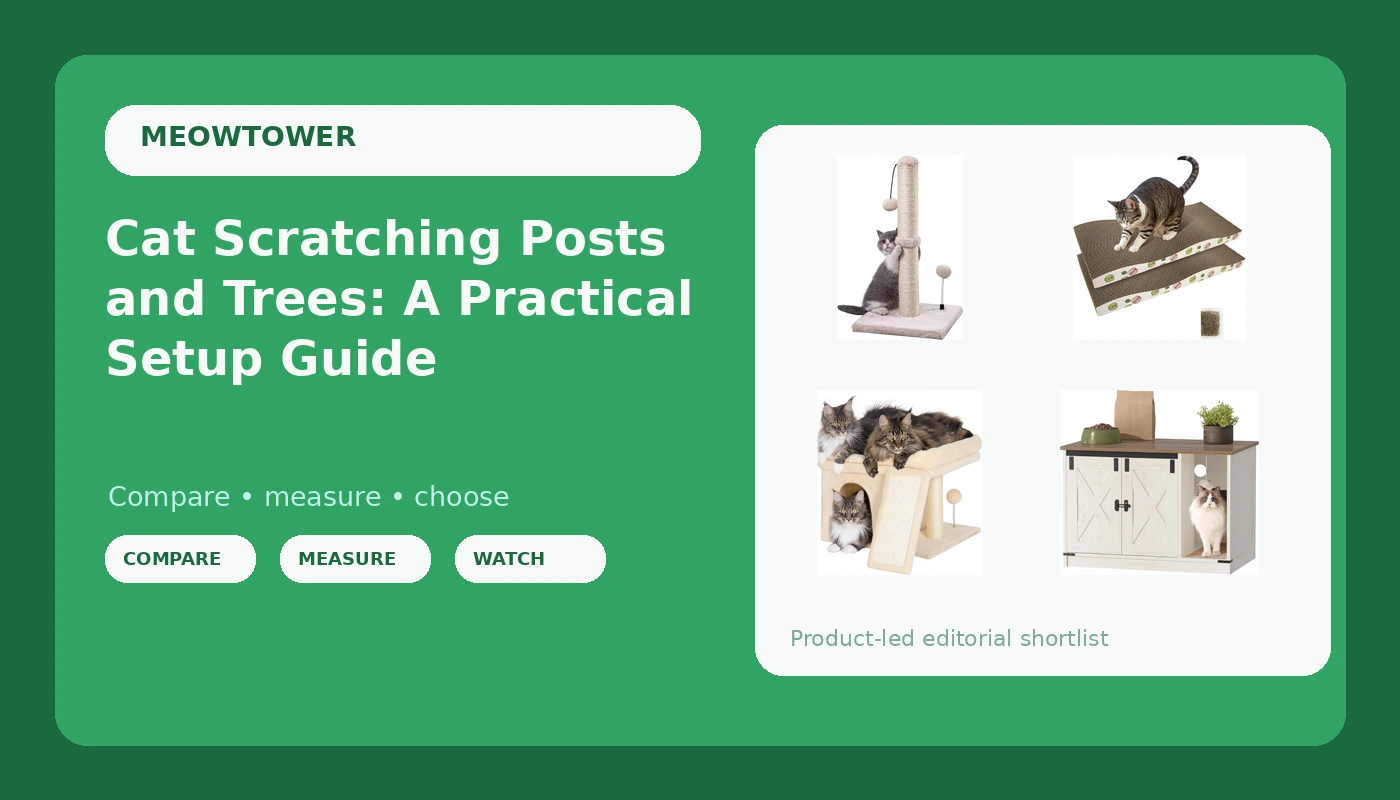
Most people buy cat furniture in the wrong order. They start with the tallest tower they can afford, because height looks like value, then wonder why the top perch stays empty and the sofa arm keeps losing its corners. The pieces that actually change behavior are usually smaller and less dramatic: a cat scratching post that stands at the right height on a base that does not slide, a corrugated pad placed exactly where scratching already happens, a compact tree whose perch is wide enough for a full-grown cat, and a litter setup that keeps the box in a shared room without pushing it somewhere the cat refuses to go. This guide covers four pieces that handle those jobs, explains what each one does, and shows how to combine them without buying anything twice.
Related: Cat Tree Stability Checklist: What to Test Before You Buy →
Quick answer
Match the furniture to the behavior you want to redirect, not to the size of the box it ships in. A sisal post sized for a kitten or a small cat covers vertical scratching. A corrugated board covers the horizontal, floor-level scratching most cats start with, and it is cheap to replace once it wears down. A compact tree with a genuinely large perch gives a big cat somewhere to sit above the room. A litter box enclosure keeps the box in a shared space without hiding it from the cat. These are four separate jobs, so no single product replaces the others.
Four useful options
| Model | Best fit | What stands out |
|---|---|---|
| MECOOL Cat Scratching Post Premium Basics Kitten Scratcher | Kittens and smaller cats that need a vertical post | 22 inch sisal post with a hanging ball |
| TIMHAKA Cat Scratching Board | Floor-level scratching in any room | Pack of two, double-sided, catnip included |
| Aechonow Small Cat Tree Tower for Large Cat | A big cat that needs a perch and a bed | Large perch and bed house in a small footprint |
| Hzuaneri Cat Litter Box Enclosure | Hiding the box in a shared room | Cabinet furniture built around a litter box |
Starter post: MECOOL Cat Scratching Post Premium Basics Kitten Scratcher
A 22 inch post is a starting point, not a forever purchase. Kittens scratch low and grow upward, so a short post gets used hard for the first year and then gets ignored once the cat can reach the back of the couch. That is fine if you treat it as a first stage and plan to add height later. What matters more than the height is the material: sisal rope gives claws something to catch and shred, which is the whole point of the exercise. A carpet-wrapped post teaches a cat that carpet is a scratching surface, and then your stairs become the next logical target. The hanging ball is a small bonus, but it also keeps a kitten returning to the post between naps, which is how the habit gets built.
Floor-level option: TIMHAKA Cat Scratching Board
Cardboard and sisal are not competing materials, they cover different angles. Many cats scratch horizontally along the floor before they ever scratch vertically, and a flat pad placed over the spot they already favor redirects that behavior immediately. The double-sided design matters because corrugated board compresses and goes bald in the middle, and being able to flip a board roughly doubles how long it lasts before it becomes confetti. The pack of two means one board can live in the living room and one near the box. Cardboard is a consumable, not a fixture, so the reasonable way to judge it is cost per month of use rather than cost per unit.
Vertical territory: Aechonow Small Cat Tree Tower for Large Cat
Perch size is where cheap trees fail, and it is the specification most listings bury. A perch that fits a six-pound kitten is a perch a fifteen-pound cat will hang off of, and a cat that cannot lie flat on the top platform stops using it. A tree that advertises a large perch and a bed house in a small footprint solves the two things cats actually want from vertical territory: a high, secure place to watch the room, and a covered place to sleep. Before you commit to any tower, check the base dimensions against the perch dimensions. A wide, heavy base under a modest perch is a stable arrangement. A narrow base under a wide perch is the opposite, and it is the configuration that ends up tipped over.
Concealed box: Hzuaneri Cat Litter Box Enclosure
This is the piece people buy last and appreciate most, because it solves a room problem rather than a cat problem. An enclosure lets the box live in a living room or hallway instead of a basement corner, which matters for cats who avoid isolated boxes. The trade-off is air. An enclosed box holds odor, so the enclosure has to be cleaned more often, not less, and the box inside it still needs to be sized for the cat rather than squeezed to fit the cabinet. Measure your existing box before ordering anything, and confirm the cat can enter, turn around, and dig without hitting a wall.
Prices and availability may change. Product images, names, and retailer links are matched to verified listings. No current price, rating, stock status, or measured result is stated here without current evidence.
Why scratching is communication, not damage
Scratching is how a cat marks territory, sheds the outer sheath of the claw, and stretches the whole shoulder and back chain. It is not misbehavior, which means the goal is never to stop it, only to move it onto a surface you can live with. That distinction explains why punishment fails and redirection works. A cat that scratches a couch has already decided that spot matters, usually because it is near a doorway, a window, or the middle of the household's traffic. The fix is to place an acceptable surface at that exact location, not in the corner where the scratching post looks tidier.
Material matters just as much as placement. Sisal rope has a rough, fibrous texture that catches claws and visibly shreds, which is exactly the feedback a cat is looking for. Corrugated cardboard offers a similar resistance in a flat format and wears out faster, which is why it is sold in multi-packs. Carpet offers the wrong feedback and the wrong lesson: it teaches a cat that soft, looped fiber is a scratching surface, and the next soft, looped fiber in the house is your stairs or your sofa. Carpet-wrapped posts are the most common reason people conclude that their cat "won't use a scratching post."
Height, base, and perch size
Three numbers decide whether a piece of cat furniture gets used: how tall it is, how wide and heavy the base is, and how much room the top perch offers. Height determines whether a cat feels secure. A tree that stops below your waist is a rug with legs, because the point of climbing is the view. Base size determines whether the whole thing stays upright when a cat lands on the top perch from a run, which is the load case that actually matters, not the gentle step-up a kitten performs. Perch size determines whether the cat stays up there once it arrives.
- Measure your cat nose to tail base while it is stretched out, and treat that as the minimum perch depth.
- Check the base footprint against the perch footprint, and favor a base that is wider than the platform above it.
- Place the post or tree on the surface it will live on, carpet or hard floor, and test for movement before the cat does.
- Put the scratching surface where the scratching already happens, then move it an inch at a time if you need it elsewhere.
- Replace cardboard pads when the corrugation compresses flat, and replace or rewrap sisal when the rope frays into loose strands.
Setting the pieces up in a real room
- Put a vertical post within reach of wherever your cat currently scratches, not in a spare bedroom.
- Add a flat corrugated pad in at least one high-traffic room, since horizontal scratching is often the first behavior to appear.
- Keep the tree near a wall or a corner, where a cat can brace and where the unit is harder to tip.
- Leave the litter box enclosure in a spot the cat already uses, and clean inside it on a shorter cycle than an open box.
- Replace worn surfaces rather than replacing the whole piece, because posts and pads are the parts that wear out.
Which option should you choose?
Choose the MECOOL Cat Scratching Post Premium Basics Kitten Scratcher when you have a kitten or a smaller cat and need a sisal post at a height that suits a young cat. Choose the TIMHAKA Cat Scratching Board when your cat scratches flat surfaces near the floor, or when you want a low-cost surface you can replace without thinking about it. Choose the Aechonow Small Cat Tree Tower for Large Cat when your cat is too big for a typical compact tower and needs a perch it can actually lie on. Choose the Hzuaneri Cat Litter Box Enclosure when the box has to live in a shared room and you want it out of sight without moving it somewhere the cat avoids.
A caveat on all four: the product listings describe materials, dimensions, and included accessories, and nothing beyond that. Stability depends on your floor, your assembly, and your cat's launch habits. Scratching preference depends on the individual cat, and some cats want vertical sisal while others want horizontal cardboard, regardless of what the marketing copy promises. Buy one piece at a time, watch what gets used, and add from there.
The bottom line
The furniture that works is the furniture that matches a behavior you already see. A sisal post handles vertical scratching, a corrugated pad handles horizontal scratching, a compact tree with a genuinely large perch handles the need to be up high, and a litter box enclosure handles the room problem that has nothing to do with the cat. None of them needs to be expensive, and none of them works if it wobbles, sits in the wrong room, or offers a perch a full-grown cat cannot fit on. Fix the surface, the height, and the placement first, and the rest is decoration.