Related: Best Cat Tree for Large Cats: Sturdy Perches That Hold
Scratching is communication. I have said that sentence more times than I can count in eight years as a veterinary technician, and it is still the thing most cat owners have never heard. When your cat drags her claws down the arm of your sofa, she is not being spiteful. She is marking territory, stretching her spine, and shedding the outer sheath of her claws, all at the same time. The problem is rarely the behavior. The problem is the surface you offered her.
That is why I think of every purchase in this category as a cat scratch furniture protector first and a piece of furniture second. A protector only works if the cat actually uses it. A scratcher that wobbles, sits too low, or uses a material cats refuse to touch is a decoration with a marketing budget.
This guide covers four pieces that solve different parts of the same problem. One is a real scratching surface that lives next to your couch. One fixes a resource problem in a multi-cat house. One is a training tool for the weeks while you are redirecting a habit. And one is comfort, because a cat with a good place to sleep is a cat who is not testing your countertops.
Best Overall: Cat Scratcher Side Table for Couch
This is the top pick for a boring reason: placement. Most scratching posts fail because they are in the wrong room. Your cat scratches the couch because the couch is where she hangs out with you, and a post in the corner of the hallway does not compete with that. A side table form factor puts the approved surface exactly where the unwanted scratching already happens, right at the arm of the sofa.
Cats scratch at corners and edges. That is why the arm of a couch takes so much abuse and why the middle of a rug never does. A side table that doubles as a scratcher gives her an edge to work and a height where she can stretch to full extension, which is the part people underestimate. Cats do not just paw at a surface. They lean in, stretch, and hold.
Two things to check before you commit. The scratching surface has to be something your cat will actually use, and the unit has to be heavy enough that a full-body stretch does not scoot it across the floor. A table that slides mid-scratch teaches a cat that the surface is unreliable, and unreliable surfaces get abandoned fast. The upside of this form factor is that it stays useful furniture. You get a table next to the couch, your cat gets an approved edge, and the couch arm gets a break.
Best for Multi-Cat Homes: 65" Double Cat Litter Box Enclosure with Power Outlet
Litter boxes are where multi-cat households go wrong most often. The rule I give clients is one box per cat plus one, and the second rule is that boxes need separation, because a cat who has to pass another cat to use the bathroom will find somewhere else to go. A double enclosure handles the count without turning your living room into a litter box showroom.
The 65 inch length and the double configuration tell you this is built as furniture first. The power outlet is the detail I did not expect and now think about constantly. It means a fountain, a self-cleaning box, or a night light can live inside the cabinet instead of stretching a cord across the floor where cats and dogs will find it.
What matters is airflow and escape routes. An enclosure that traps odor is a box your cat will avoid, and a box your cat avoids is a box she replaces on your carpet. Look for ventilation, a door that opens wide enough to scoop comfortably, and an entry your cat can exit without being cornered. That last point matters more than people think in a five-cat house. Give the boxes real separation inside the unit, and keep the litter, the food, and the water in three different places.
Best Deterrent: Sofisti-Cat Training Tape
Double-sided tape is not a solution. It is a bridge. The point is to make the wrong surface unpleasant for a few weeks while the right surface becomes the obvious choice. This is a 2.5 inch by 15 foot roll of double-sided repellent tape, which is enough to cover the corners and arms of a couch, the spots cats actually target.
Tape alone creates a cat who scratches somewhere else. That is the failure mode I see constantly. People cover the couch, the cat moves to the chair, they cover the chair, the cat moves to the curtains. The tape only works if the approved scratching surface is already in place and more rewarding than anything else in the room.
A few practical notes from fostering. Clean the surface before applying, press it down firmly on fabric, and expect to replace it as it collects hair and loses tack. On leather or finished wood, test a hidden area first. And watch your cat. Some cats treat tape as a puzzle, and if yours is one of them, the redirect surface is doing all the work anyway. The tape is there to buy you time, not to win the argument.
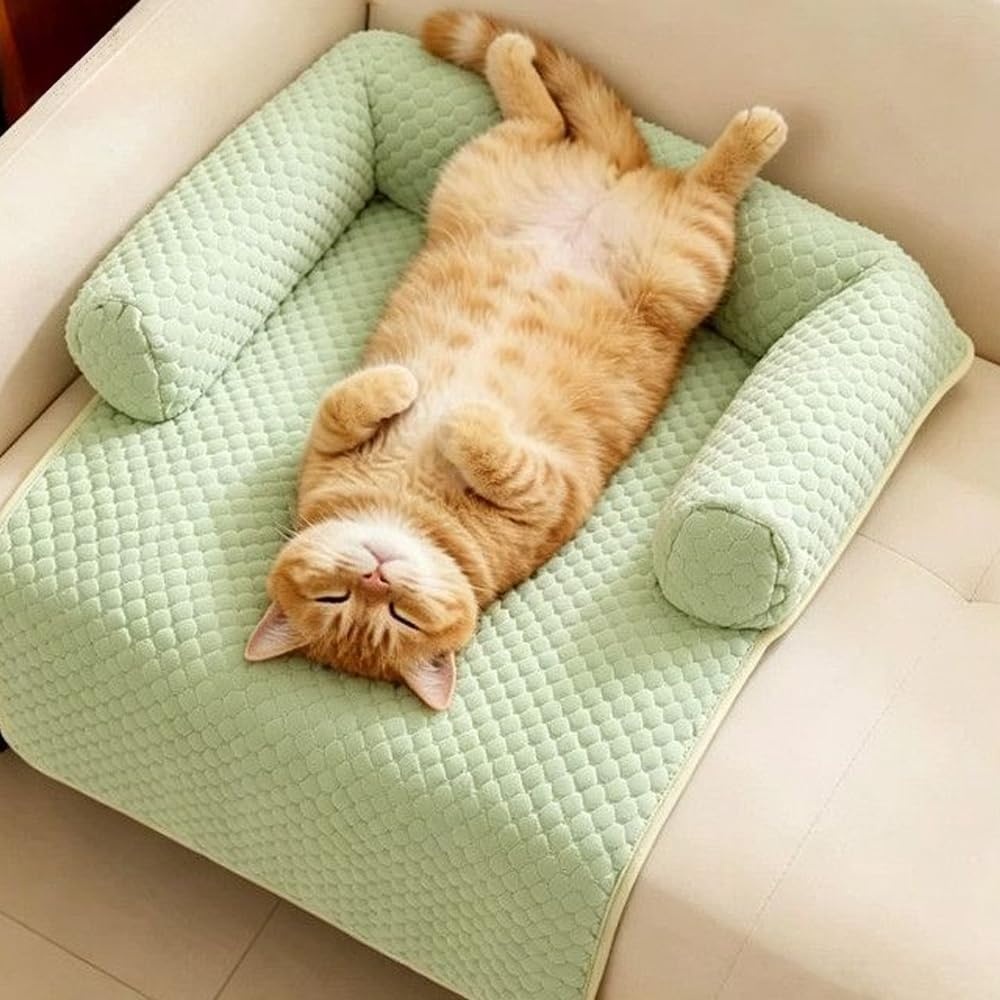
Best Comfort Pick: Cooling Dog Bed Mat with Bolster Pillow
I live in Tampa, which means my foster room runs warm for most of the year. This is a cooling mat with a bolster pillow, 31.5 by 23.6 inches, and it is made for both dogs and cats. In a house with a dog and cats, shared sleeping spots are the norm, and a mat that both species accept earns its floor space.
Cats want to sleep high, but they also want to sleep where the household is, and in a Florida summer they want a cool surface. A mat on the floor or on a low platform gives an older cat a landing spot that does not require a jump, and the bolster edge gives her something to press her head against. That sense of being enclosed is why cats pick the strangest spots in the house.
Here is how this connects to scratching. Cats scratch when they wake up. A cat who naps on the couch scratches the couch. A cat who naps on a mat beside the couch is far more likely to use the scratcher beside it. Comfort and scratching are the same conversation, which is why I would rather solve both at once than buy three gadgets that each do one thing badly.
How I evaluate cat furniture
Everything that comes into my foster room gets checked the same way, and the checks are simple.
Does it move? If a twelve pound cat launching onto the top surface shifts the unit, it is out. Wobble is the number one reason a scratcher gets abandoned, and it is the number one reason a tree ends up in a giveaway pile.
Is the surface one a cat will use? Sisal and replaceable panels, every time. Carpet wrapped posts teach a cat that carpet is a scratching surface, which is the exact lesson you are trying to unlearn.
Is the height right? A surface that only reaches your ankle cannot support a full stretch. Cats want to reach up, dig in, and pull down.
Does it survive five cats? In a foster house, nothing gets a gentle introduction. If a piece cannot handle a rotating crew of adults, kittens, and one very opinionated senior, it is not a recommendation.
Can I clean it? Hair, litter dust, and the occasional hairball are part of the deal. Anything that cannot be wiped or vacuumed will be disgusting within a month.
What actually matters
Scratching has three variables, and every good purchase addresses at least one of them. The surface is the material under the claws. The location is where the surface sits relative to where the cat already spends time. The height is how far the cat can extend.
Get the surface wrong and nothing else matters. Get the location wrong and you own a very nice object that no one touches. Get the height wrong and you get a cat who stretches on your doorframe instead.
Then there is stability. The base plate is the whole game. Wide and heavy beats tall and pretty every time, whether you are buying a tree or a side table. A cat will test a new surface before committing to it, and if it shifts under that first test, she will not come back.
Multi-cat houses add a fourth variable: resource separation. Litter, food, water, and resting spots all need to be in different places with clear lines of sight. A double litter enclosure is not a luxury in a five-cat home. It is how you keep the boxes off the carpet.
Finally, deterrence comes last, not first. Blocking the wrong surface without offering the right one just relocates the problem. Block, redirect, and reward, in that order.
Cat furniture reference table
| Product | Role | Best for | What to check first |
|---|---|---|---|
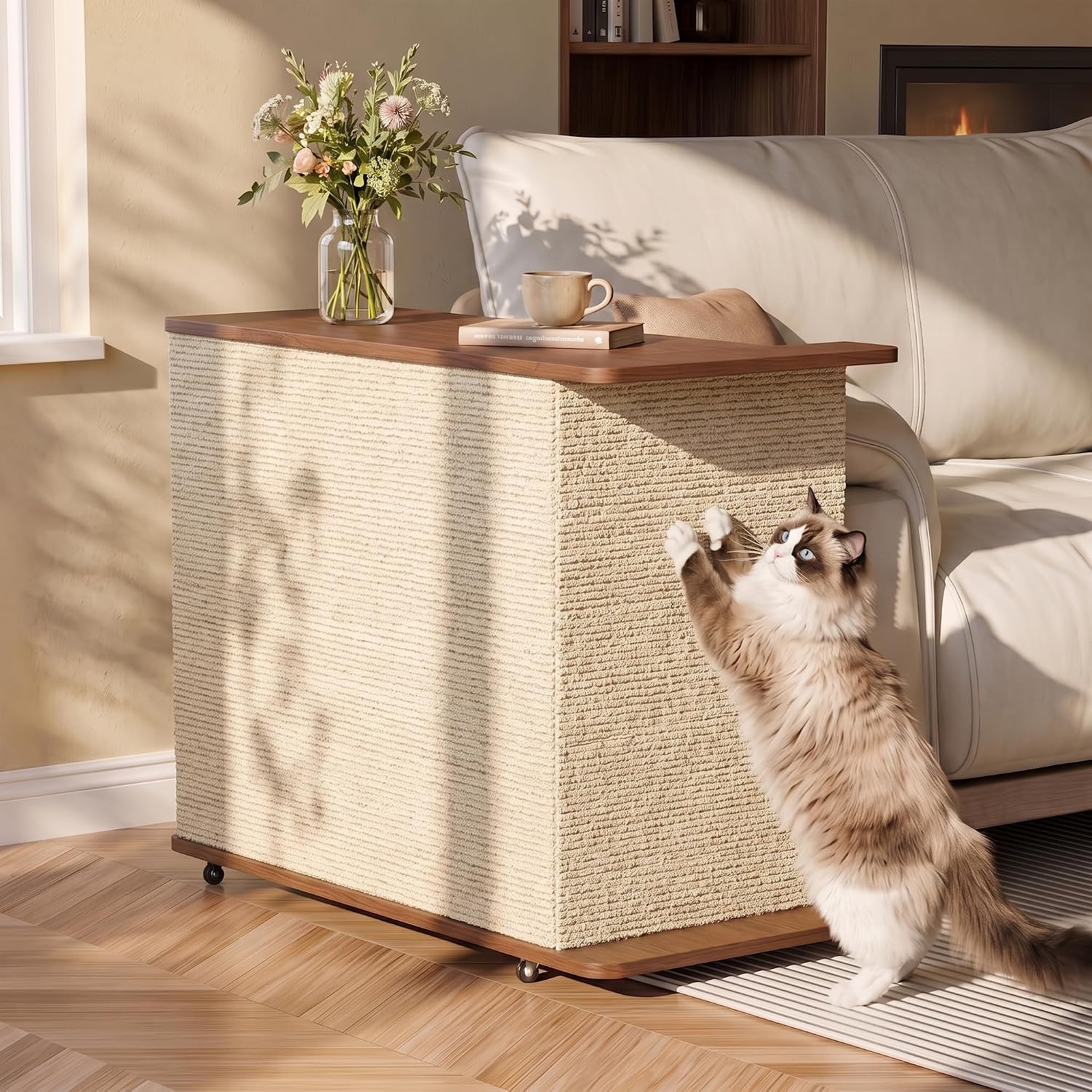 Visit on Amazon → Cat Scratcher Side Table for Couch |
Approved scratching surface | Couch-scratching cats | Weight, surface material, usable height |
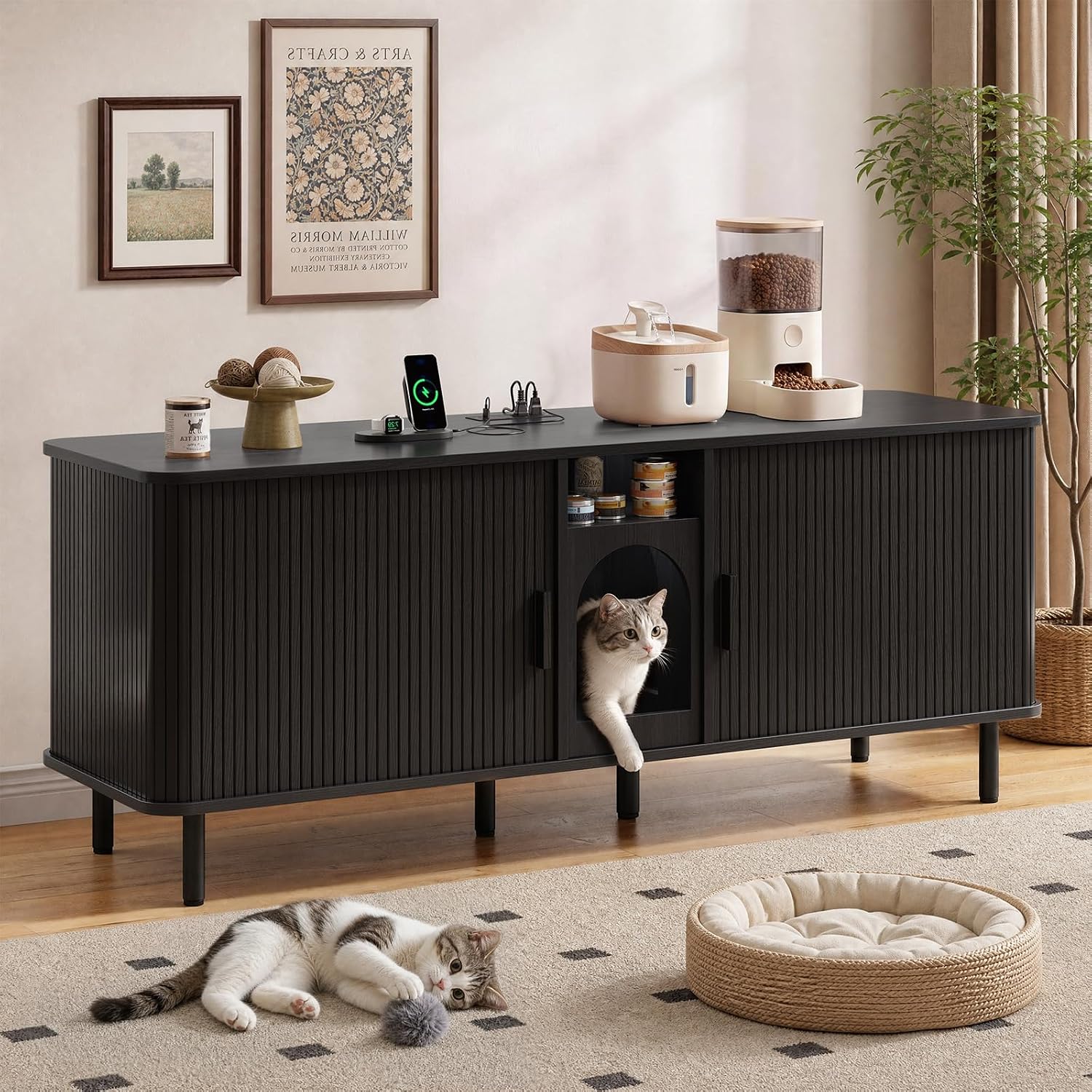 Visit on Amazon → 65" Double Cat Litter Box Enclosure with Power Outlet |
Litter box furniture | Two cats and up | Ventilation, entry and exit paths, cord routing |
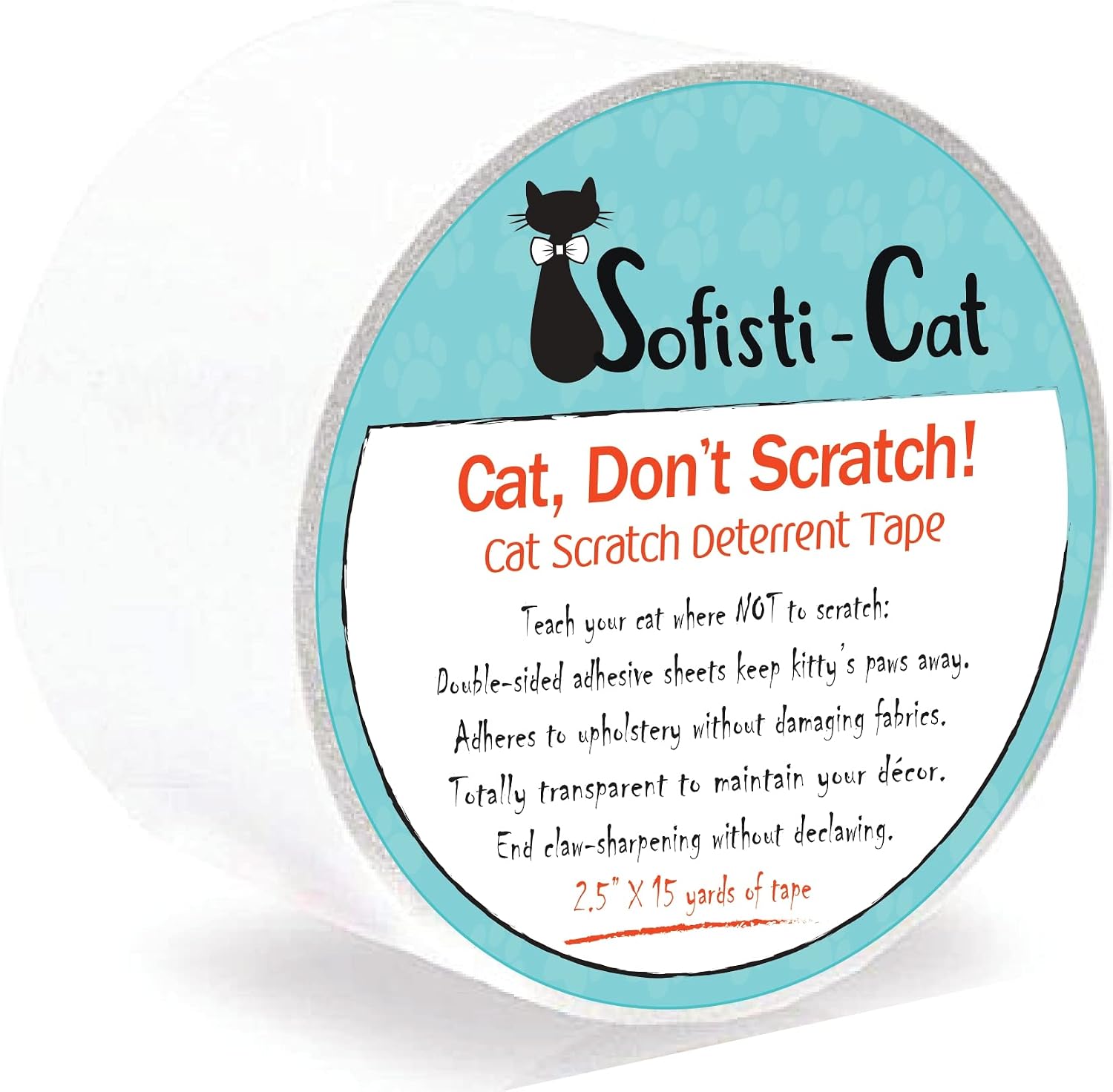 Visit on Amazon → Sofisti-Cat Training Tape |
Temporary deterrent | Retraining a couch scratcher | Fabric compatibility, replacement as tack fades |
 Visit on Amazon → Cooling Dog Bed Mat with Bolster Pillow |
Rest spot | Warm rooms, dog and cat homes | Size against your floor space, washability |
Where the tape fits in the sequence
Tape goes on last and comes off first. Put the scratching surface in place, let the cat find it, and only then cover the couch arm if she is still going back to it. If you tape first, you are teaching her that her usual spot is broken with no replacement, and she will find a replacement you like even less.
On the height question
If your cat scratches the side of the couch, she is scratching low because that is where the edge is, not because she prefers low surfaces. Offer something she can stretch up on, and most cats switch within a week or two. Vertical territory is not just for trees and shelves. It applies to scratching too.
Should you buy the Cat Scratcher Side Table for Couch?
Yes, if your cat scratches the arm of your sofa. Placement is the whole argument here. A scratcher in the hallway does not compete with the couch your cat hangs out on, and a side table puts an approved surface exactly where the damage already happens. It also stays useful when the scratching habit is fixed, which is more than I can say for most of the gadgets I have tried in a foster room.
Check the weight before you commit. A unit that slides during a full-body stretch will not get used twice, and no amount of catnip will change that.
Should you buy the Sofisti-Cat Training Tape?
Buy it as a bridge, not a fix. Double-sided tape makes the wrong surface unpleasant for a few weeks while the right surface becomes the obvious choice. If you tape the couch without offering a real scratcher, your cat will simply move to the chair, and then the curtains.
Clean the surface before applying, press it down firmly, and test a hidden spot on leather or finished wood before you commit the whole roll. Replace it as it collects hair and loses tack, because tape that has stopped being sticky is just decoration.
The bottom line
Scratching is not a discipline problem. It is a surface, location, and height problem, and every piece in this guide solves one of those three. Put a real scratching surface next to the furniture your cat already loves. Give a multi-cat house enough separated boxes that nobody has to guard a doorway. Use deterrent tape only after the right surface is in place. And give the household a cool place to sleep, because a cat who wakes up on your couch is a cat who scratches your couch.
Biscuit, my senior foster, has rejected more furniture than she has accepted. She has never once rejected a sisal surface that stayed still. Start there.