Most cat furniture advice starts with the tree. Buy a tree, put it by the window, hope the cat uses it. I've watched that advice fail in my own foster room for eight years, and the failure is almost never the cat. It's the furniture. Wall mounted cat furniture is where I send people now, and this is how you hang it without wrecking your walls.
A wall solves the two problems a freestanding tree cannot. It doesn't wobble when a twelve-pound cat launches off the top perch, because the wall is attached to your house. And it takes up zero square feet of floor, which matters in a Tampa apartment where the litter box already owns a corner.
I'm a veterinary technician, and I've fostered more than sixty cats. My current crew is five, and they are brutal on furniture. What follows is how I plan a wall setup, how I hang it so it actually holds, and the two pieces I keep coming back to.
Why you should trust me
I've been a vet tech for eight years, most of it in a clinic where the number one behavior complaint is scratching. Owners call it destruction. Cats call it communication. The fix in almost every case is a better surface in a better place, and the wall is the best place there is.
I've also assembled, repaired, and replaced more cat trees than I can count, from cheap carpet-wrapped disasters to solid wood condos that cost more than my couch. Fostering sixty-plus cats means I've watched a lot of furniture get tested by animals who never read the marketing copy.
My rules are simple. If a piece of cat furniture wobbles when a twelve-pound cat lands on it, it does not go on my wall. If the scratching surface is carpet, I don't recommend it. And if a perch is too small for an adult cat to sprawl on, it's a kitten toy with adult pricing.
How I picked and how I tested
Everything here has hung in my own foster room, on drywall over studs, with five cats cycling through it. That's the test that matters, because a wall setup is only as good as its anchors and its spacing.
Four things decide whether a wall piece earns a spot:
The mounting points. Wall-mounted cat furniture is a structural decision, not a decor decision. If a piece can only be attached at one point, a cat's momentum will find that point. Multiple mount points spread the load.
The scratching surface. Sisal rope is what cats actually want to dig into. Carpet feels good to a kitten and teaches bad habits to an adult, because carpet on a post feels exactly like carpet on your stairs.
The height. A scratching post has to be tall enough that a cat can stretch all the way up with its front paws over its head. A short post gets used once and abandoned, and then your sofa becomes the post.
The perch depth. Cats sleep sprawled. A shelf that fits a kitten will not fit a fifteen-pound adult, and a cat that doesn't fit will find somewhere that does.
I also look hard at the hardware, because the box is where most wall furniture fails. A beautiful shelf with weak anchors is a falling shelf.
The two pieces I would hang first
You don't need a whole wall of cat furniture on day one. You need one scratching surface and one place to perch, hung correctly. Everything else is expansion.
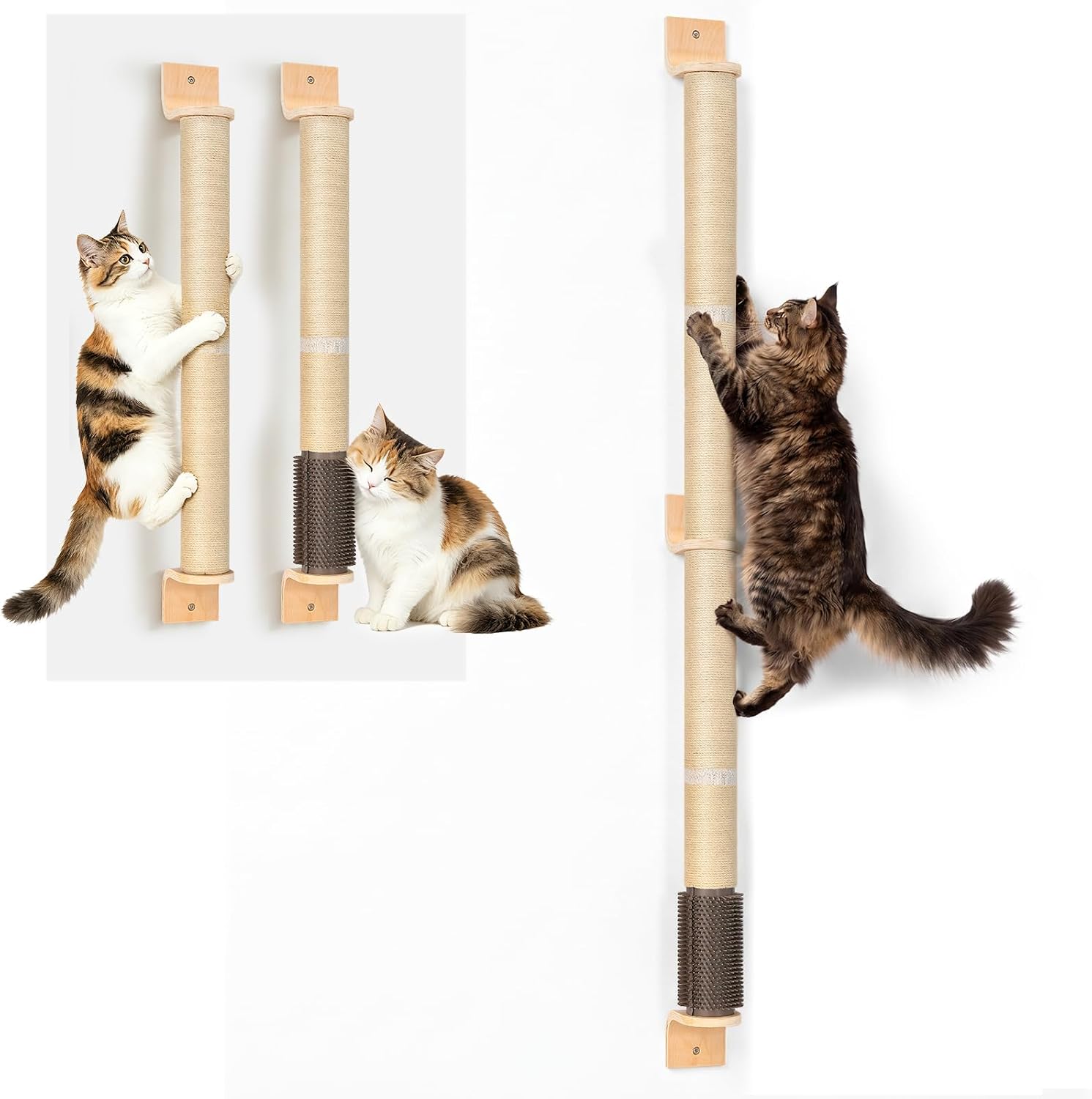
The tall post: Wall Mounted Cat Scratching Post 60 Inch Tall
 Visit on Amazon →
Sixty inches is the number that matters. That's a full vertical stretch for an adult cat, and it's what turns a post from a curiosity into a habit. When a cat can reach up, grab, and pull its whole body length against the rope, the post does the job your couch was doing.
I hung this one low enough that the base sits near the floor and the top clears the head of a standing cat, in the corner where my foster crew does their morning stretch. It has become the first thing they touch when they wake up, which is exactly the behavior you want to redirect.
A verified buyer noted that the anchors in the box are fine for a stud but not for bare drywall, and that matches what I see with almost every wall-mounted piece. Find the stud or add a backer. Don't trust a drywall anchor with a jumping animal.
Flaws but not dealbreakers: It's a post, not a playground. If your cat wants to climb and perch, this alone won't satisfy them. It's the scratching half of the setup.
Anyone whose cat is currently shredding the side of a sofa should start here, because scratching is the behavior that costs you money.
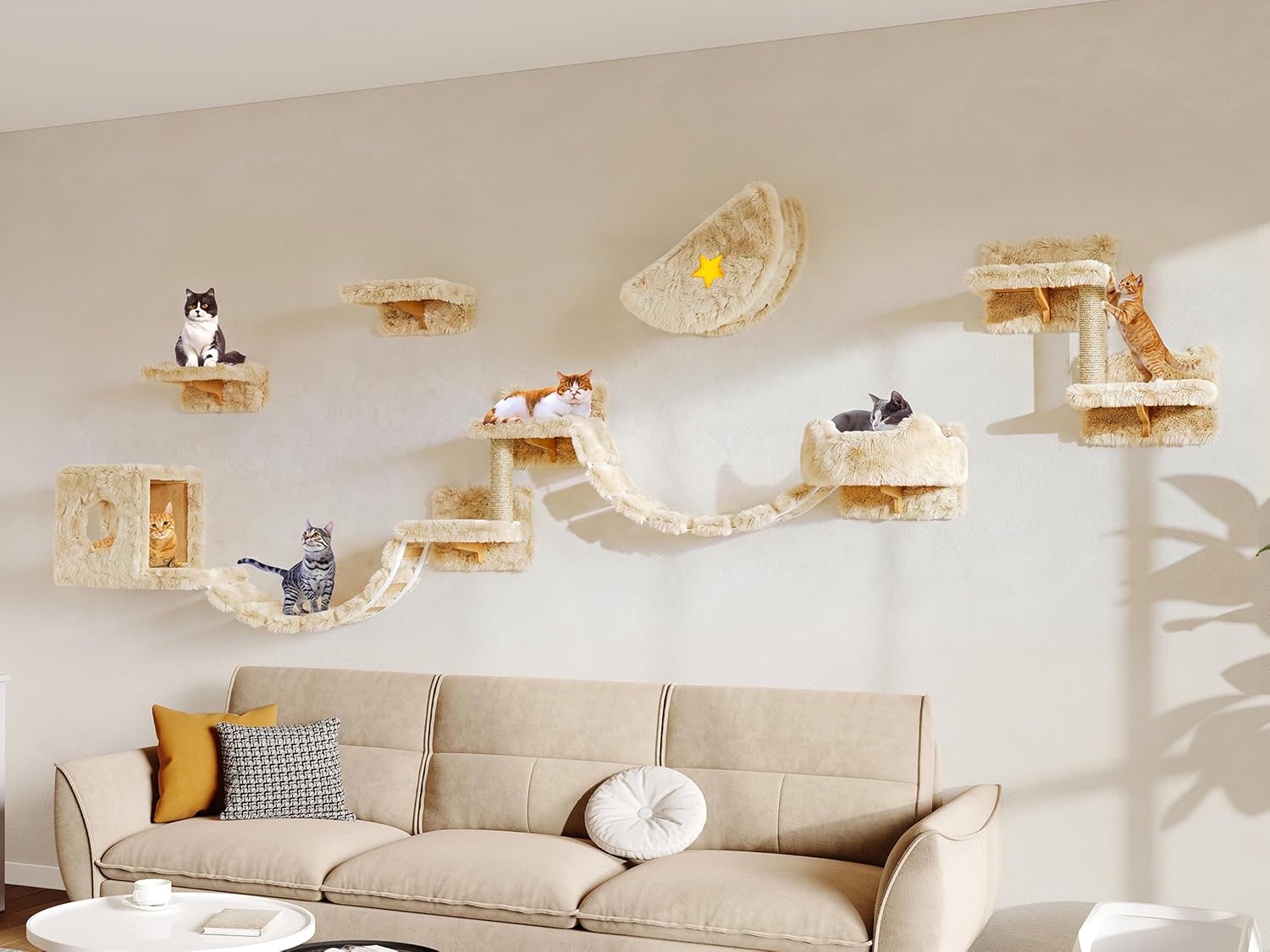
The layout piece: 13-in-1 Cat Wall Shelves, Moon & Bridge Cat Wall Furniture, Beige
 Visit on Amazon →
Thirteen pieces means you aren't buying a shelf, you're buying a route. The moon shapes and the bridge give you a climbing path with landings, and the beige finish disappears against a light wall instead of announcing itself like a plastic tower.
This is the piece I recommend when someone has vertical territory questions. Cats want height for security, not just for exercise. A high shelf near a window or above a doorway is a lookout, and a cat with a lookout is a calmer cat, especially in a house with other animals or a dog.
The catch with any multi-piece kit is planning. You're committing to more holes in the wall, and you're committing to a layout that has to work for the cats you actually have, not the cats in the product photos. I map it on paper first, then tape the shapes to the wall and live with the arrangement for a day before drilling.
A verified buyer mentioned that the pieces feel sturdy once they're in studs and that spacing is the hard part, which is the same note I'd give. Take the extra hour with painter's tape.
Flaws but not dealbreakers: Thirteen pieces is a lot of mounting hardware and a lot of holes. If you rent and patch at move-out, this is the piece that makes you think twice.
Anyone with an empty wall, a climber cat, and a few hours on a Saturday will get years out of this.
The actual installation workflow
This is the part people skip, and it's why wall furniture falls. Follow the order.
Step one: pick the wall for the cat, not for you. Cats want to watch something. A wall with a window, a doorway, or a view of the room where you spend your evenings beats a blank hallway every time. If the wall is near where your cat already scratches or sleeps, you're already ahead.
Step two: find the studs before you buy anything. A stud finder is ten minutes of work and it decides your layout. Mark every stud with painter's tape so you can see the pattern at a glance. If your studs are sixteen inches apart, which is standard in most US homes, you have a reliable ladder of mounting points. If they're further apart, plan on a backer board.
Step three: sketch the route. Put the scratching post where the cat already stretches, usually near where they wake up. Then run the shelves up and across, keeping each step close enough that a cat can hop up without a leap and far enough that it still feels like a climb. Leave the highest perch for the cat who spends the day avoiding everyone else, because that cat needs the escape hatch.
Step four: mark, drill, and check for wires. Pilot holes first. If you're on a shared wall in an apartment, know what's behind the drywall before the bit goes in. I've heard enough stories about nicked plumbing to say it out loud.
Step five: mount the heavy pieces into studs. The post and the shelves both carry live weight, so both go into wood. If a mounting point falls between studs, use a backer board that spans two studs and mount to that. Toggle bolts are better than nothing, but they are not better than a stud.
Step six: tighten, then test with your hand before you test with a cat. Push the post sideways with real force. Grab the shelf and pull down. If there's any flex, fix it now, because a cat's landing is worse than your hand.
Step seven: introduce the furniture. Rub the sisal with a little catnip or press a few treats into it, and put a favorite toy on the first shelf. Don't carry the cat up and place them on it. Cats don't respect furniture they were forced onto. Let them discover it.
Step eight: re-tighten after a week. New mounts settle. After seven days of a jumping cat, go back and snug every screw. That one habit is the difference between a setup that lasts a decade and a setup that sags by month three.
The competition and why it lost
The obvious alternative is a freestanding cat tree, and I say that as someone who has owned plenty of them. A freestanding tree works when it's wide, heavy, and short. It fails when it's tall and light, which is most of what gets sold, because a tall light tree is a tipping hazard and a tipping tree teaches a cat that height isn't safe.
Carpet-wrapped posts are the other alternative, and they're the one I'd skip entirely. Carpet is a scratching surface that can't be replaced, it holds hair and odor, and it trains a cat to scratch the same material that covers your stairs. If the choice is a carpet post or no post, get the sisal post and put it on the wall.
Floor-to-ceiling tension poles have their fans, and in a rental with a normal ceiling height and a very determined cat they can work. But they depend on the ceiling staying exactly where it is, they wobble when they aren't perfectly loaded, and they eat floor space in the exact spot where a cat wants to walk.
Wall-mounted wins on the two things I care about most: it doesn't move, and it doesn't take up floor. That's the whole argument.
What this all costs
Prices move constantly, so I won't quote a number that's stale by the time you read this. Check current Amazon price on each listing above and weigh it against what you're replacing.
The honest math is this. A shredded sofa arm is a more expensive problem than either of these pieces, and it gets more expensive every year you keep the same cat. A wall setup is a one-time purchase that improves as your cats age, because the layout can grow with them. Add a piece a year, or add nothing, but the post and the perch are the foundation.
If you're on a budget, buy the post first. Scratching is the behavior that damages your home, and it's the easiest one to redirect. Add the shelves when you have a free weekend and a stud finder.
That's the job. Hang it into wood, space it for a real cat, and re-tighten after a week. Your walls can take it. Your couch will thank you.