Most wall mounted cat shelves fail for a boring reason: they get hung like pictures instead of built like a climbing route. A cat does not want a decorative ledge at hip height. She wants a staircase that ends above your head, a perch wide enough to sprawl on, and a scratching surface on the way up that is not your sofa.
I have been a veterinary technician for eight years and a foster mom to more than 60 cats, most of them in a Tampa apartment smaller than the average living room. Vertical territory is the only reason five cats can share that space without a daily standoff. Water matters just as much. Cats who climb all day drink more when the water is moving, which is why the setup below pairs the wall system with a fountain instead of a bowl on the floor.
Below is the order I do this in, the mistakes I see most often in foster homes, and the two pieces I would buy before anything else.
Why you should trust me
I have spent eight years as a vet tech, and I have assembled, repaired, and watched cats destroy more cat trees than I can count, from $40 carpet-wrapped disasters to solid wood condos that cost more than my first car. Every piece of cat furniture that comes through my foster room gets the same treatment from a rotating crew of five cats. I keep a destruction score for every post and perch, and I take post-use photos of every scratching surface, because a sisal post nobody touched is just decoration.
The pattern never changes. Cats need height, stability, and a surface that accepts a claw. Everything else, the hammocks, the condos, the little houses, is optional.
How I picked and how I tested
Every wall system I put in front of my fosters has to pass the same checks before I will say a good word about it.
Does it survive a 12-pound cat launching onto the top perch without shifting on the wall? If a setup wobbles when an adult cat lands, it is a tipped-tower lawsuit waiting to happen, and I have watched it happen.
Is it solid wood, not MDF or particle board? Solid wood holds a bolt without splitting and does not flex under a hard landing. MDF is fine for a bookshelf. It is not fine for a predator that weighs 12 pounds and lands like a sack of wet sand.
Are the scratching surfaces sisal? Carpet-wrapped posts are the enemy. They teach a cat that carpet is a scratching surface, and then your stairs pay the price.
Is the perch wide enough for a sprawled adult cat? A perch sized for a kitten gets abandoned the moment that kitten grows up.
For fountains, the checks are different. Ceramic or stainless steel over plastic, a pump you can pull apart and clean without tools, and enough weight that it stays where you put it. I also test every wall setup in a rental apartment with drywall and standard studs, because that is what most people actually have. A system that only works when you can bolt into concrete is not a system I can recommend to anyone.
What you need before you start
Two pieces carry this setup. One gives your cat the territory. The other gives her a reason to stay hydrated while she patrols it.
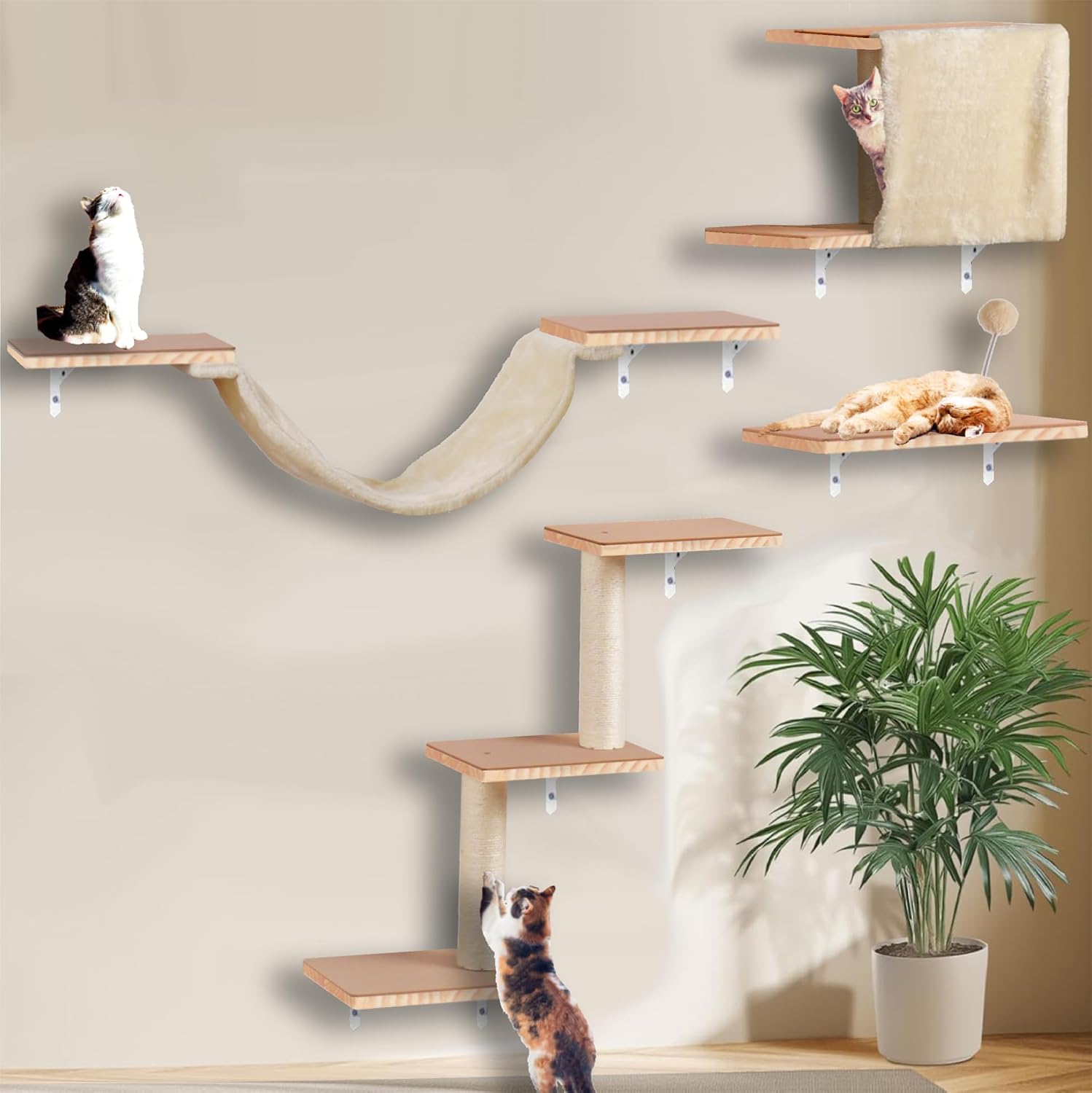
Our pick: Cat Shelves for Wall, Solid Wood Cat Wall Furniture, with Cat's House, Bed, Hammock, Sisal Scratching Post Ladder (Beige)
 Visit on Amazon →
The name tells you most of what you get: solid wood construction, a cat house, a bed, a hammock, and a sisal scratching post ladder, all in a beige finish that mostly disappears against a light wall. Check current Amazon price. What I care about is the material. Solid wood holds a lag bolt without splitting, and it does not flex when a cat lands hard on the top piece. That is the difference between a wall setup that lasts years and one that ends up in a donation pile by spring.
The house and the bed give you two separate resting spots, which matters in a multi-cat home where one cat always wants the good seat. The hammock is the piece kittens claim first, and it tends to stay popular because it moves a little under them. The sisal ladder is the part that earns its keep. A vertical scratching surface at the base of the route means your cat scratches there on the way up instead of on the side of the couch, and that single detail decides whether the whole setup works.
Flaws but not dealbreakers: This is a multi-piece install, not a hang-it-in-ten-minutes project. Budget an afternoon, and plan on bringing your own lag bolts if you want to be sure of what is holding the weight.
Renters and apartment dwellers who want real vertical territory without giving up floor space will get the most out of this.
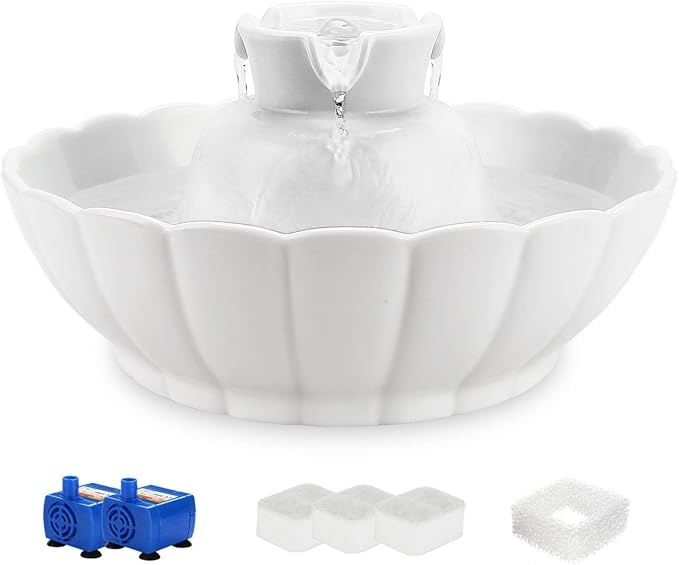
Also worth adding: iPettie Tritone Ceramic Cat Water Fountain, Heavy-Duty Waterer for Pets
 Visit on Amazon →
A wall setup changes where your cat spends her day, and cats who spend the day up high often drink less than they should. A fountain fixes that better than a bowl, because moving water triggers the same interest that makes a cat drink from a dripping faucet at 4 a.m. Check current Amazon price. Ceramic is the material I want in a fountain. Plastic bowls scratch, and scratched plastic holds onto everything you cannot see no matter how well you rinse it. Ceramic also has enough weight that a cat cannot bat it across the kitchen, which is the fate of every lightweight fountain I have brought home.
Flaws but not dealbreakers: A fountain is a cleaning commitment, not a set-and-forget appliance. Plan on pulling the pump apart and rinsing it every week or so, and more often in a home with several cats. If you know you will not do that, a wide ceramic bowl you change twice a day is the more honest choice.
Where to put it: on the floor near the base of the wall system, away from the food bowl and well away from the litter box. Cats are wired to avoid water that sits next to their food or their bathroom.
The actual setup, step by step
Now the part you came for. None of this requires special tools beyond a drill, a level, a stud finder, and painter's tape.
Step one: pick the wall before you pick the shelf. The wall should face the room your cat already watches. If she spends her evenings staring at the front door or the bird feeder, that is the wall. She wants to survey territory, not stare at a blank corner. Avoid walls above heat vents, radiators, or anywhere a cat could land on a stove, a staircase, or a running treadmill.
Step two: find the studs and mark the whole layout before you drill. Tape every piece to the wall with painter's tape, stand back, and look at it the way a cat would. Check the jump distances, check the landing zones, and check that the top perch is not directly above something breakable. One hole in the wrong place is annoying. Six holes in the wrong place is a patching project.
Step three: build the route from the bottom up. Cats jump up far more confidently than they jump down. The bottom step should be reachable from a couch, a windowsill, or a sturdy piece of furniture, and the whole route needs a descent path that does not end in a blind drop to the floor. A setup with a great climb and no way down is a setup where your cat screams at you from the top perch at 2 a.m.
Step four: set the top perch above your eye level. A tree that does not reach above your waist is a rug with legs, and the same logic applies to a wall. If you can rest your chin on the top perch, it is too low. Height is the entire point of vertical territory. It is what makes a nervous cat feel secure and what makes a confident cat stop using your kitchen counter as an observation deck.
Step five: hang the house and the bed first. They are the heaviest pieces and they set the anchor points for everything else. Two people, a level, and bolts that actually reach the stud. If your studs do not land where you want them, add a painted plywood backer board and mount to that instead of trusting drywall anchors.
Step six: put the sisal ladder where the scratching already happens. Watch your cat for two days before you commit. If she scratches the corner of the couch next to the window, the ladder goes on the wall above that corner. You are not training her to use a new spot. You are giving her a better version of the spot she already chose.
Step seven: hang the hammock at the mid level. A mid-level resting spot gives a cat a place to pause without committing to the full climb, and it gives a second cat somewhere to be that is not directly in the first cat's face. In a five-cat house, that matters more than any other piece.
Step eight: add the fountain and place it deliberately. Put it at the base of the wall system, away from the food bowl and far from the litter box. Clean it before the first use, and put a towel underneath for the first week while you figure out how much your cat splashes.
Step nine: introduce the cat, then get out of the way. Do not plop her on the top shelf to show her how it works. Put treats on the lowest step, walk away, and repeat for a week. A pheromone spray on the perches helps. Most cats claim the top perch within a week. Some take a month. One of my fosters took three months and then refused to come down for dinner, which I consider a success.
Mistakes I see in foster homes
Anchoring into drywall only. This is the number one killer of wall setups. Drywall anchors are for pictures. Every piece that holds a cat's full weight needs a stud or proper blocking.
Hanging everything at the same height. A row of shelves at the same level is a bench, not a climb. Cats want progression: low step, middle platform, high perch.
Skipping the scratching surface. If the only thing on the wall is a perch, your cat still needs somewhere to scratch, and she will pick the nearest vertical surface she can reach. That is usually your couch.
Putting the fountain next to the food bowl. Convenient for you, unappealing to your cat. Separate them.
Cleaning the fountain once a month. Five cats drinking from one fountain means weekly maintenance at minimum, or the pump slows down and your cat goes back to the toilet.
Ignoring the landing zone. Cats jump down as much as they jump up. Leave clear floor beneath the route, and keep the descent away from stairs.
What I skipped and why
Floor-to-ceiling tension poles are the classic first apartment option, and they can work, but they put a column in the middle of your living space and they wobble on carpet. That wobble is what makes a cat hesitate, and a hesitant cat uses the couch instead.
Carpet-wrapped trees are everywhere and they teach the wrong lesson. Carpet on a post tells your cat that carpet is a scratching surface, and then the stairs and the sofa arm become fair game.
MDF and particle board shelf kits look fine in photos and flex under a landing. If the shelf bends, the bolt loosens, and the whole wall starts moving.
Plastic fountains are cheap and light, which is exactly the problem. They scratch, they slide, and they end up as a bowl you refill and ignore.
What this all costs
The two pieces above are the entire spend for this setup, plus a stud finder, a level, and a box of lag bolts if you want to upgrade the hardware. Check current Amazon price on both before you commit, and remember that the fountain has a small ongoing cost in electricity and filters, which works out to pocket change per day.
Compare that to the cost of replacing a shredded couch arm, or of buying a cheap tree now and a better one next year. A solid wood wall system spread over the years it actually lasts is the cheapest thing in this article, and it is the only one that gets better as your cats use it.
The hard part is not the money. It is the afternoon with a tape measure, a level, and a plan. Do that part once, hang it into studs, put the scratching surface where your cat already scratches, and then leave the room and let her figure it out. She will.