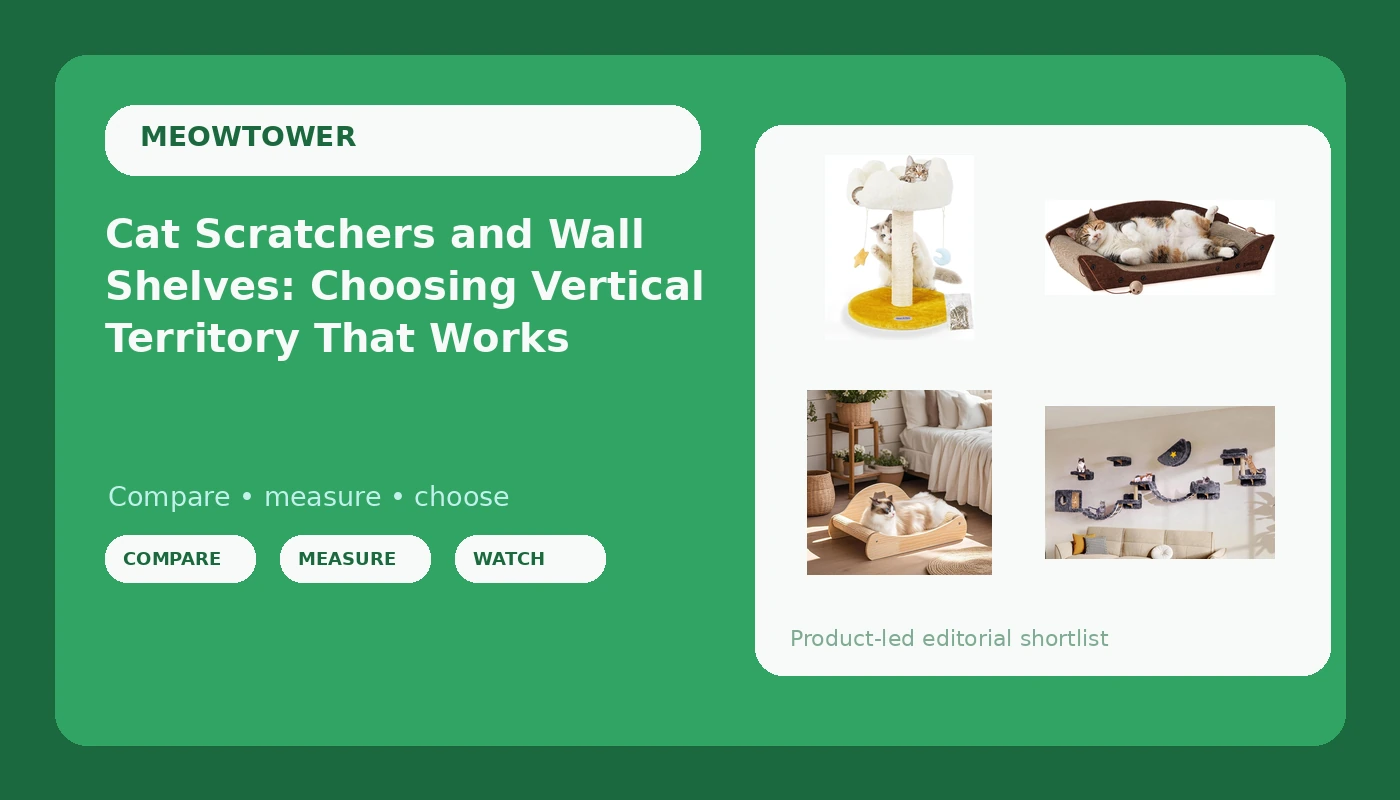
There is a moment in every cat household when you notice the couch has become a scratching post. Maybe it is the armrest corner that has gone fuzzy, or a chair leg that has lost its finish. The behavior itself is not the problem. Scratching is how cats stretch their spine and shoulders, shed the dull outer layer of their claws, and leave scent marks that tell them the territory is theirs. You are not going to train it away, and you should not want to. What you can do is give the behavior a better target and, while you are at it, give your cat the height it keeps asking for.
That is why cat scratchers and wall shelves come up in the same conversation. A scratcher answers the claw question. Height answers the security question. Some cats need both, some only need one, and the four options below cover the range from a compact kitten tree to a wall-mounted system that adds vertical territory without adding floor clutter.
Related: Cat Tree Stability: What to Check Before It Wobbles →
Quick answer
No single piece of cat furniture covers every household, because a scratching surface and a climbing structure solve different problems. A compact tree with a post and a bed is a sensible first purchase for a kitten or a small cat that has nothing yet. A dedicated scratcher bed in sisal or cardboard is the better add-on for an adult cat that already has a tree but keeps attacking the sofa. Wall-mounted shelves add height without taking up floor space, but they depend on your walls and on correct installation. Match the material to how your cat actually scratches, and match the mounting to the wall you actually have.
Four useful options
| Model | Best fit | What stands out |
|---|---|---|
| Happi N Pets Cloud Cat Tree, Cat Scratching Post with Soft Bed for Kitten | Kittens and small cats that need a first scratching post | Combines a scratching post and a soft bed in one compact piece |
| 23" Large Sisal Cat Scratcher Lounge Bed for Indoor Cats | Adult cats that scratch sisal and like to lounge | A 23 inch lounge format with a sisal scratching surface |
| ZOMISIA 26'' Cardboard Cat Scratcher Bed for Indoor Cats, 1PC, Brown | Cats that already reach for cardboard | A 26 inch cardboard bed sold as a single piece |
| 13-in-1 Cat Wall Shelves, Moon & Bridge Cat Wall Furniture, Grey | Homes with limited floor space and usable walls | A 13 piece wall-mounted set in a moon and bridge design |
Kitten starter: Happi N Pets Cloud Cat Tree, Cat Scratching Post with Soft Bed for Kitten
Kittens are not miniature adults. They climb awkwardly, they misjudge jumps, and they change size fast. A compact tree lets a young cat practice both scratching and climbing at a height where a fall is not a big deal. The trade-off is obvious once your cat grows: a piece sized for a kitten will not satisfy an adult cat that wants to sit above human eye level, and it is not the structure you would choose for a cat that launches itself onto the top perch. Treat this as a starting point. If your kitten takes to it, you will likely add height later, and the scratching post still earns its place.
Sisal option: 23" Large Sisal Cat Scratcher Lounge Bed for Indoor Cats
Sisal is the material most behavior guidance points to, and for a practical reason. It is a tough plant fiber with a texture that gives a cat resistance without rewarding the same motion your carpet does. A carpet-wrapped post teaches a cat that scratching fabric feels good, and your rug is fabric. The trade-off with this piece is orientation. A lounge is a horizontal scratcher, and some cats only scratch by reaching up and pulling down. If your cat has always attacked the vertical corner of the sofa, a horizontal lounge may sit unused. If your cat stretches out and rakes the carpet, this format matches what it already does.
Cardboard option: ZOMISIA 26'' Cardboard Cat Scratcher Bed for Indoor Cats, 1PC, Brown
Cardboard is the material many cats take to first, because the density gives claws something to sink into and the texture throws satisfying debris. That debris is also the trade-off. Cardboard is a consumable surface, not a permanent one. It shreds, it sheds bits onto the floor, and eventually the whole piece gets replaced rather than repaired. For a household trying to figure out what a cat prefers, that short lifespan is actually useful information. If your cat ignores cardboard but destroys sisal, you have learned something. If it goes straight for the cardboard, you know where to spend next time.
Wall-mounted option: 13-in-1 Cat Wall Shelves, Moon & Bridge Cat Wall Furniture, Grey
Wall furniture is the answer for apartments and small rooms where a floor tree is not practical, and it is often the only way to give a cat height above a doorway or window. The trade-offs are installation and scope. Every piece has to be anchored into something solid, leveled, and spaced so your cat can move between shelves without an awkward jump. That means locating studs, or using hardware rated for the wall type and the load. It also means a lease check if you rent. And note what this set does not do: it adds height and perching space, not a scratching surface, so it belongs alongside a scratcher rather than instead of one.
Prices and availability may change. Product images, names, and retailer links are matched to verified listings. No current price, rating, stock status, or measured result is stated here without current evidence.
Why scratching and climbing are two different needs
Cats scratch for reasons that have nothing to do with ruining your furniture. The motion stretches the muscles through the shoulders and back, which is why cats often scratch right after waking up. It also removes the loose outer sheath of the claw, and it deposits scent from glands in the paws. Scratching is a marking behavior. A cat that scratches a prominent object in a busy room is claiming space in the most visible way it can.
That is why the material matters more than the shape. Carpet is a bad scratching surface in a cat household because it trains the wrong association. A cat that learns fabric feels good under its claws has no reason to distinguish the post from the sofa, and most carpet-wrapped posts are destroyed long before the couch is. Sisal rope and cardboard both give a different feedback: a firm surface that grabs the claw and lets the cat pull. Wood, including the structural posts some higher-end trees use, does the same job.
Climbing is a separate drive. Cats are both predator and prey animal, and they feel safest when they can see a room from above it. A cat that spends its day on the floor is a cat that gets stepped over. Height is not decoration; it is the reason a cat tree exists at all. This is why a low piece does not really solve the problem. If a structure tops out below your waist, your cat is not getting the vantage point it is looking for, and it will find one on the kitchen counter instead.
The two needs do not have to come from one product, and often they should not. A wall-mounted system can supply height while a scratcher bed on the floor handles claws. That split is usually cheaper and easier to place than a single tall tower, and it adapts as your cat's preferences become clear.
What to check before you buy
Most disappointing cat furniture purchases come down to one of five mismatches. Work through these before you order anything.
- Weigh and measure your cat. An adult cat sprawled out takes more room than you think, and a perch or bed that only fits a curled-up kitten will be ignored once your cat grows. If you have a large cat, size every surface up rather than down.
- Decide whether you are solving claws or height. If the couch is the problem, you need a scratching surface. If your cat is climbing your bookshelves, you need height. Buying one when you need the other is the most common wasted purchase.
- Check the base or the mounting. A floor piece lives or dies by its base plate: wide and heavy stays put, narrow and light tips. A wall piece lives or dies by what is behind the drywall. Find out before you order, not after.
- Match orientation to your cat's habit. Watch where your cat scratches now. A cat that rakes the carpet horizontally will use a lounge. A cat that reaches up the side of the sofa wants a vertical post.
- Plan placement before assembly. Scratchers work best near the spot your cat already targets, and wall shelves work best over a soft landing. Moving furniture after the fact rarely fixes a placement problem.
Practical guidance for setup
- Put the new scratcher next to the place your cat already scratches, then move it a few inches at a time once the habit transfers.
- Anchor wall-mounted pieces into studs where you can, and use hardware rated for your wall type and the load when you cannot.
- Space wall shelves so your cat can step or make a short jump between them rather than a long leap.
- Place wall furniture above a soft surface, since a misjudged landing on tile is how cats get hurt.
- Expect cardboard to be replaced periodically and sisal to outlast it, and budget for that difference rather than being surprised by it.
Which option should you choose?
Choose the Happi N Pets Cloud Cat Tree, Cat Scratching Post with Soft Bed for Kitten when you have a kitten or a small cat with nothing of its own yet and you want a post and a resting spot in one compact piece. Choose the 23" Large Sisal Cat Scratcher Lounge Bed for Indoor Cats when your adult cat already scratches horizontally and you want a durable sisal surface in a lounge shape. Choose the ZOMISIA 26'' Cardboard Cat Scratcher Bed for Indoor Cats, 1PC, Brown when you want to find out what your cat actually prefers, or when cardboard is already the material it goes for. Choose the 13-in-1 Cat Wall Shelves, Moon & Bridge Cat Wall Furniture, Grey when floor space is tight and you can install into solid walls, and pair it with a scratcher rather than expecting it to cover claws too.
One caveat applies to all four: the descriptions above come from the product listings, not from a controlled comparison. Material and format tell you a lot about how a piece is likely to be used, but individual cats have strong and unpredictable preferences. The cheapest way to learn yours is to watch where your cat scratches and climbs today, then buy for that behavior instead of for the photo.
The bottom line
Scratching and climbing are separate needs, and the fastest way to waste money on cat furniture is to buy one product for both when your cat only has one problem. If you are starting from nothing with a kitten, a compact post-and-bed piece gets you moving. If you have an adult cat with a tree already and a shredded couch, a dedicated sisal or cardboard scratcher is the missing piece. If your constraint is floor space, wall-mounted shelves are how you add vertical territory without giving up the room, provided you can mount them properly. Watch your cat first. The furniture decision gets much easier once you know which behavior you are actually solving for.